
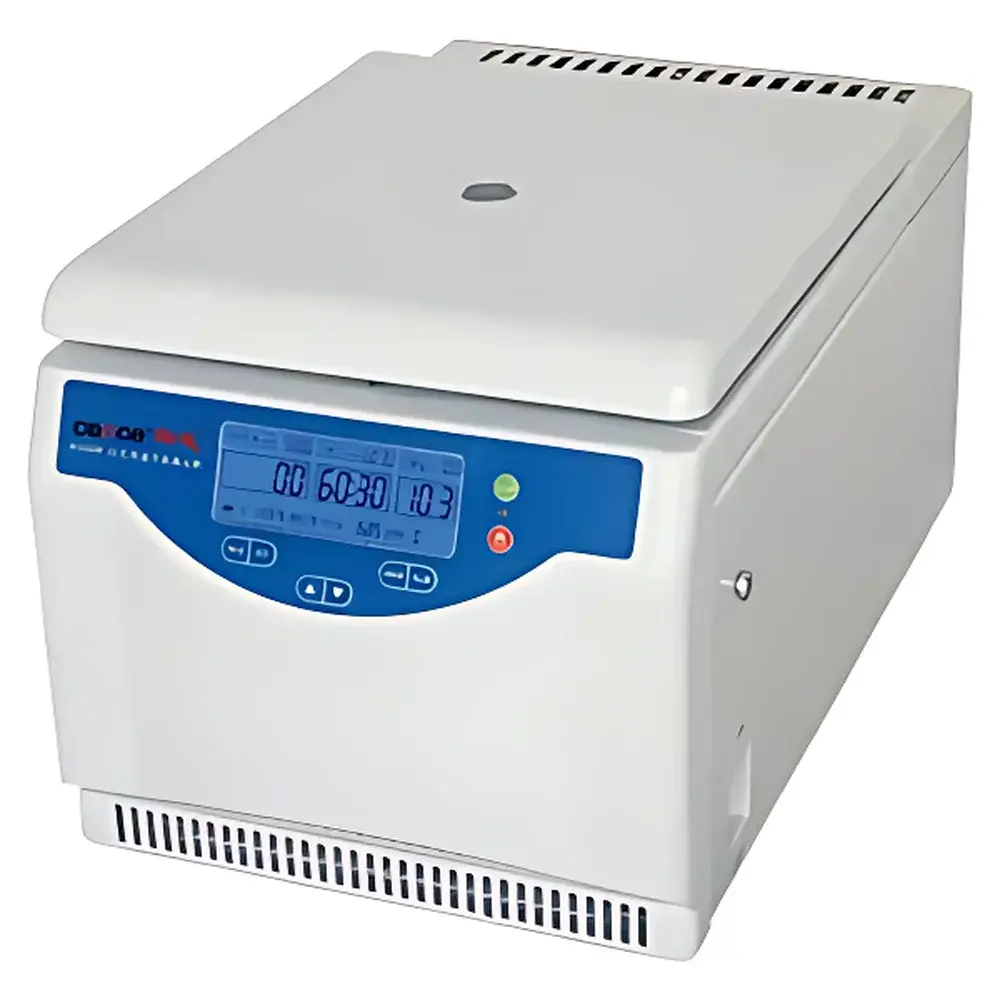
Xiangyi H1650R Benchtop High-Speed Refrigerated Centrifuge
| Brand | Xiangyi |
|---|---|
| Origin | Hunan, China |
| Manufacturer Type | Manufacturer |
| Product Category | Domestic |
| Model | H1650R |
| Instrument Type | Benchtop Centrifuge |
| Speed Range | 10,000–30,000 rpm (High-Speed) |
| Function | Refrigerated Centrifuge |
| Configuration | Fixed-Angle Rotor Centrifuge |
| Separation Level | Cellular & Bacterial |
| Maximum Capacity | 36 × 1.5/2.2 mL |
| Maximum Speed | 16,500 rpm |
| Maximum RCF | 21,532 × g |
| Dimensions | 350 × 600 × 340 mm |
| Speed Accuracy | ±10 rpm |
| Timer Range | 30 s – 99 min 59 s |
| Temperature Range | −20 °C to +40 °C |
| Temperature Accuracy | ±1 °C |
| Refrigerant | R134a |
| Noise Level | ≤65 dB(A) |
| Power Supply | AC 220 V ±22 V, 50 Hz, 10 A |
| Power Consumption | 1,000 W |
| Weight | 70 kg |
| Compressor | Imported High-Performance Unit |
| Rotor Options | 8 Fixed-Angle Rotors (including PCR strip, microtube, and 10 mL tube configurations) |
Overview
The Xiangyi H1650R Benchtop High-Speed Refrigerated Centrifuge is engineered for precision separation of biological samples requiring both high rotational force and precise thermal control. Based on fixed-angle rotor architecture and governed by Newtonian sedimentation dynamics under centrifugal acceleration, the H1650R delivers reproducible pelleting of cells, bacteria, subcellular organelles, and nucleic acid complexes. Its maximum speed of 16,500 rpm generates a peak relative centrifugal force (RCF) of 21,532 × g—sufficient for routine isolation of bacterial lysates, mitochondrial fractions, and plasmid DNA preparations. The integrated refrigeration system maintains sample integrity during extended runs, with all rotors capable of sustaining internal chamber temperatures ≤ −4 °C at full speed—a critical capability for heat-sensitive biomolecules and enzymatic assays.
Key Features
- Eight interchangeable fixed-angle rotors—including 0.2 mL PCR strip carriers, 1.5/2.2 mL microtubes, 5 mL conical tubes, and 10 mL round-bottom tubes—enabling method flexibility across molecular biology, microbiology, and clinical labs.
- Direct-drive brushless AC frequency-controlled motor with high starting torque ensures rapid acceleration (0–16,500 rpm in <18 s) and stable speed regulation (±10 rpm accuracy).
- Large backlit LCD display supports simultaneous real-time monitoring of set and actual values for speed (rpm), RCF (×g), time (hh:mm:ss), and temperature (°C), with automatic rpm/RCF cross-conversion.
- Programmable operation with user-defined protocols: up to 9 acceleration profiles and 10 deceleration curves (including free-coast option), plus pulse mode for transient sedimentation steps.
- Triple-stage damping system and reinforced stainless-steel chamber reduce vibration transmission and enhance run stability, particularly at high speeds.
- Comprehensive safety architecture includes overspeed detection, overtemperature cutoff, automatic door interlock, stainless-steel rotor chamber, and redundant thermal protection circuits.
- Energy-efficient refrigeration using imported compressors and environmentally compliant R134a refrigerant; achieves −20 °C to +40 °C temperature control with ±1 °C uniformity across the rotor cavity.
Sample Compatibility & Compliance
The H1650R accommodates standard microcentrifuge tubes (0.2–10 mL), PCR strips, and low-retention consumables without adapter requirements. Its validated performance meets foundational operational criteria aligned with ISO 13485 quality management systems for in vitro diagnostic equipment manufacturing. While not certified to FDA 21 CFR Part 11 out-of-the-box, its programmable parameters, audit-ready protocol storage, and non-volatile memory support GLP-compliant documentation workflows when integrated into laboratory information management systems (LIMS). Temperature and speed calibration procedures are traceable to national metrological standards per JJG 837–2018 (Chinese national verification regulation for centrifuges).
Software & Data Management
The embedded microcontroller firmware supports up to 30 user-programmable methods stored in non-volatile memory. Each method retains independent settings for speed, time, temperature, acceleration/deceleration profiles, and rotor ID validation. All parameter changes are logged with timestamped entries accessible via front-panel navigation. No external software or PC interface is required for routine operation; however, optional RS-232 or USB-to-serial adapters enable integration with third-party lab automation platforms for centralized instrument monitoring and electronic record archiving.
Applications
- Routine pelleting of E. coli, yeast, and mammalian cells prior to lysis or RNA extraction.
- Clarification of crude lysates and removal of cellular debris before chromatography or electrophoresis.
- Isolation of extracellular vesicles, exosomes, and microvesicles using differential ultracentrifugation protocols (in combination with compatible rotors).
- Preparation of high-yield plasmid preps and genomic DNA from blood or tissue homogenates.
- PCR product cleanup and enzyme reaction termination via rapid spin-down of stop solutions.
- Clinical sample processing including serum/plasma separation from whole blood within CLIA-waived workflows.
FAQ
What is the minimum and maximum operating temperature range?
The H1650R operates from −20 °C to +40 °C, with ±1 °C temperature accuracy and uniformity maintained throughout the chamber volume.
Can the H1650R be used for virus purification?
Yes—when paired with appropriate high-capacity rotors (e.g., No.3 or No.4) and validated protocols, it supports initial concentration steps in viral vector and lentivirus workflows, though final ultracentrifugation typically requires ≥25,000 rpm systems.
Is rotor identification automated or manual?
Rotor recognition is manual: users must select the correct rotor type from the menu prior to run initiation to ensure accurate RCF calculation and safety interlock activation.
Does the unit comply with international electrical safety standards?
It conforms to GB 4793.1–2019 (equivalent to IEC 61010-1:2010) for safety requirements of electrical equipment for measurement, control, and laboratory use.
How often does the refrigeration system require maintenance?
Under normal usage (≤4 hrs/day), the sealed R134a circuit requires no scheduled refrigerant servicing; annual inspection of condenser coil cleanliness and compressor performance is recommended.
Related Products



