
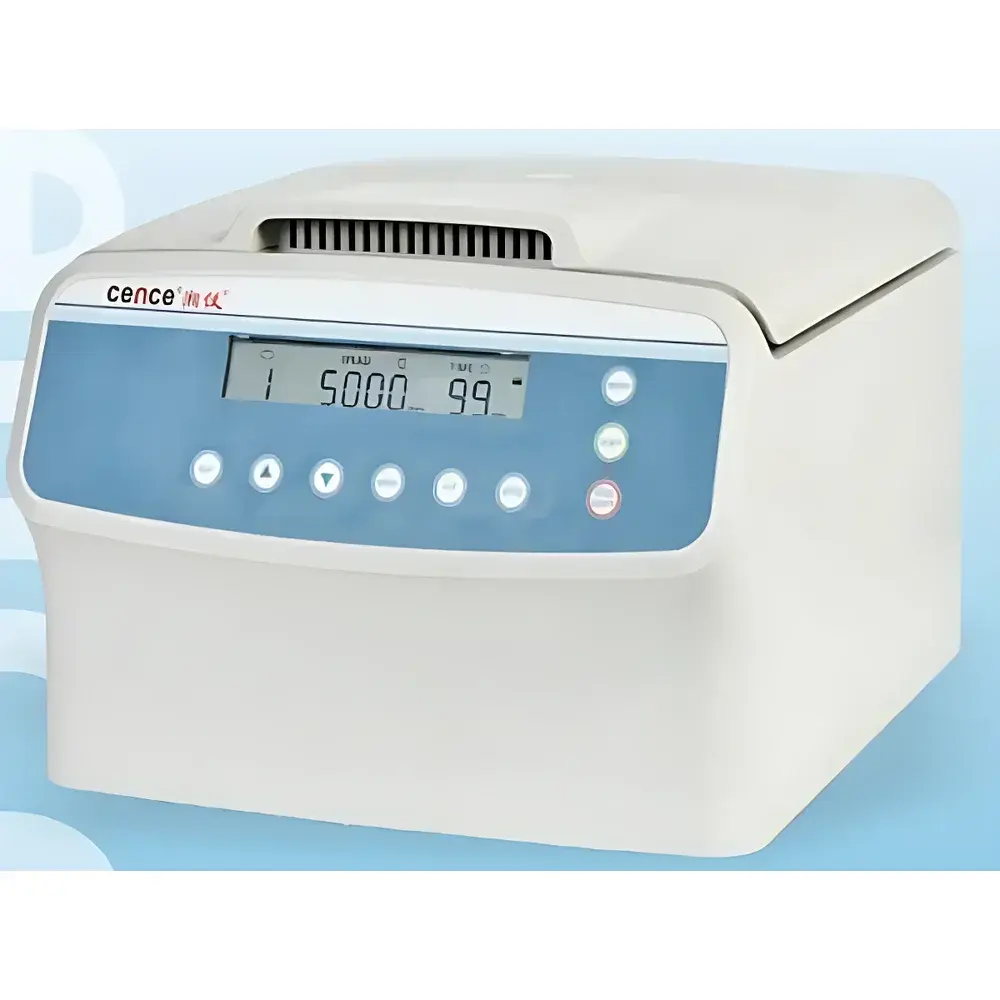
Xiangyi PRP400 Benchtop Platelet-Rich Plasma (PRP) Centrifuge
| Brand | Xiangyi |
|---|---|
| Origin | Hunan, China |
| Manufacturer | Xiangyi Instrument Co., Ltd. |
| Type | Benchtop Centrifuge |
| Speed Range | 0–4000 rpm |
| Max RCF | 2760 × g |
| Max Capacity | 4 × 50 mL |
| Rotor Type | Fixed-angle rotor |
| Application Class | Cellular separation (platelets, leukocytes, fibrin) |
| Dimensions (W×D×H) | 380 × 500 × 300 mm |
| Drive System | Microprocessor-controlled DC brushless motor |
| Safety Features | Electronic lid lock, automatic imbalance detection, auto-stop on fault |
| Accessories | PRP syringe adapters, medical-grade stainless-steel plug caps |
| Compliance | Designed for ISO 13485-aligned workflows and GLP-compliant clinical laboratory environments |
Overview
The Xiangyi PRP400 is a purpose-engineered benchtop centrifuge optimized for the reproducible isolation of platelet-rich plasma (PRP), platelet-rich fibrin (PRF), and concentrated growth factors (CGF) from whole blood—critical steps in regenerative aesthetics, dermatology, and orthopedic biologics applications. Unlike general-purpose low-speed centrifuges, the PRP400 implements a precisely calibrated two-phase spin protocol: an initial soft spin (e.g., 1200–1800 rpm, ~300–600 × g) to separate red blood cells while preserving platelet viability, followed by a secondary high-yield spin (up to 4000 rpm, 2760 × g) to concentrate platelets into a small, injectable volume without activation. Its design adheres to established clinical centrifugation principles described in ASTM F2655-22 (Standard Guide for Preparation of Platelet-Rich Plasma) and aligns with best practices outlined in peer-reviewed protocols for autologous biologic preparation.
Key Features
- Microprocessor-controlled DC brushless motor delivering consistent torque across the full speed range (0–4000 rpm), eliminating carbon brush wear and particulate contamination—essential for sterile processing environments.
- Real-time RCF (Relative Centrifugal Force) calculation and display on a high-contrast LCD touchscreen; eliminates manual conversion errors between rpm and ×g values.
- Pre-programmed and user-definable protocols: stores up to 50 rotor-specific methods, including customizable acceleration/deceleration profiles optimized for PRP, PRF, and CGF workflows.
- Integrated active vibration damping system with auto-balancing capability—compensates for minor sample mass imbalances without interrupting run cycles.
- Electromechanical lid interlock with dual-sensor verification: prevents start-up if the lid is unlatched and forces immediate deceleration if opened during operation, meeting IEC 61010-2-020 safety requirements for laboratory centrifuges.
- Ergonomic one-touch lid closure mechanism requiring minimal actuation force; seals reliably with tactile feedback and visual status indication.
Sample Compatibility & Compliance
The PRP400 accommodates standard PRP collection tubes (e.g., 10 mL and 15 mL sodium citrate or ACD-A vacutainers) and integrates seamlessly with commercially available PRP syringe-based kits via its dedicated stainless-steel syringe adapter set. All contact surfaces—including rotor chambers, adapters, and plug caps—are fabricated from medical-grade 316L stainless steel, passivated per ASTM A967, and compatible with ethanol, hydrogen peroxide vapor, and low-temperature sterilization methods. The instrument supports traceable operation under Good Laboratory Practice (GLP) and Good Manufacturing Practice (GMP)-adjacent workflows: audit-ready runtime logs (time, speed, RCF, rotor ID, user ID) are stored internally and exportable via USB interface. While not FDA-cleared as a medical device, its operational parameters conform to widely adopted clinical guidelines for autologous biologic preparation referenced in USP and ISO 22679:2021 (Biological evaluation of medical devices — Biological assessment of blood-contacting devices).
Software & Data Management
The embedded control firmware enables full method parameterization—including ramp/brake times, hold durations, and end-of-run actions (e.g., “hold at 4°C”, “coast to stop”). All executed runs are timestamped and logged with rotor identification, total runtime, peak RCF, and any system alerts (e.g., imbalance warning, temperature deviation). Data export is supported in CSV format via USB-A port for integration into LIMS or electronic lab notebooks. No proprietary software installation is required; exported logs are natively readable in Excel, LabArchives, or OpenLab CDS. The system does not require network connectivity and operates independently to maintain data integrity in isolated clinical settings.
Applications
- Clinical PRP preparation for facial rejuvenation, hair restoration, and intra-articular injection in outpatient aesthetic and sports medicine practices.
- PRF membrane generation for oral surgery and periodontal defect repair.
- CGF isolation using triple-spin protocols for enhanced growth factor concentration in chronic wound management.
- Blood-derived exosome precursor enrichment in translational research laboratories studying extracellular vesicle therapeutics.
- Quality control centrifugation of autologous cell suspensions prior to point-of-care administration.
FAQ
Is the PRP400 compliant with FDA 21 CFR Part 11 for electronic records?
No—the PRP400 does not implement electronic signature capabilities or audit-trail encryption required under Part 11. However, it provides timestamped, non-editable run logs suitable for GLP documentation when paired with procedural SOPs.
Can the centrifuge accommodate 10-mL PRP tubes with integrated gel separators?
Yes—rotor adapters are configurable for both standard conical-bottom tubes and gel-separator tubes; custom adapter inserts are available upon request.
What maintenance is required for long-term reliability?
The brushless motor requires no scheduled maintenance. We recommend quarterly cleaning of the rotor chamber with 70% isopropyl alcohol and annual calibration verification using a certified tachometer and RCF reference standard.
Does the PRP400 support refrigerated operation?
No—it is a non-refrigerated unit. For temperature-sensitive protocols, pre-chill samples and use insulated rotors; ambient lab temperature should be maintained between 15–25°C.
Can I integrate this centrifuge into an automated PRP workflow with pipetting robots?
While the PRP400 lacks RS-232 or Ethernet interfaces, its programmable start/stop triggers and consistent mechanical repeatability make it suitable for semi-automated integration via external footswitch or PLC-controlled relay signals (optional accessory).



