
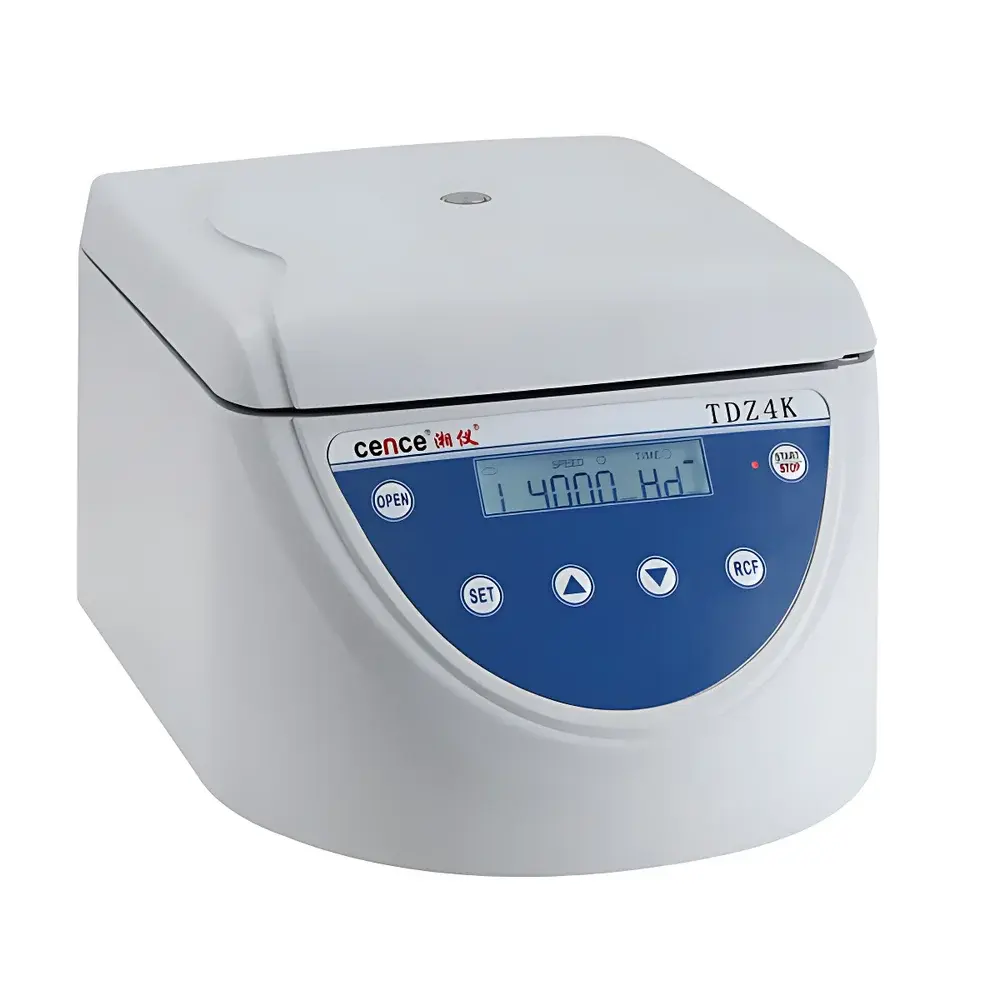
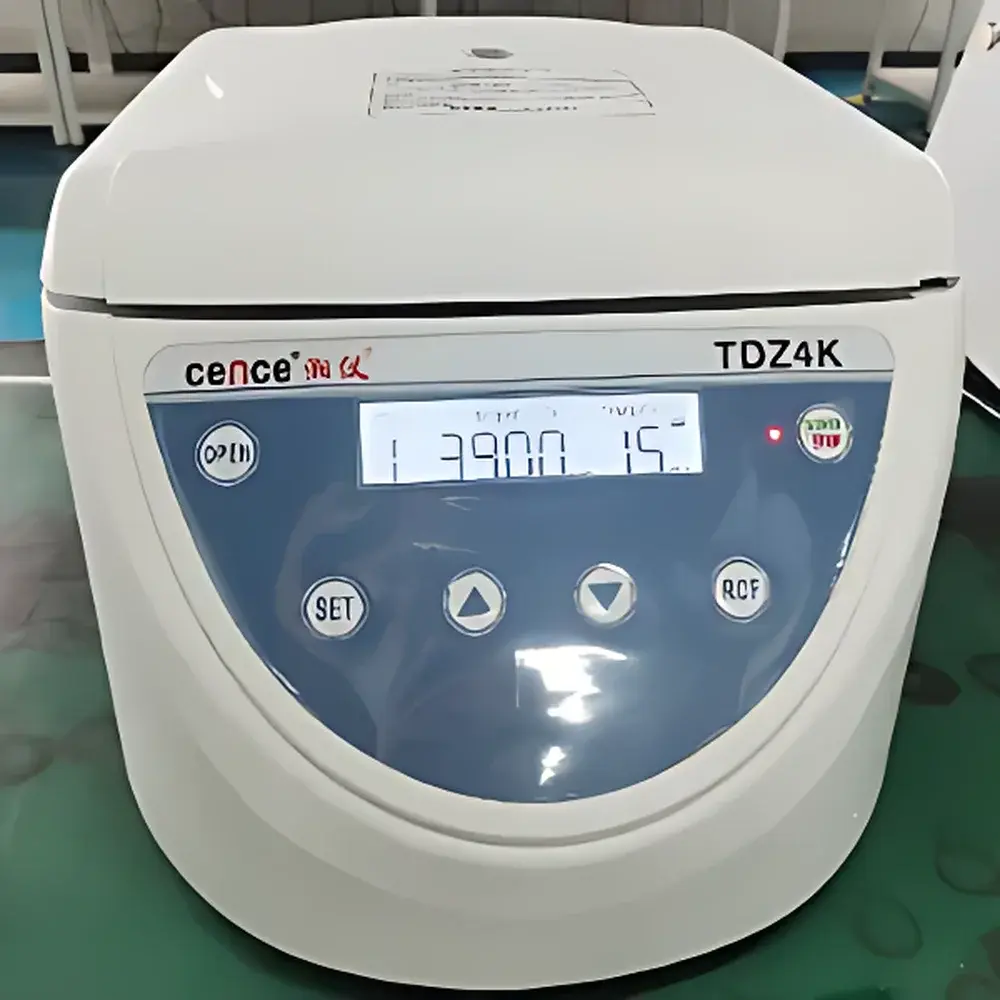
Xiangyi TDZ4K Benchtop Low-Speed Centrifuge
| Brand | Xiangyi |
|---|---|
| Origin | Hunan, China |
| Manufacturer Type | Direct Manufacturer |
| Product Category | Domestic |
| Model | TDZ4K |
| Instrument Type | Benchtop Centrifuge |
| Speed Range | Up to 4000 rpm |
| Max RCF | 2200 × g |
| Max Capacity | 12 × 20 mL |
| Dimensions (W×D×H) | 456 × 330 × 266 mm |
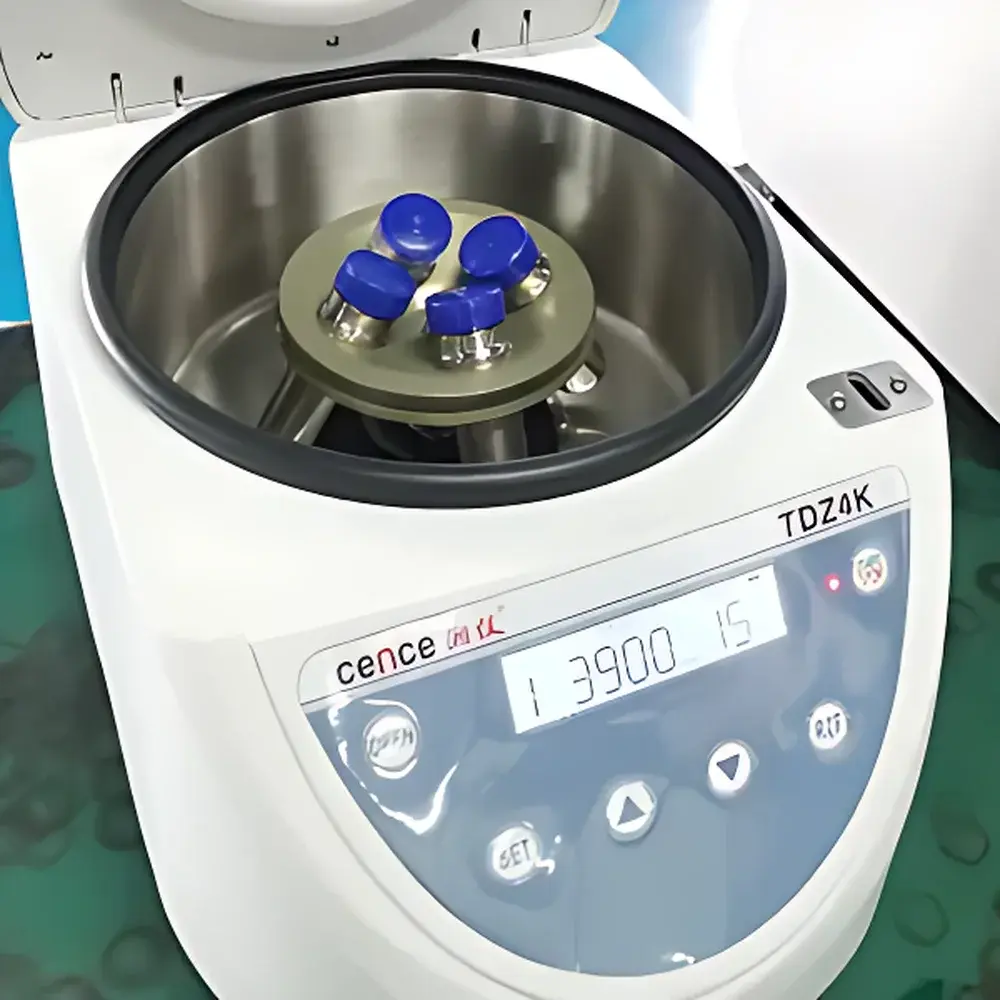
| Rotor Options | 18 × 10 mL, 12 × 20 mL, 4 × 50 mL, 24 × 10 mL angular rotors |
| Drive System | Microprocessor-controlled DC brushless motor |
| Safety Features | Electronic lid lock, automatic imbalance detection, self-balancing suspension |
| Display | LCD with touch panel |
| Timer Range | 1 sec–99 min 59 sec (countdown shown in seconds when <60 sec) |
| Construction | Integrated molded housing |
| Vibration Damping | Specialized passive dampers |
Overview
The Xiangyi TDZ4K is a microprocessor-controlled benchtop low-speed centrifuge engineered for routine separation tasks in clinical laboratories, academic research facilities, and quality control environments. Operating on the principle of sedimentation under centrifugal force, it enables efficient pelleting of cells, bacteria, erythrocytes, and other particulates from suspensions at moderate rotational speeds. Designed for reliability and operational safety rather than ultra-high performance, the TDZ4K delivers consistent RCF (relative centrifugal force) up to 2200 × g—sufficient for most preparative protocols involving whole blood fractionation, yeast harvesting, or tissue culture supernatant clarification. Its fixed-angle rotor configuration supports standardized tube formats without requiring complex rotor interchange procedures, making it especially suitable for high-throughput sample processing where reproducibility and ease of use are prioritized over variable acceleration profiles or refrigeration.
Key Features
- DC brushless motor drive ensures stable speed control, eliminates carbon brush wear, and prevents particulate contamination—critical for maintaining ISO 14644-1 Class 7 cleanroom compatibility in shared lab spaces.
- Integrated electronic lid interlock system prevents rotor activation unless the lid is fully closed and mechanically secured; meets IEC 61010-2-020 safety requirements for laboratory centrifuges.
- Self-balancing suspension mechanism with specialized passive dampers minimizes vibration transmission during operation, even under partial loading conditions—reducing mechanical stress on adjacent instrumentation and extending service life.
- LCD touch interface provides intuitive navigation, real-time parameter display (rpm, RCF, time remaining), and programmable memory for up to 10 user-defined protocols.
- One-piece molded chassis enhances structural rigidity and simplifies decontamination—supporting routine disinfection with 70% ethanol or quaternary ammonium solutions per CLSI GP26-A4 guidelines.
- Low-noise operation (<65 dB(A) at 1 m) enables placement in open-plan laboratories without acoustic isolation enclosures.
Sample Compatibility & Compliance
The TDZ4K accommodates standard polypropylene and polycarbonate conical tubes (10–50 mL) across four interchangeable angular rotors. It is validated for use with common anticoagulant-treated blood samples (EDTA, heparin, citrate), bacterial cultures in LB or TB media, and mammalian cell suspensions in DMEM/FBS. While not certified for biosafety level 3 (BSL-3) containment, its sealed rotor design and absence of airflow pathways limit aerosol generation during deceleration—aligning with CDC/NIH Biosafety in Microbiological and Biomedical Laboratories (BMBL) 6th edition recommendations for BSL-2 workflows. The instrument complies with CE marking requirements under Directive 2014/30/EU (EMC) and 2014/35/EU (LVD), and supports audit-ready documentation for GLP-compliant studies when paired with external timestamped loggers.
Software & Data Management
The TDZ4K operates as a standalone unit without proprietary software dependency. All run parameters—including speed, time, and RCF—are stored locally in non-volatile memory and displayed in real time. For laboratories requiring traceability, optional RS-232 serial output allows integration with LIMS via ASCII-based command protocols (e.g., “GET_RPM”, “SET_TIME”). Though lacking native 21 CFR Part 11 compliance features such as electronic signatures or audit trails, its deterministic behavior and hardware-enforced safety constraints support validation under GMP Annex 11 when used within controlled procedural frameworks.
Applications
- Clinical hematology: Separation of serum/plasma from whole blood specimens prior to immunoassay or clinical chemistry analysis.
- Microbiology: Harvesting bacterial pellets for DNA extraction, antibiotic susceptibility testing, or Gram staining preparation.
- Cell biology: Recovery of adherent and suspension mammalian cells post-trypsinization or transfection.
- Food & beverage QA: Clarification of milk, juice, or fermentation broths for turbidity measurement or microbial load assessment.
- Environmental testing: Concentration of waterborne pathogens (e.g., E. coli, Legionella) from large-volume filtration eluates.
FAQ
Is the TDZ4K suitable for centrifuging infectious samples?
Yes, provided appropriate biosafety practices are followed—including use of sealed tubes, secondary containment, and post-run decontamination per institutional biosafety office protocols.
Can I use this centrifuge for density gradient separations?
No—the TDZ4K does not support swing-out rotors or controlled deceleration profiles required for intact gradient preservation; it is optimized for simple pelleting applications.
Does the instrument include rotor calibration certificates?
Factory-calibrated rotors are supplied with individual serial-numbered calibration labels indicating maximum rated speed and load tolerance; full NIST-traceable calibration reports are available upon request.
What maintenance is required beyond routine cleaning?
The brushless motor requires no scheduled maintenance; periodic inspection of lid latch integrity and damper mounting bolts every 6 months is recommended per manufacturer’s preventive maintenance schedule.
Is remote monitoring supported?
Not natively—but analog voltage outputs (0–5 V) corresponding to rpm and temperature can be interfaced with third-party data acquisition systems for continuous operational logging.



