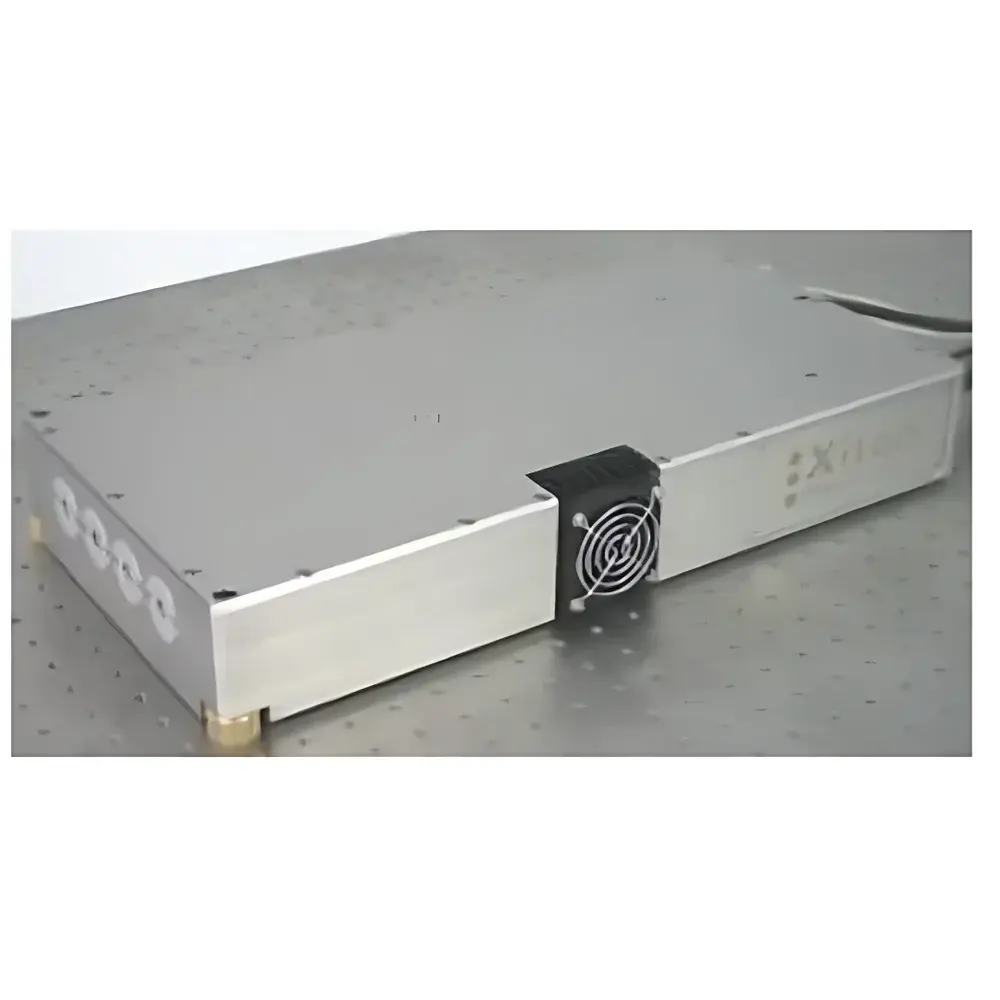
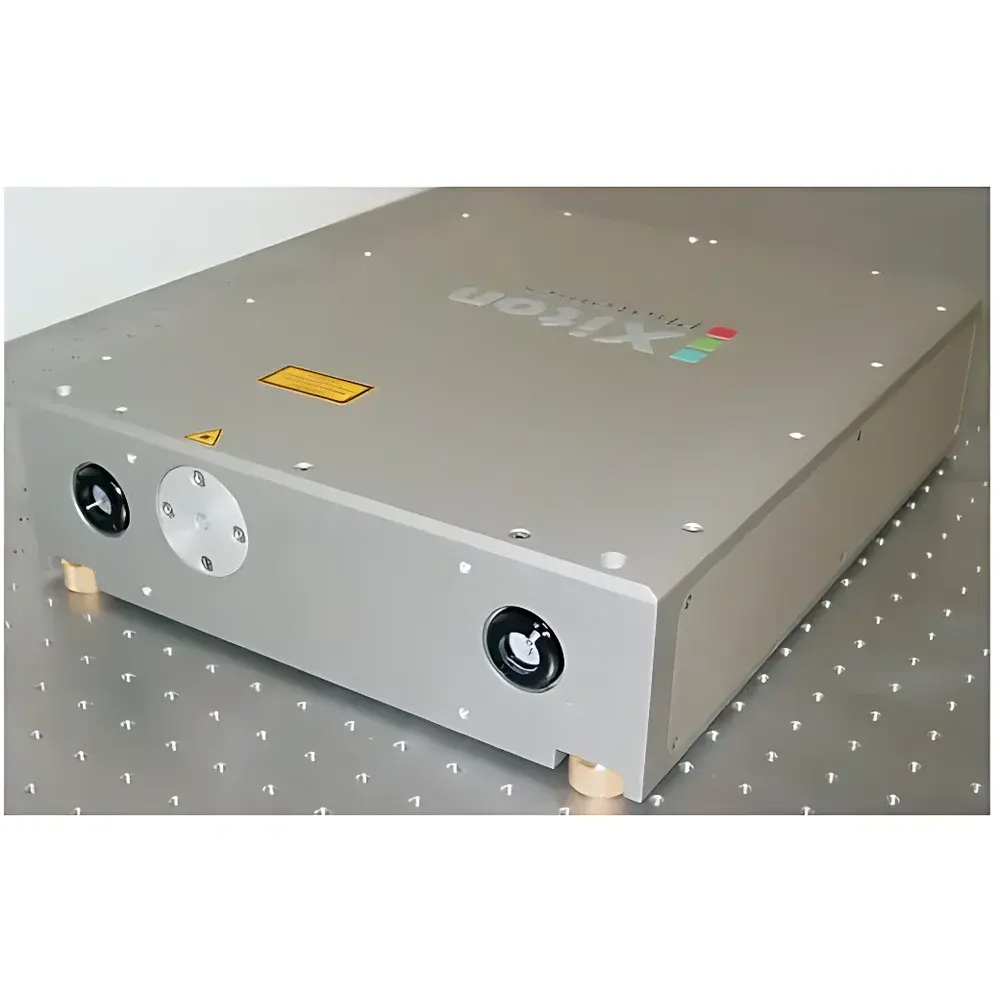
XITON IMPRESS 213/224 nm Diode-Pumped Q-Switched Solid-State Deep-UV Nanosecond Laser System
| Brand | XITON |
|---|---|
| Origin | Germany |
| Model | IMPRESS 213/224 nm |
| Wavelength | 213 nm / 224 nm |
| Average Output Power | 150 mW (213 nm) / 300 mW (224 nm) |
| Pulse Width | <7 ns (213 nm) / <9 ns (224 nm) |
| Pulse Energy | >15 µJ (213 nm) / >30 µJ (224 nm) |
| Repetition Rate | 0.1–30 kHz |
| Beam Quality (M²) | <1.6 |
| Pumping Method | Diode-Pumped |
| Q-Switching | Active |
| Laser Medium | Solid-State (Nd:YAG-based harmonic generation) |
Overview
The XITON IMPRESS 213/224 nm laser system is a diode-pumped, actively Q-switched solid-state laser engineered for high-repetition-rate deep-ultraviolet (DUV) emission at two discrete harmonically generated wavelengths: 213 nm and 224 nm. Based on a master oscillator power amplifier (MOPA) architecture with intracavity frequency conversion in nonlinear crystals (e.g., BBO or CLBO), the system delivers stable, TEM00-mode nanosecond pulses with exceptional spatial coherence and temporal reproducibility. Its sub-10 ns pulse duration, diffraction-limited beam quality (M² < 1.6), and precise wavelength stability make it particularly suited for applications demanding high photon energy, minimal thermal load, and sub-micron spatial resolution—such as direct-write photolithography, fiber Bragg grating (FBG) inscription, and UV-sensitive material ablation. Unlike gas-based or excimer lasers, the IMPRESS platform eliminates consumables, offers turnkey operation, and complies with Class 4 laser safety standards per IEC 60825-1.
Key Features
- Deep-UV output at 213 nm and 224 nm—enabling high-photon-energy interactions with wide-bandgap materials (e.g., fused silica, CaF2, and UV-grade polymers)
- Diode-pumped solid-state design ensures long-term reliability, low thermal drift, and >10,000 hours of pump diode lifetime
- Actively Q-switched operation supports fully programmable repetition rates from 100 Hz to 30 kHz with jitter < 1 ns (RMS)
- TEM00 beam profile with M² < 1.6 and beam pointing stability < 5 µrad over 8 hours
- Integrated thermal management and hermetically sealed optical cavity minimize environmental sensitivity and maintenance intervals
- Compact OEM-ready footprint (≤ 300 × 200 × 120 mm) with standard 19″ rack-mount or benchtop configuration options
- Compliance with RoHS, CE, and IEC 60825-1:2014 laser safety directives
Sample Compatibility & Compliance
The IMPRESS 213/224 nm laser is compatible with standard UV-fused silica optics, reflective beam delivery systems (e.g., dielectric-coated mirrors and off-axis paraboloids), and vacuum-compatible FBG inscription stages. It supports direct coupling into single-mode and photosensitive fibers (e.g., Ge-doped or B/Ge co-doped SMF-28) without hydrogen loading—enabling rapid, high-fidelity grating fabrication under ambient air or nitrogen purge. The system meets requirements for ISO 10110-7 surface quality specifications on transmitted wavefront distortion and conforms to ASTM F2792-22 for laser-based microfabrication process validation. For regulated environments, optional firmware modules support audit trails, user access control, and electronic signature logging aligned with FDA 21 CFR Part 11 and EU Annex 11 principles.
Software & Data Management
The laser is controlled via Ethernet-connected GUI software (Windows/Linux) supporting real-time monitoring of pulse energy, repetition rate, internal temperature, and diode current. All operational parameters are logged with UTC timestamps and exportable in CSV or HDF5 format. Remote API (TCP/IP and SCPI-compliant) enables integration into automated metrology platforms (e.g., coordinate measuring machines or mask aligners) and closed-loop feedback systems using external photodiode signals. Firmware updates are performed securely over HTTPS with SHA-256 signature verification. Optional LabVIEW™ and Python SDKs provide native support for custom sequence scripting, multi-laser synchronization, and statistical process control (SPC) data aggregation.
Applications
- Fiber Bragg grating inscription: High-speed, phase-mask-free FBG writing in standard and radiation-hardened fibers with reflectivity >99.9% and bandwidth < 0.1 nm
- Semiconductor inspection & repair: Defect-selective ablation of metal interconnects and transparent conductive oxides (e.g., ITO) without substrate damage
- Micro-optics fabrication: Direct-write structuring of diffractive optical elements (DOEs), microlens arrays, and waveguide couplers in UV-curable resins
- Photoluminescence excitation spectroscopy: Resonant excitation of wide-bandgap semiconductors (e.g., AlN, GaN, ZnO) and quantum-confined structures
- Display panel repair: Pixel-level isolation of shorted OLED or LCD subpixels using sub-10 µm spot sizes
- Replacement for water-cooled argon-ion lasers in confocal microscopy and Raman spectroscopy setups requiring compact, air-cooled DUV sources
FAQ
What is the typical warm-up time required to achieve spectral and power stability?
The system reaches full radiometric and wavelength stability within ≤15 minutes after cold start, with power drift < ±0.5% over 4 hours at constant ambient temperature (20–25 °C).
Is the laser compatible with third-party pulse pickers or delay generators?
Yes—the IMPRESS features TTL-sync input/output ports with adjustable delay compensation (0–100 ns resolution) and supports external triggering up to 30 kHz without timing degradation.
Can the 213 nm and 224 nm outputs be used simultaneously?
No—wavelength selection is hardware-configured via interchangeable harmonic generation modules; dual-wavelength operation requires sequential reconfiguration by qualified service personnel.
What maintenance is required during normal operation?
No routine optical alignment or consumable replacement is needed; recommended preventive maintenance includes quarterly calibration of internal energy monitor and annual verification of beam pointing stability per ISO 11146.
Does the system include beam delivery optics?
Standard configuration includes collimated free-space output with Ø10 mm beam diameter and adjustable divergence (< 0.5 mrad); fiber-coupling adapters and focusing objectives are available as configurable options.