
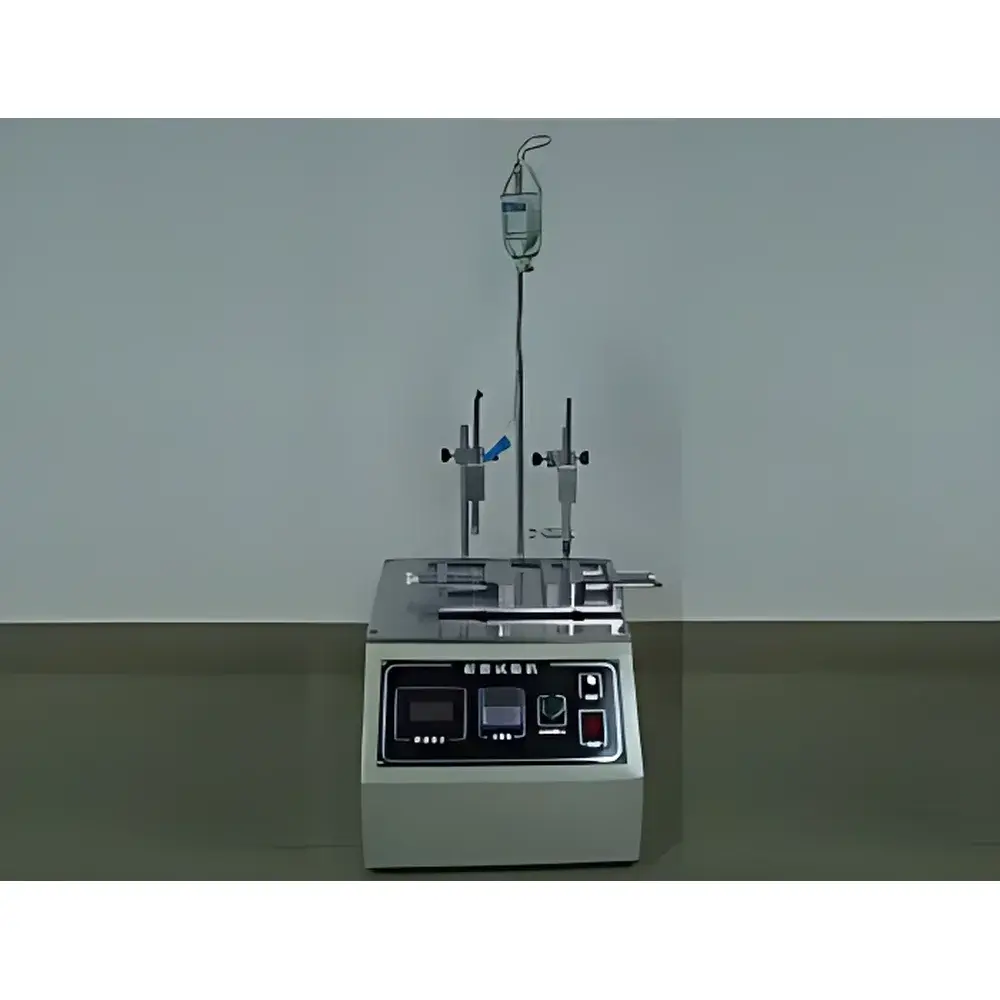
XM-860 Alcohol-Resistant Abrasion Tester
| Origin | Shanghai, China |
|---|---|
| Manufacturer Type | Authorized Distributor |
| Origin Category | Domestic (China) |
| Model | XM-860 |
| Price | Upon Request |
| Stroke Range | 0–80 mm |
| Max Load Capacity | 5 kg |
| Display | Digital (6-digit counter, 0–999999) |
| Applied Load | 80–1000 g |
| Standard Weights | 10, 20, 50, 100, 200, 300, 500 g (2 sets included) |
| Abrasion Speed | 10–80 rpm |
| Test Media | Eraser, cotton cloth, alcohol-saturated swab, pencil tip |
| Net Weight | ~30 kg |
| Power Supply | 1-phase AC 220 V, 1 A |
| Power Consumption | ~150 W |
| Accessories | Alcohol applicator head, pencil abrasion head, eraser head (1 each), alcohol bottle holder, silicone alcohol delivery tubing, power cord |
Overview
The XM-860 Alcohol-Resistant Abrasion Tester is a precision-engineered tribological testing instrument designed to evaluate the durability and surface integrity of printed, coated, or finished materials under controlled mechanical and chemical stress. It operates on the principle of reciprocating linear abrasion—where a standardized test medium (e.g., alcohol-dampened cotton cloth or eraser) is driven across a stationary sample surface at defined load, speed, and stroke length. Unlike rotary or oscillating wear testers, the XM-860 employs a unidirectional horizontal motion with programmable stroke adjustment, enabling repeatable simulation of real-world handling, cleaning, or rubbing conditions encountered in end-use environments. Its primary function is to quantify resistance to alcohol-induced degradation—such as ink smearing, coating delamination, or pigment fading—commonly observed during routine sanitation (e.g., isopropyl alcohol or ethanol wiping) in electronics, medical device, and consumer goods manufacturing.
Key Features
- Real-time adjustable stroke (0–80 mm) and rotational speed (10–80 rpm) without interrupting active testing—enabling dynamic parameter optimization during qualification runs.
- Digital 6-digit counter with independent speed display and cycle setting interface for precise test termination at pre-defined abrasion counts.
- Modular test head system: Interchangeable applicator assemblies for alcohol-saturated swabbing, pencil scratch testing (per ASTM D3363), and dry eraser abrasion—each calibrated for consistent contact geometry and force distribution.
- Standardized mass loading via certified stainless-steel weights (10 g to 500 g), traceable to national metrology standards, ensuring compliance with ISO 5470-1 (rubbing fastness of coatings) and GB/T 23989–2009 (determination of solvent resistance of coatings).
- Robust aluminum-alloy frame with vibration-damped base, supporting stable operation under variable load conditions up to 5 kg sample weight.
- Integrated alcohol delivery subsystem: Includes solvent-resistant tubing, gravity-fed bottle mount, and leak-tight applicator nozzle—designed to maintain consistent wetting volume and dwell time per stroke.
Sample Compatibility & Compliance
The XM-860 accommodates flat or gently curved substrates—including injection-molded plastics (ABS, PC, PP), anodized aluminum housings, PVC-insulated cables, synthetic leathers, and printed circuit board overlays. Sample fixation uses non-marring clamps with adjustable pressure, preventing edge deformation during high-cycle testing. The instrument supports method development aligned with multiple international standards: ISO 11640 (abrasion resistance of leather), ASTM F2298 (rub resistance of medical device markings), and IEC 60601-1 (surface durability of Class II medical equipment). All test configurations are fully documentable for GLP/GMP audits, and raw data logs (cycle count, speed, elapsed time) are exportable for traceability under FDA 21 CFR Part 11-compliant workflows when paired with validated third-party software.
Software & Data Management
While the XM-860 operates as a standalone benchtop unit with embedded digital control logic, it is compatible with optional PC-based data acquisition modules (sold separately) that enable automated test sequencing, real-time graphing of cycle vs. visual degradation score, and CSV/Excel export of timestamped event logs. The firmware supports user-defined test profiles—storing up to 10 preset combinations of speed, stroke, load, and cycle target—reducing setup variability across shifts or laboratories. Audit trails record operator ID, calibration date, and parameter changes, satisfying internal quality system requirements for instrument qualification (IQ/OQ/PQ) documentation.
Applications
- Validation of alcohol-wipe resistance for QR codes, serial labels, and UI legends on handheld diagnostics devices.
- Comparative assessment of UV-cured ink adhesion on automotive interior trim versus solvent-based alternatives.
- Quality control screening of silk-screened insulation markings on UL-listed electrical cables prior to batch release.
- Development testing of antimicrobial coatings on hospital-grade plastic surfaces subjected to repeated disinfection cycles.
- Failure analysis of screen-printed conductive traces on flexible PCBs after accelerated abrasion with IPA-saturated lint-free wipes.
FAQ
Does the XM-860 comply with ASTM D5402 for solvent rub resistance testing?
Yes—the instrument’s stroke repeatability (±0.3 mm), load accuracy (±1.5% of set value), and speed stability (±2 rpm) meet the mechanical performance criteria specified in ASTM D5402 Annex A1 for manual and automated rub testers.
Can the alcohol delivery rate be calibrated or adjusted?
The system uses passive gravity feed with fixed-orifice nozzles; flow consistency is maintained by controlling bottle height (±5 mm tolerance) and using viscosity-stabilized reagents (e.g., 70% IPA in water). For quantitative solvent dosing, optional peristaltic pump integration is available.
Is the eraser head compliant with ISO 11640 Annex B specifications?
The supplied vinyl eraser conforms to hardness (Shore A 75±5) and dimension (6.5 × 25 × 12 mm) requirements outlined in ISO 11640:2017 Annex B for standard abradants.
What maintenance intervals are recommended for long-term accuracy?
Bi-weekly verification of stroke linearity (using calibrated dial indicator), monthly torque check of drive belt tension, and quarterly recalibration of digital counter timing against a NIST-traceable stopwatch are advised per the manufacturer’s service protocol.
Are replacement test heads and weights supplied with NIST-traceable calibration certificates?
Certified weights include individual calibration reports traceable to CNAS-accredited labs (equivalent to ISO/IEC 17025). Test heads are serialized and shipped with dimensional inspection records; full calibration certificates require separate order and lead time.



