
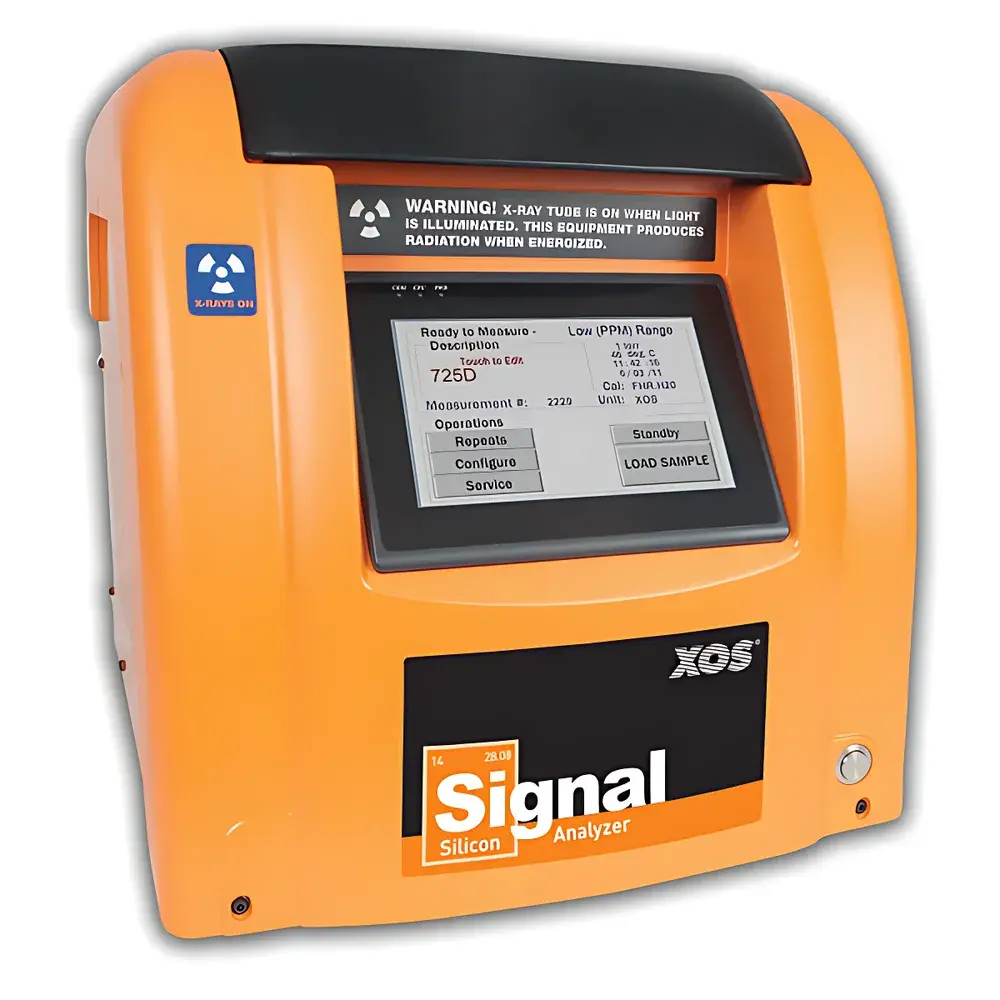
XOS Signal Single-Wavelength Wavelength-Dispersive X-Ray Fluorescence (WDXRF) Silicon Analyzer
| Brand | XOS |
|---|---|
| Model | Signal |
| Instrument Type | Benchtop |
| Excitation | Monochromatic WDXRF |
| Target Element | Silicon (Si) |
| X-ray Tube Power | 75 W |
| Detection Limit (LOD) | 0.65 ppm (at 600 s) |
| Measurable Range | 0.65–3000 ppm |
| Sample Volume | ≤10 mL |
| Sample Membrane | Prolene film |
| Measurement Time | 30–900 s (user-configurable) |
| Compliance | ASTM D7757-17, NB/SH/T 0993-2019 |
Overview
The XOS Signal is a benchtop single-wavelength wavelength-dispersive X-ray fluorescence (WDXRF) analyzer engineered exclusively for the precise, direct quantification of silicon (Si) in hydrocarbon-based fuels and related petroleum products. Unlike energy-dispersive (EDXRF) or multi-element WDXRF systems, the Signal employs monochromatic excitation—using a dual curved-crystal optical configuration—to isolate and deliver only the optimal Kα-excitation energy (corresponding to ~17.4 keV) for silicon. This eliminates spectral interference from matrix elements (e.g., S, Cl, Ca, Fe) and dramatically suppresses bremsstrahlung background, resulting in exceptional signal-to-noise ratio and sub-ppm detection capability. Designed for routine compliance testing in refinery QC labs, third-party inspection facilities, and regulatory testing centers, the Signal delivers trace-level Si measurement without acid digestion, combustion, dilution, or derivatization—fully aligning with the physical and chemical constraints of volatile, low-viscosity fuel matrices.
Key Features
- Monochromatic WDXRF architecture with two independently aligned doubly curved crystal (DCC) optics: the first focuses and monochromatizes the primary X-ray beam; the second collects only Si Kα fluorescence at λ = 0.713 nm, ensuring elemental specificity and ultra-low background.
- Detection limit of 0.65 ppm Si at 600-second counting time—validated per ASTM D7757-17 protocol—enabling confident verification of regulatory thresholds (e.g., ≤4 ppm Si in gasoline per U.S. EPA and EN 228).
- Benchtop footprint (W × D × H ≈ 45 × 50 × 35 cm) with integrated power supply; operates on standard 100–240 V AC, 50/60 Hz—no external cooling water, inert gas purge, or high-voltage auxiliary systems required.
- Fixed-geometry optical path with zero moving parts in the analyzer chamber—eliminating mechanical drift, alignment recalibration, and maintenance downtime associated with goniometers or scanning spectrometers.
- Prolene film-supported liquid sampling: ≤10 mL of neat fuel is pipetted into a disposable cup sealed with 6 µm-thick Prolene film—no evaporation control, no solvent handling, and no risk of crystallization or membrane rupture under ambient conditions.
- Multi-curve calibration storage: up to 16 independent calibration models (e.g., for gasoline, diesel, jet fuel, biodiesel blends) can be loaded and selected via intuitive touchscreen interface; each curve includes blank correction, linearity validation, and residual diagnostics.
Sample Compatibility & Compliance
The Signal is validated for direct analysis of unmodified liquid hydrocarbon samples including gasoline (E10, E15, E85), diesel (ultra-low-sulfur, biodiesel blends B5–B20), jet fuel (Jet A, Jet A-1), kerosene, naphtha, reformate, and hydrotreated distillates. It complies fully with ASTM D7757-17 “Standard Test Method for Silicon in Gasoline and Related Hydrocarbons by Monochromatic Wavelength Dispersive X-Ray Fluorescence Spectrometry” and NB/SH/T 0993-2019 “Determination of Silicon Content in Gasoline and Related Products by Monochromatic Wavelength Dispersive X-Ray Fluorescence Spectrometry.” Its measurement principle satisfies ISO/IEC 17025:2017 requirements for method validation—including specificity, linearity (r² ≥ 0.9995 over 0.65–3000 ppm), repeatability (RSD < 2.1% at 5 ppm), and intermediate precision across operators and days. The system supports audit-ready documentation per GLP and GMP environments, with optional instrument qualification packages (IQ/OQ/PQ) available.
Software & Data Management
The embedded SignalControl software (v3.x) provides full control of acquisition parameters, calibration management, and report generation. All measurements are timestamped and logged with operator ID, sample ID, calibration ID, integration time, count rate, net peak area, background estimate, and statistical uncertainty (k = 2). Raw spectral data (channel counts vs. energy-equivalent channel index) are stored in vendor-neutral ASCII format. The software supports automated pass/fail flagging against user-defined specification limits (e.g., “Si > 4.0 ppm → REJECT”) and exports compliant PDF reports containing full metadata, calibration history, and digital signature fields. For enterprise integration, optional OPC UA and CSV export modules enable bidirectional communication with LIMS (e.g., Thermo Fisher SampleManager, LabVantage) and support 21 CFR Part 11-compliant electronic records when deployed with validated Windows OS and domain authentication.
Applications
The Signal addresses critical quality control and regulatory compliance needs across the downstream petroleum value chain. Refineries deploy it for incoming catalyst feedstock screening, real-time blending tank monitoring, and final product release testing. Independent testing laboratories use it to verify supplier declarations and support litigation-grade forensic analysis of fuel-related engine failures. Regulatory agencies apply it in surveillance programs targeting silicon-contaminated fuel batches linked to oxygen sensor poisoning and catalytic converter degradation. Its robustness extends to biofuel producers verifying silicone antifoam carryover from fermentation units, and to additive manufacturers certifying Si-free dispersant formulations. Field-deployable variants (with shock-mounted optics and extended temperature range) are qualified for mobile lab deployment at marine terminals and pipeline custody transfer points.
FAQ
Does the Signal require daily calibration or frequent standardization?
No. Due to its fixed-optic monochromatic design and stable X-ray tube output, the Signal maintains calibration for ≥30 days under typical lab conditions. A single daily check standard (e.g., 5 ppm Si in iso-octane) is recommended for trend monitoring—not mandatory recalibration.
Can the Signal analyze viscous or high-boiling-point samples such as lubricating oils or residual fuels?
No. The Signal is optimized for low-viscosity, volatile hydrocarbons (flash point < 60 °C). High-boiling or particulate-laden matrices cause film rupture, evaporation artifacts, or spectral attenuation not addressed by its calibration model.
Is helium purge or vacuum required for silicon detection?
No. Silicon Kα (0.713 nm) is efficiently transmitted through ambient air and Prolene film; the system operates at atmospheric pressure without gas purge or vacuum pumping.
What is the typical measurement uncertainty at 2 ppm Si?
At 2 ppm Si and 300-second acquisition, expanded uncertainty (k = 2) is ±0.21 ppm (relative ±10.5%) based on within-run precision and calibration model residuals per ASTM D7757-17 Annex A3.
How is instrument performance verified between calibrations?
The software includes built-in performance verification routines: tube output stability check (via reference detector), crystal alignment diagnostic (using internal scatter peak), and background homogeneity test—all generating pass/fail flags with traceable logs.



