
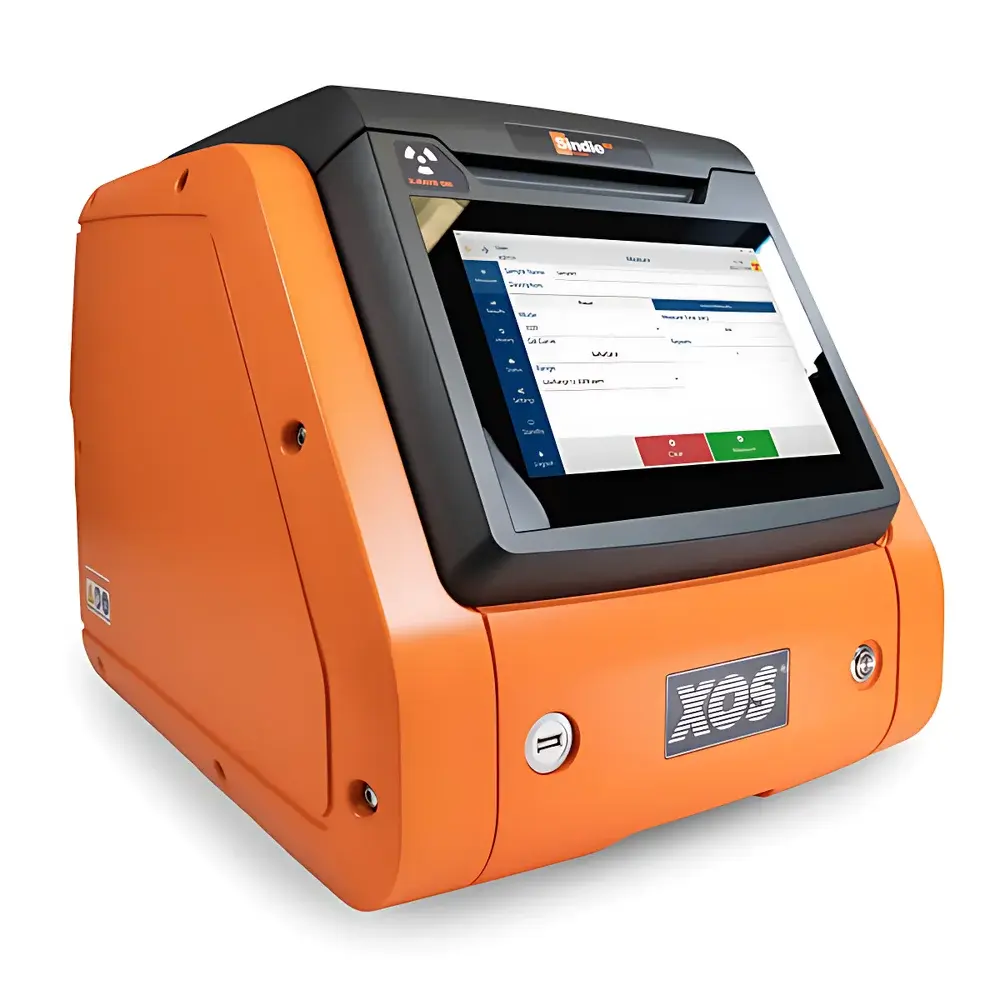
XOS Sindie R2 Single-Wavelength Wavelength Dispersive X-Ray Fluorescence (WDXRF) Sulfur Analyzer
| Brand | XOS |
|---|---|
| Model | Sindie R2 |
| Instrument Type | Benchtop |
| Excitation Principle | Monochromatic WDXRF (MWD-XRF) |
| Target Element | Sulfur (S) |
| X-ray Tube Power | 75 W |
| Detection Limit | 0.4 mg/kg @ 300 s |
| Measuring Range | 0.4 mg/kg – 3000 mg/kg and 3000 mg/kg – 10 wt% |
| Sample Volume | ≤10 mL |
| Sample Membrane | Polyethylene (Mylar) |
| Measurement Time | 10–999 s (user-selectable) |
| Display | 10-inch color touchscreen |
| Data Storage Capacity | >50,000 test records |
| Compliance Standards | ASTM D7039-15a(2020), ASTM D2622-21, NB/SH/T 0842-2017, ISO 20884:2019, GB/T 11140-2008 |
Overview
The XOS Sindie R2 is a benchtop single-wavelength wavelength dispersive X-ray fluorescence (WDXRF) sulfur analyzer engineered for high-precision, routine quantification of total sulfur in liquid hydrocarbon fuels and related petroleum products. Unlike energy-dispersive XRF (EDXRF) systems, the Sindie R2 employs monochromatic excitation via dual hyperbolic curved-crystal optics — a core principle of monochromatic WDXRF (MWD-XRF). This architecture delivers exceptional spectral resolution by isolating only the optimal incident photon energy (corresponding to the sulfur Kα absorption edge) to selectively excite sulfur atoms, while suppressing bremsstrahlung background and matrix-induced interferences. The resulting secondary sulfur Kα fluorescence (λ = 0.5373 nm) is collected with high angular selectivity and detected with proportional counter or scintillation detection, enabling trace-level sensitivity without chemical digestion, combustion, or carrier gas consumption. Designed explicitly for compliance-driven environments, the Sindie R2 operates fully within the physical and procedural boundaries defined by ASTM D7039, ASTM D2622, ISO 20884, and GB/T 11140.
Key Features
- Monochromatic WDXRF optical path with dual hyperbolic bent-crystal optics for ultra-low background and enhanced signal-to-noise ratio
- Detection limit of 0.4 mg/kg sulfur at 300-second acquisition time — validated per ASTM D7039 precision requirements
- Wide dynamic range: 0.4 mg/kg to 10 wt% sulfur, supporting both ultra-low-sulfur diesel (ULSD) and high-sulfur residual fuel analysis
- Benchtop footprint (<60 cm × 50 cm × 45 cm) with no moving parts in the analyzer head — minimizing mechanical drift and maintenance intervals
- Integrated 10-inch capacitive touchscreen interface with on-board data management, real-time diagnostics, and audit-ready error logging
- Non-destructive analysis: samples remain intact; no oxidation, dilution, or derivatization required
- Low-power 75 W X-ray tube optimized for sulfur-specific excitation — reducing thermal load and extending tube lifetime
- Accucell sample cup compatibility with standard 4-mil Mylar film — ensuring consistent geometry and minimal absorption artifacts
- Multi-curve calibration storage supporting independent calibrations for gasoline, diesel, biodiesel blends, naphtha, and heavy fuel oil
- Optional automated sample changer for unattended batch analysis in QC laboratories operating under GLP or ISO/IEC 17025 frameworks
Sample Compatibility & Compliance
The Sindie R2 accepts homogeneous liquid hydrocarbon samples up to 10 mL volume, including but not limited to: gasoline (E10, E15, ethanol-blended), diesel (EN 590, ASTM D975), jet fuel (Jet A-1, JP-8), kerosene, biodiesel (B100), B5–B20 blends, naphtha, crude oil (after stabilization), lubricating oils, and atmospheric/residual fuel oils. Sample containment uses inert polyethylene (Mylar) films — eliminating contamination risks associated with quartz or polymer alternatives. All measurement protocols align with regulatory and industry-standard test methods: ASTM D7039-15a(2020) for low-sulfur gasoline/diesel; ASTM D2622-21 for broader petroleum matrices; NB/SH/T 0842-2017 for Chinese refinery QC; ISO 20884:2019 for global fuel certification; and GB/T 11140-2008 for domestic compliance reporting. The system supports full traceability through embedded metadata tagging (operator ID, timestamp, calibration ID, instrument status flags), satisfying documentation requirements for FDA 21 CFR Part 11–aligned workflows where electronic records are subject to audit.
Software & Data Management
The onboard firmware implements a deterministic, real-time acquisition engine with configurable dwell times (10–999 s), automatic peak integration, and iterative background subtraction using crystal diffraction profile modeling. Calibration curves are stored as polynomial or segmented linear functions with uncertainty propagation. Raw spectra and processed results are archived in CSV and proprietary binary formats, exportable via USB or Ethernet. The software enforces role-based access control (administrator, operator, reviewer) and maintains immutable audit trails for all method changes, calibration updates, and result overrides. Optional PC-based XOS Insight Suite provides advanced statistical process control (SPC), trend analysis across shifts/lots, and automated report generation compliant with ISO/IEC 17025 clause 7.8. Data integrity safeguards include cyclic redundancy checks (CRC), write-once filesystem partitioning, and timestamped digital signatures for exported datasets.
Applications
The Sindie R2 serves as a primary or confirmatory sulfur analyzer in refinery process labs, third-party testing facilities, petrochemical quality assurance departments, and government regulatory laboratories. It is routinely deployed for: real-time monitoring of hydrotreater effluent streams; final product release testing against Euro 5/6, Tier 3, and China VI sulfur limits; incoming inspection of feedstocks and blending components; certification of marine fuels meeting IMO 2020 <0.50 wt% global cap; verification of biodiesel purity per ASTM D6751; and forensic analysis of adulterated fuels. Its robustness, minimal consumables, and absence of high-temperature reactors or gas cylinders make it especially suitable for remote field labs, mobile testing units, and facilities with constrained infrastructure.
FAQ
Does the Sindie R2 require external cooling water or compressed air?
No. The instrument operates with passive air convection and solid-state thermal management — no auxiliary utilities are needed beyond standard 100–240 VAC power.
Can it analyze viscous or high-boiling-point samples such as bunker fuel or bitumen?
Yes, provided samples are homogenized and loaded as stable liquids at ambient temperature. For highly viscous materials, pre-heating to 40–50 °C (using external hot plate) ensures uniform film formation under Mylar — no internal heating capability is required.
Is method validation support available from XOS?
XOS provides IQ/OQ documentation templates, certified reference material (CRM) recommendations (e.g., NIST SRM 2724b, EXXONMobil CRM sets), and application notes aligned with ASTM precision statements for D7039 and D2622.
How frequently must the instrument be recalibrated?
Under routine use with daily system suitability checks (SSC) using a check standard, recalibration is typically required every 3–6 months — significantly less frequent than combustion-based analyzers due to optical stability and absence of electrode or furnace degradation.
Is the detector sealed or vacuum-pumped?
The detector operates under ambient air; no vacuum or purge gas is required — further simplifying operation and reducing cost of ownership.





