
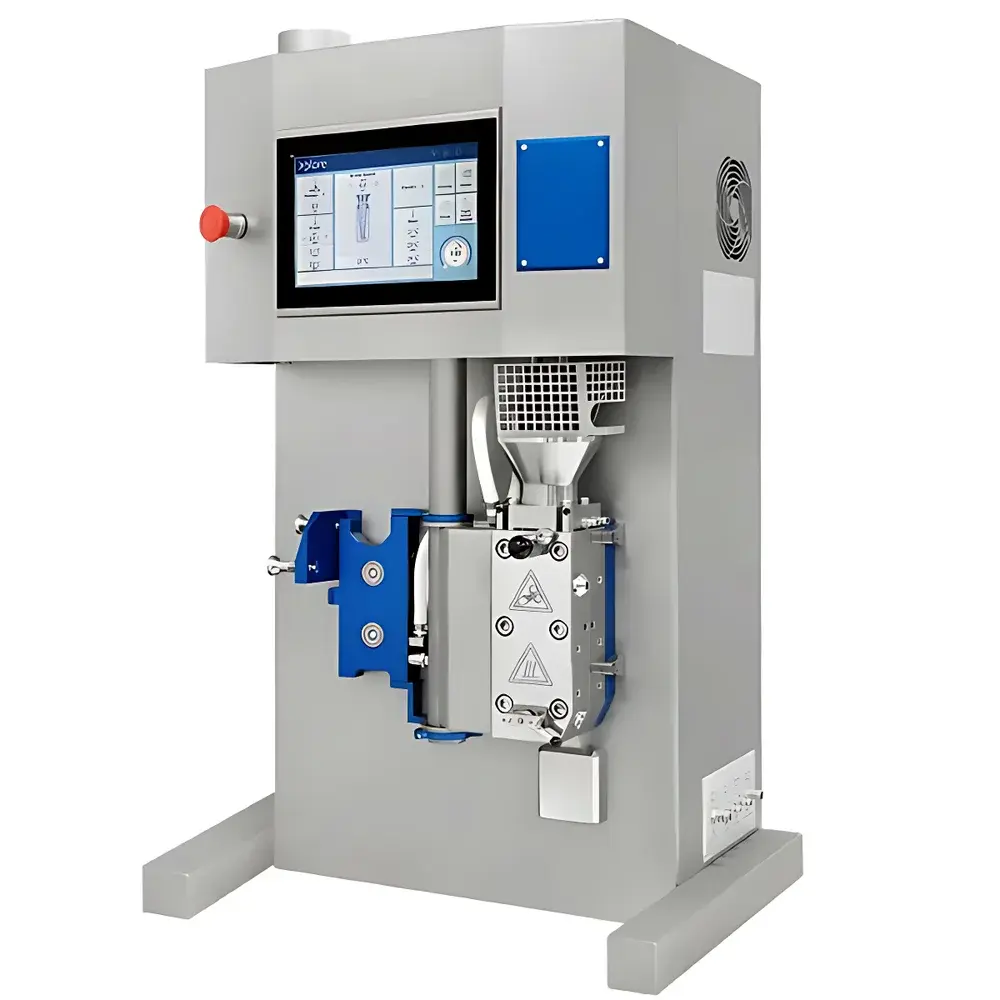
Xplore MC 15 HT Micro Compounder
| Brand | Xplore |
|---|---|
| Origin | Netherlands |
| Model | MC 15 HT |
| Batch Capacity | 15 mL (3–7 mL optional via Vari-Batch™) |
| Max Torque | 40 Nm (full speed range 1–500 rpm) |
| Max Temp | 450 °C |
| Temp Control | 8 heating zones, 7 thermocouples, melt thermocouple feedback |
| Torque & Rheological Data Acquisition | melt torque, shear viscosity, shear rate, shear stress |
| Max Pressure | 250 bar |
| Cooling Time (240→80 °C) | <10 min (water-cooled) |
| Weight | 145 kg |
| Dimensions (H×W×D) | 95×50×27 cm |
| Drive Power | 1350 W |
| Electrical Supply | 400 V / 50–60 Hz, 3-phase 5-wire, 16 A (or 210 V option) |
| Screw Hardness | 54 HRC, coating 1000 HV |
| Barrel Hardness | 64 HRC, coating 2000 HV |
| Chemical Resistance | pH 0–14 |
| Data Export | Excel (.xlsx) |
Overview
The Xplore MC 15 HT Micro Compounder is a high-torque, vertically oriented laboratory-scale twin-screw compounder engineered for precise, reproducible polymer and elastomer formulation development. Operating on co-rotating or counter-rotating screw principles, it delivers controlled shear history, residence time distribution, and thermal profiling—critical parameters in reactive extrusion, masterbatch development, nanocomposite dispersion, and thermoplastic elastomer optimization. Its vertical architecture enables direct integration into fume hoods and eliminates horizontal space constraints, while the sealed barrel design supports accurate liquid dosing and volatile handling under inert or controlled atmospheres. Designed for R&D labs requiring industrial relevance without pilot-scale footprint, the MC 15 HT bridges the gap between screening-scale feasibility studies and process transfer to production extruders.
Key Features
- Full-Speed Constant Torque Delivery: Maintains 40 Nm maximum melt torque across the entire 1–500 rpm rotational range—enabling consistent shear stress application regardless of viscosity, essential for high-solids loading, filler dispersion, and shear-sensitive formulations.
- Vari-Batch™ Technology: Supports batch volumes of 3 mL, 7 mL, and 15 mL using interchangeable barrels and screws—allowing method scalability from rapid screening to representative material generation with minimal re-optimization.
- Vertical Liquid-Tight Barrel Design: Enables precise gravimetric or volumetric liquid injection (e.g., plasticizers, curatives, solvents) directly into the melting zone, with leak-free operation up to 250 bar pressure.
- Multi-Zone Thermal Management: Eight independent heating zones and seven embedded thermocouples—including a melt thermocouple—support programmable axial temperature gradients and real-time melt temperature feedback for closed-loop control.
- Industrial-Grade Mechanical Construction: Barrels hardened to 64 HRC with 2000 HV PVD coating and screws at 54 HRC with 1000 HV coating ensure >10-year service life under abrasive or chemically aggressive conditions (pH 0–14).
- Integrated Cleaning Protocol: Automated water-cooled cleaning cycle reduces downtime—barrel cools from 240 °C to 80 °C in under 10 minutes, followed by mechanical purging and screw extraction in <5 minutes.
Sample Compatibility & Compliance
The MC 15 HT processes thermoplastics (PP, PE, PA, PC, PEEK), thermoplastic elastomers (TPEs, TPU), rubber compounds (NR, SBR, EPDM), filled systems (CaCO₃, silica, carbon black), nanocomposites (CNT, graphene), and reactive formulations (peroxide-cured, silane-grafted, polycondensation). Its chemical resistance (pH 0–14) accommodates acidic catalysts, alkaline stabilizers, and halogenated flame retardants. The system meets mechanical safety requirements per EN ISO 12100 and electrical compliance per IEC 61000-6-2/6-4. While not certified as GMP equipment, its data logging, user access levels, and audit-ready Excel export support GLP-aligned workflows and internal validation protocols aligned with ASTM D3835 and ISO 1133-2 for melt flow index correlation.
Software & Data Management
Control and acquisition are managed via an integrated 7-inch industrial touchscreen interface or optional USB-connected PC software. All operational parameters—including screw speed, torque, melt temperature, barrel zone temperatures, pressure (if equipped), and elapsed time—are sampled at 10 Hz and timestamped. Rheological outputs (shear stress, shear rate, apparent viscosity) are calculated in real time using calibrated torque-to-force conversion and geometry-specific flow models. Raw data exports automatically to .xlsx format with column headers compliant with LIMS ingestion standards. No proprietary binary formats are used. Audit trails record user login, method changes, and calibration events—supporting traceability requirements under internal quality management systems.
Applications
- Rapid formulation screening for polymer blends, compatibilizer selection, and additive interaction studies
- Dispersion optimization of nanofillers, pigments, and flame retardants in low-volume batches
- Reactive extrusion development: grafting, crosslinking, and in-situ polymerization kinetics
- Thermoplastic vulcanizate (TPV) and dynamic vulcanization process mapping
- Recycled polymer decontamination and stabilization trials
- Reference material preparation for rheometry, DSC, and mechanical testing
- Process window definition for scale-up to 16 mm or 25 mm twin-screw extruders
FAQ
What batch sizes does the MC 15 HT support?
The standard configuration operates at 15 mL nominal capacity. With Vari-Batch™ hardware kits, users can switch to 3 mL or 7 mL barrels—each with matched screw geometries—to maintain consistent specific mechanical energy (SME) and shear history across scales.
Can the MC 15 HT handle highly abrasive fillers like silica or wollastonite?
Yes. The barrel’s 2000 HV PVD coating and screw’s 1000 HV coating provide exceptional wear resistance, validated over >5,000 cycles with 40 wt% silica-filled PP formulations.
Is vertical downward extrusion compatible with inline rheometry or pelletizing?
The unit features a standardized Ø12 mm die port with DIN 2828 thread. It integrates with Xplore’s optional inline capillary rheometer module or gravity-fed strand pelletizer—no third-party adapters required.
How is temperature calibration verified?
Each unit ships with NIST-traceable certificate for all seven barrel thermocouples and the melt probe. Users may perform field verification using a calibrated immersion thermometer in the melt pool during steady-state operation.
Does the system support automated method sequencing?
Yes. Up to 99 sequential steps—including ramp/soak profiles, torque-limited speed control, and conditional triggers (e.g., “hold until melt temp ≥ 200 °C”)—can be programmed and saved as reusable methods.



