
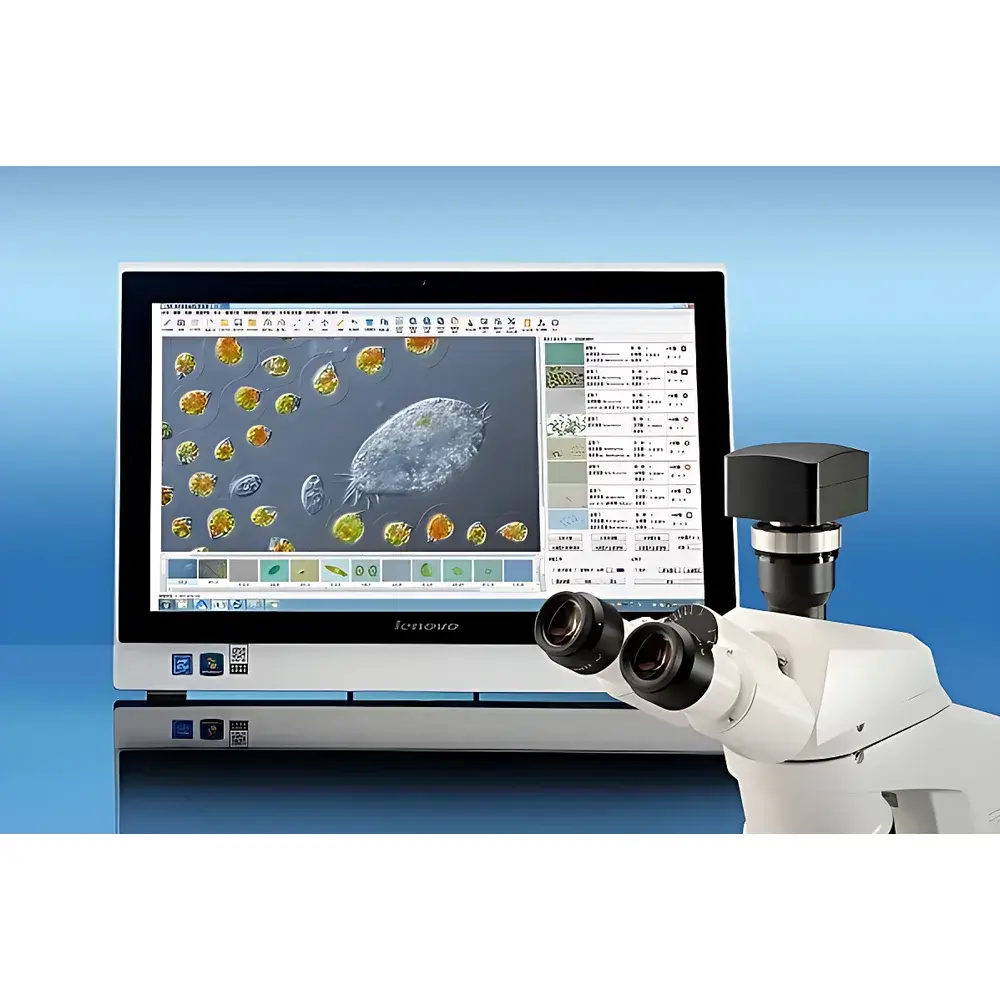
Xunshu Algacount F310 Plankton Identification and Enumeration System
| Brand | Xunshu |
|---|---|
| Origin | Zhejiang, China |
| Manufacturer Type | OEM Manufacturer |
| Region Category | Domestic (China) |
| Model | Xunshu Algacount F310 |
| Instrument Type | Algal and Plankton Counter |
| Camera Resolution | 12 Megapixels |
| Objective Magnifications | 4×, 10×, 20×, 40× |
| Identification Methods | Morphological Classification, Keyword Search, Multidimensional Similarity Matching, Confusion-Resolving Comparative Analysis |
Overview
The Xunshu Algacount F310 is a high-performance digital plankton identification and enumeration system engineered for environmental monitoring laboratories, water quality research institutions, and regulatory agencies engaged in freshwater and marine phytoplankton assessment. It integrates advanced optical microscopy with AI-assisted image analysis to support standardized, reproducible, and auditable plankton quantification workflows. At its core, the system employs brightfield microscopy coupled with high-fidelity CMOS imaging (12 MP resolution, USB 3.0 interface) and computational morphometrics—leveraging pixel-level feature extraction, multi-plane depth fusion, and panoramic image stitching—to resolve taxonomically critical structures across diverse planktonic forms. Designed in compliance with internationally recognized protocols for phytoplankton enumeration (e.g., ISO 17025–accredited lab practice, EPA Method 1623 adaptations, and national standards GB/T 12763.8–2007), the Algacount F310 delivers traceable, defensible data suitable for ecological status assessment, eutrophication monitoring, HAB (Harmful Algal Bloom) early warning, and regulatory reporting.
Key Features
- Multi-layer focus stacking: Automated z-stack acquisition and fusion to generate extended-depth-of-field images—critical for resolving three-dimensional morphology of colonial cyanobacteria, diatom frustules, and ciliate ciliature.
- Ultra-wide-field image mosaicking: Seamless horizontal/vertical tiling of adjacent microscope fields at 40× magnification, enabling full-cell visualization without stage repositioning or manual stitching artifacts.
- Seven adaptive segmentation algorithms: Dynamically selects optimal thresholding, edge detection, and region-growing strategies for accurate single-cell microalgal counting—including Chlamydomonas, Nannochloropsis, and Scenedesmus under variable background illumination and culture density.
- Colony and filament analysis modules: Quantifies subcellular units within mucilaginous colonies (e.g., Microcystis aeruginosa) and estimates cell counts per chain segment in unbranched filaments (e.g., Anabaena, Planktothrix).
- Integrated micro-measurement suite: Digital caliper with automatic magnification calibration (4×–40×), supporting length, width, area, and perimeter measurements compliant with ICES and HELCOM morphometric guidelines.
- Biomass estimation engine: Applies geometric models (spheres, cylinders, prolate spheroids, ellipsoids) to measured dimensions, computing biovolume (µm³), carbon biomass (pg C cell⁻¹), nitrogen content (pg N cell⁻¹), and total community carbon load.
Sample Compatibility & Compliance
The Algacount F310 supports fixed and live samples prepared on standard glass slides or sedimentation chambers (Utermöhl-type). It accommodates freshwater, brackish, and marine plankton suspensions—including centric and pennate diatoms, dinoflagellates, cryptophytes, chlorophytes, cyanobacteria, rotifers, cladocerans, copepod nauplii, and ciliates. Its database architecture aligns with the latest taxonomic revisions published by AlgaeBase and WoRMS, with dual-language (Chinese/Latin) nomenclature and curated metadata for >2,800 freshwater taxa (covering China’s seven major river basins and 28 key lakes/reservoirs) and >1,400 marine taxa (from the Bohai Sea, Yellow Sea, East China Sea, and South China Sea). All software operations—including user authentication, audit trail logging, electronic signatures, and raw image retention—support GLP-compliant documentation per ISO/IEC 17025:2017 Annex A.2 and FDA 21 CFR Part 11 requirements for data integrity.
Software & Data Management
The Algacount F310 runs on Windows 10 with a dedicated x64 application built using Qt framework and OpenCV libraries. Core modules include: (1) Real-time imaging control with white balance, exposure time (0.1 ms–15 s), and frame rate optimization; (2) “XunSao” intelligent identification engine featuring four orthogonal search paradigms—hierarchical taxonomy browsing (Phylum–Order–Genus–Species), keyword-driven text retrieval, multidimensional similarity matching (3–5 s response time against >30,000 reference micrographs), and side-by-side comparative morphology for confusable taxa; (3) Workflow-based enumeration with color-coded tagging, auto-cumulative tallying across multiple fields of view (up to 200 FOVs), and statistical output including dominance index (Berger–Parker), Shannon–Wiener diversity (H′), Pielou evenness (J′), abundance (cells·L⁻¹), and volumetric density (mm³·L⁻¹); (4) Role-based access control (administrator, analyst, reviewer) with encrypted local database storage, immutable electronic records, and export to Excel (.xlsx) or PDF with embedded metadata and timestamped audit logs.
Applications
- Regulatory water quality monitoring programs (e.g., China’s “Blue Sky & Clear Water” initiative, EU WFD phytoplankton metrics)
- Ecotoxicology studies assessing algal community shifts following chemical exposure or nutrient enrichment
- HAB forecasting and source tracking in reservoirs, estuaries, and coastal zones
- Algal biofuel strain screening and photobioreactor QC
- Taxonomic training and inter-laboratory proficiency testing
- Long-term ecological research requiring standardized, repeatable enumeration across decades
FAQ
Does the Algacount F310 comply with international water quality standards?
Yes—the system supports methodologies aligned with ISO 8692 (freshwater algal growth inhibition), ISO 10253 (marine phytoplankton enumeration), and national standards GB/T 12763.8–2007 and HJ 1081–2019.
Can raw images and analysis parameters be exported for third-party verification?
All captured images, measurement coordinates, segmentation masks, and statistical outputs are stored in a tamper-evident SQLite database; full datasets—including annotated TIFFs and CSV-formatted counts—can be exported with metadata headers and user-defined filters.
Is remote software update and technical support available outside China?
Firmware and application updates are delivered via secure HTTPS portal; remote desktop assistance (with user consent) and English-language documentation are provided globally through Xunshu’s international support channel.
How does the “multidimensional similarity matching” algorithm differ from conventional template matching?
It applies convolutional feature encoding across shape, texture, contrast gradient, and spatial frequency domains—not pixel-wise correlation—enabling robust recognition despite minor focus drift, staining variation, or partial occlusion.
What hardware is included in the base configuration?
The standard package includes the Algacount F310 software license, USB 3.0 scientific-grade CMOS camera (Sony IMX226, 1/1.7″ sensor, 1.85 µm pixel pitch), C-mount adapter, Lenovo all-in-one PC (Intel Core i3/i5, 4 GB RAM, 1 TB HDD, 23″ display, Windows 10 Pro), and calibration slide.







