
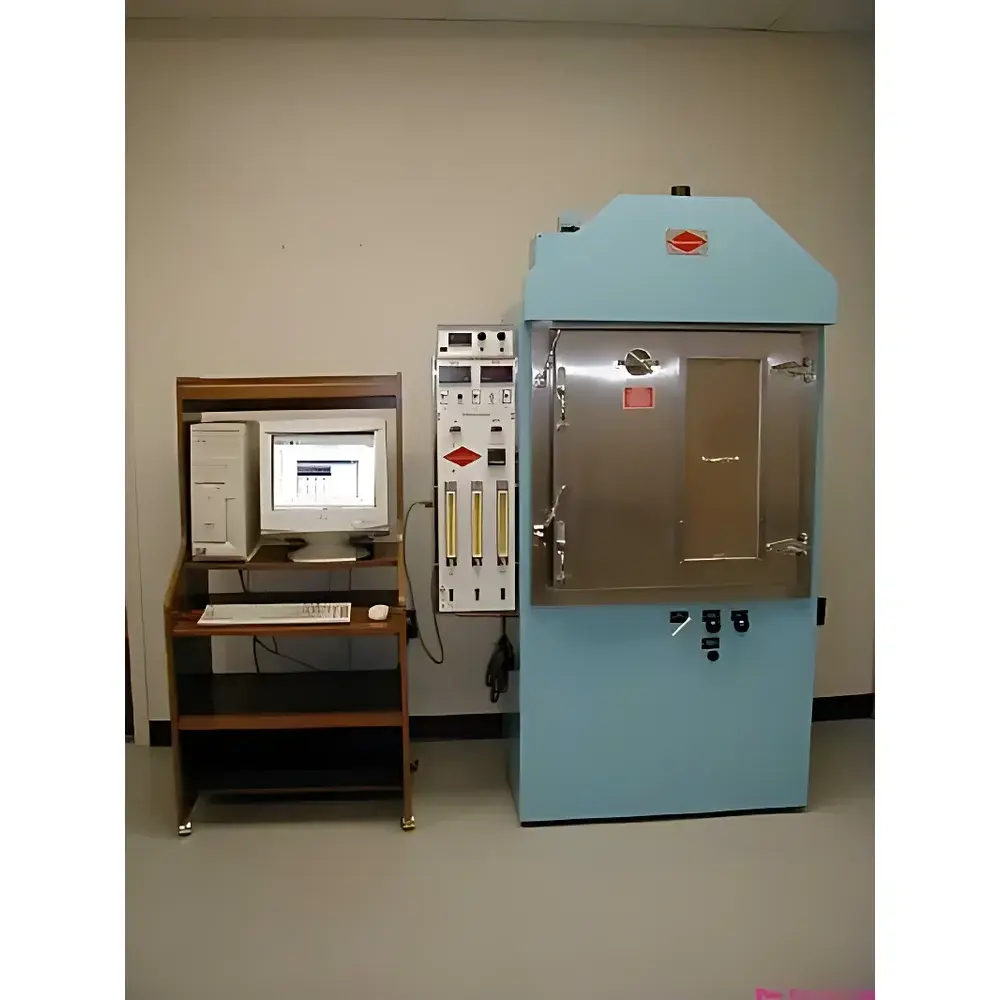
Newport 4-5800 Series ASTM/FAA-Compliant NIST-Traceable Smoke Density Chamber
| Brand | Newport |
|---|---|
| Origin | USA |
| Model | 4-5800 Series (ASTM E662 / FAA TSO-C135 Compliant) |
| Chamber Volume | 0.50 m³ |
| Optical Path Length | 914 mm |
| Sample Area | 0.0774 m² |
| Radiation Heat Flux | 2.5 W/cm² ±0.25 W/cm² |
| Power Supply | 230 V, 50–60 Hz |
| Dimensions (H×W×D) | 1956 × 1169 × 966 mm |
| Weight | 205 kg |
| Light Source | Tungsten-Halogen Lamp with ND2 Neutral Density Filter (Transmission Accuracy: 0.0001%) |
| Photodetector System | NIST-Traceable Silicon Photodiode Assembly |
| Data Acquisition | Real-time Transmittance vs. Time Plotting at 1 Hz Sampling Rate |
| Compliance | ASTM E662, ASTM F814, FAR 25.853, NFPA 258, BS 6401, FAA AC 20-135, ATS 1000.01, NES 711 |
Overview
The Newport 4-5800 Series Smoke Density Chamber is a NIST-traceable, standards-compliant instrument engineered for quantitative measurement of specific optical density (Ds) generated by solid materials during controlled flaming or radiant combustion. It operates on the principle of photometric attenuation: a collimated tungsten-halogen light beam traverses a defined optical path (914 mm) through a standardized 0.50 m³ test chamber containing the specimen. As smoke particles scatter and absorb incident radiation, the transmitted light intensity declines; this change in transmittance (T) is continuously recorded by a calibrated silicon photodiode. The specific optical density is calculated in real time using the internationally recognized formula: Ds = (V / A·L) · log10(100/T), where V is chamber volume (m³), A is exposed sample surface area (m²), and L is optical path length (m). This method—originally codified by the U.S. National Bureau of Standards (NBS), now NIST—is the definitive basis for regulatory smoke toxicity assessment in aerospace, rail, marine, and building material certification.
Key Features
- Modular dual-mode combustion system: integrated six-nozzle propane/air burner (flaming mode) and water-cooled radiant panel (2.5 W/cm² ±0.25 W/cm², FAA-certified heat flux) with mechanical positioning rods—enabling precise, non-intrusive alignment without chamber opening
- NIST-traceable photometric train: stabilized tungsten-halogen source, ND2 neutral density filter (0.0001% transmission accuracy), and temperature-compensated silicon photodiode detector, all calibrated per ASTM E662 Annex A1
- Full-spectrum data acquisition: 1 Hz sampling rate captures transient smoke development from ignition to peak Ds and decay; software computes maximum specific optical density (Ds,max) and time-to-peak automatically
- Enhanced safety architecture: redundant gas solenoid cutoff valves, interlocked chamber door, pressure-relief venting, and Class I explosion-proof electrical enclosure per UL 61010-1
- Ergonomic stainless-steel removable specimen holder accommodating both non-dripping and melt-dripping materials per ASTM E662 Section 7.2
- Integrated exhaust management: high-efficiency centrifugal fan (≥1200 CFM) with top-mounted sampling port compliant with ISO 16750-2 for real-time off-gas analysis
Sample Compatibility & Compliance
The 4-5800 Series accommodates flat, rigid, or semi-rigid specimens up to 100 mm × 100 mm × 25 mm (ASTM E662) or 152 mm × 152 mm × 13 mm (FAR 25.853), including composites, polymers, foams, textiles, and coated substrates used in aircraft cabin interiors, railcar linings, and marine bulkheads. Its design satisfies full auditability under FAA Advisory Circular AC 20-135, EASA CS-25.853, and Airbus ATS 1000.01. Optional configurations include British Navy NES 711-compliant burner assemblies and custom specimen holders for wire/cable jacket testing per MIL-STD-202. All units ship with NIST-traceable calibration certificates for radiant flux (calibrated via water-cooled calorimeter) and photometric response (calibrated against NIST SRM 2030).
Software & Data Management
The included Windows-based acquisition software (compatible with Windows 10/11 64-bit) provides real-time transmittance curve visualization, automatic Ds calculation per ASTM E662 Equation 1, and export of raw data in CSV and XML formats. Audit trails record operator ID, calibration dates, environmental parameters (chamber ambient temperature ±2 °F), and system error logs—fully compliant with FDA 21 CFR Part 11 requirements when deployed in GLP/GMP-regulated environments. Software supports user-defined pass/fail thresholds aligned with FAA TSO-C135 acceptance criteria (Ds,max ≤ 200 at 4 min) and generates PDF test reports with embedded digital signatures and electronic seals.
Applications
- Aerospace material qualification: flame-retardant seat fabrics, insulation blankets, overhead bins, and floor coverings per FAR 25.853(a)(2) and EASA CS-25.853
- Railway rolling stock compliance: interior panels and flooring tested against EN 45545-2 R22/R23 (smoke density class HL3)
- Marine fire safety: cable sheathing, gaskets, and acoustic insulation evaluated per IMO FTP Code Annex 1, Part 2
- Building product certification: ceiling tiles, wall panels, and HVAC duct liners assessed per NFPA 258 and UL 723 (ASTM E84 alternative pathway)
- Research & development: kinetic modeling of smoke generation mechanisms, comparative evaluation of halogen-free flame retardants, and validation of computational fire dynamics simulations (e.g., FDS inputs)
FAQ
What standards does the Newport 4-5800 Series fully satisfy?
It meets the core test requirements of ASTM E662 (Standard Test Method for Specific Optical Density of Smoke Generated by Solid Materials), FAR 25.853, FAA AC 20-135, NFPA 258, BS 6401, and ATS 1000.01—with optional configurations certified to NES 711 and MIL-STD-202.
Is NIST traceability provided for both optical and thermal subsystems?
Yes. Each unit ships with dual NIST-traceable calibration certificates: one for the photodetector assembly (SRM 2030), and one for the radiant panel heat flux (water-cooled calorimeter per ASTM E1530).
Can the system operate under superpressure conditions as required by ASTM E662 Annex A4?
Yes—the 4-5800 Series includes a pressure-regulated exhaust manifold enabling operation at +2.5 kPa superpressure, verified via integrated differential pressure transducer and logged in every test report.
What sample preparation support is available for irregular or low-mass specimens?
Custom stainless-steel specimen holders—including wire-mount frames, foam clamping fixtures, and low-mass substrate carriers—are available under Newport’s Engineering Services Program (ESP-SDC).
Does the software support 21 CFR Part 11 compliance for regulated laboratories?
Yes. With enabled electronic signature modules, role-based access control, and immutable audit trails, the system meets all technical and procedural requirements for FDA-regulated smoke testing in pharmaceutical packaging or medical device material development.



