
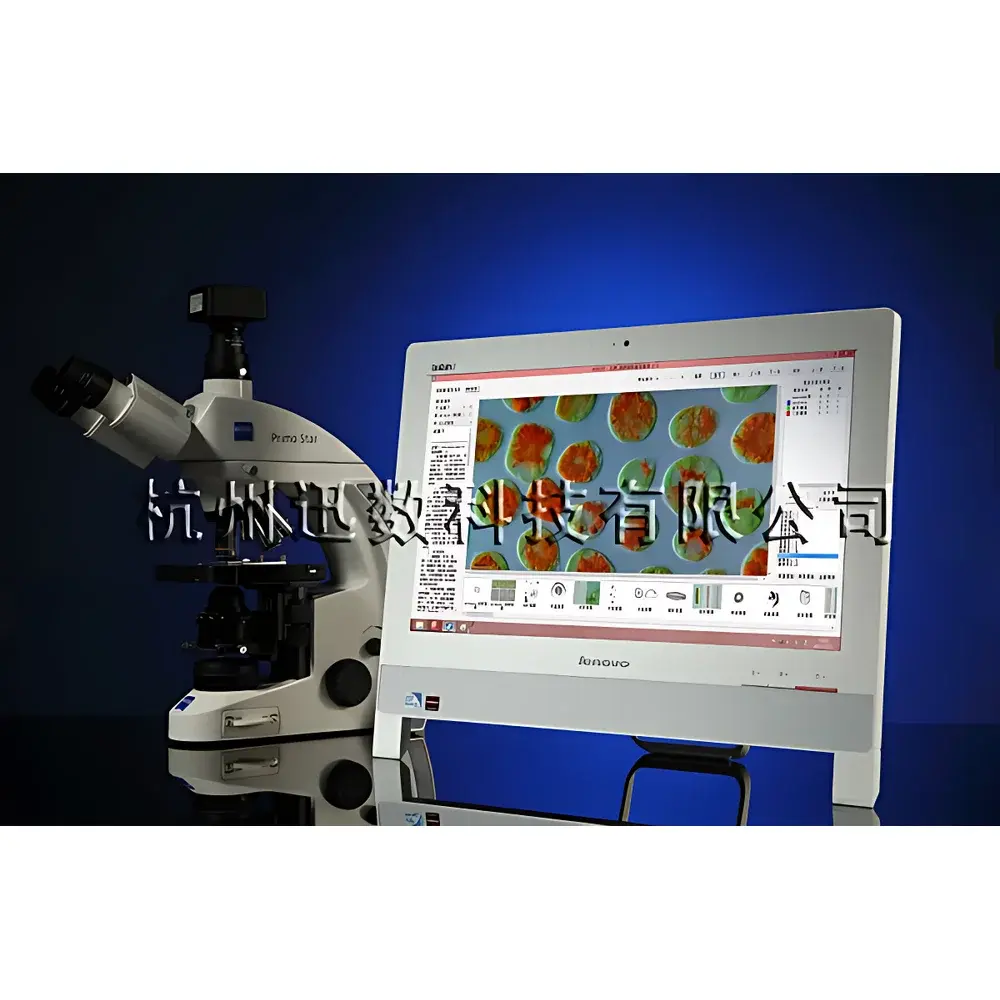
Xunshu Algacount S300 Intelligent Algal Identification and Enumeration System
| Brand | Xunshu |
|---|---|
| Origin | Zhejiang, China |
| Manufacturer Type | Original Equipment Manufacturer (OEM) |
| Product Category | Domestic |
| Model | Algacount S300 |
| Instrument Type | Algal Identification and Enumeration System |
| Imaging Sensor | Scientific-grade color CCD (2580 × 1944 pixels) |
| Optical Compatibility | Requires external upright or inverted microscope with C-mount interface (0.63× recommended) |
| Software | Algacount v5.x + optional MIC Microscopic Image Analysis Suite |
| Compliance | Designed for GLP-compliant water quality laboratories |
Overview
The Xunshu Algacount S300 Intelligent Algal Identification and Enumeration System is a dedicated digital microscopy workstation engineered for high-precision taxonomic identification, morphometric analysis, and quantitative enumeration of phytoplankton in environmental water samples. Unlike generic image analysis platforms, the S300 integrates domain-specific computer vision algorithms rooted in phycological taxonomy—leveraging both morphological descriptors (e.g., valve symmetry, striae pattern, flagellar arrangement) and photobiological features (e.g., chloroplast topology, pigment distribution, autofluorescence profiles). It operates as a hardware-agnostic imaging module: users integrate it with industry-standard research microscopes (Olympus BX series, Nikon Eclipse Ci, Zeiss Axio Imager, or Leica DM series), enabling seamless transition from manual microscopy to standardized, traceable digital workflows. The system is calibrated for compliance with EPA Method 1623.1 (for algal community assessment), ISO 14442:2021 (microscopic enumeration of plankton), and national standard HJ 1081–2019 (Chinese Technical Specification for Phytoplankton Monitoring in Surface Water). Its core architecture supports reproducible, operator-independent analysis across multi-laboratory monitoring networks.
Key Features
- Expert-curated algal reference database containing >1,200 validated taxa—including taxonomically verified freshwater and marine species—with annotated light micrographs, line drawings, and descriptive morphological keys aligned with *Flora of China: Freshwater Algae* and *Marine Algae of China*.
- Bio-similarity–enhanced intelligent search: Combines color histogram analysis, Gabor-filter–based texture extraction, and SVM-based classification to match unknown cells against reference morphology with >92% top-3 accuracy under controlled illumination conditions.
- Chaotic-genetic fuzzy C-means segmentation: Enables robust multi-class separation of mixed phytoplankton suspensions—particularly effective for co-occurring diatoms, dinoflagellates, and cyanobacteria with overlapping size ranges and variable contrast.
- Automated subcellular quantification: Dedicated algorithms for chain-forming (e.g., *Aphanizomenon*, *Anabaena*) and mucilaginous colonial forms (e.g., *Microcystis*, *Gloeocapsa*), computing daughter cell counts per colony using adaptive boundary detection and volumetric correction.
- Single-cell microalgal enumeration: Dual-mode segmentation—“ovoid-cell refinement” for regular-shaped species (*Chlorella*, *Scenedesmus*) and “complex-contour parsing” for irregular or aggregated forms (*Nannochloropsis*, *Tetraselmis*).
- Digital morphometry suite: Includes transparent on-screen calibratable scale bars (auto-adjusted per objective magnification), arbitrary line/polygon measurement tools, and geometric biovolume estimation based on standardized shape models (spheroid, prolate spheroid, cylinder, frustum) per Utermöhl sedimentation protocol conventions.
- Pigment organelle localization & quantification: Uses spectral clustering to isolate chloroplasts, pyrenoids, and carotenoid-rich bodies; outputs positional coordinates, area, perimeter, and integrated optical density relative to background-subtracted ROI.
Sample Compatibility & Compliance
The Algacount S300 processes fixed or live water samples prepared via Utermöhl settling chambers, membrane filtration (pore size ≥1.2 µm), or centrifugal concentration. It accepts standard 22 × 22 mm coverslip-mounted preparations and accommodates immersion oil, glycerol, and aqueous mounting media. All image capture, annotation, and statistical outputs are timestamped and stored with full metadata (objective ID, exposure time, gain, stage coordinates), satisfying ISO/IEC 17025 clause 7.5.2 (data integrity) and FDA 21 CFR Part 11 requirements when deployed with optional MIC software’s electronic signature and audit-trail modules. The system supports dual-reporting modes: raw count tables (CSV/Excel export) and narrative PDF reports compliant with GB/T 12763.8–2007 (Chinese National Standard for Marine Environmental Monitoring Reports).
Software & Data Management
Algacount v5.x provides a modular GUI with four functional workspaces: Acquisition, Identification, Enumeration, and Reporting. All user actions—including manual corrections to AI-generated classifications—are logged in immutable event logs. The optional MIC Microscopic Image Analysis Suite extends capabilities to adaptive contrast enhancement, multi-channel pseudo-color overlay, non-linear flat-field correction, edge-preserving denoising (non-local means), and morphological operations (erosion/dilation sequences for feature isolation). Data export includes batch-processed TIFF stacks with embedded EXIF tags, annotated JPEG thumbnails, and structured Excel worksheets containing taxon-wise abundance (cells/mL), dominance indices (Simpson, Shannon–Wiener), and biovolume histograms. Database schema follows relational design principles, permitting custom field extension for regional monitoring programs.
Applications
The S300 serves operational and research needs across municipal drinking water utilities (cyanobacterial toxin precursor screening), ecological assessment agencies (eutrophication status evaluation per OECD Trophic Index), aquaculture health monitoring (phytoplankton bloom forecasting), and academic phycology labs (morphotype evolution studies). Its chain- and colony-resolution capability supports regulatory compliance with WHO Guideline 2.3.2 (cyanobacterial cell quotas in recreational waters) and EU Bathing Water Directive Annex II (phytoplankton community composition thresholds). In biotechnology contexts, it enables QC release testing of microalgal biomass batches for nutraceutical production (e.g., *Spirulina*, *Dunaliella*) by verifying culture purity and estimating viable cell density without flow cytometry.
FAQ
Does the Algacount S300 include a built-in microscope?
No. The S300 is an imaging and analysis module requiring integration with a separately procured research-grade microscope equipped with trinocular port and C-mount adapter.
What microscope objectives are supported?
All standard finite-conjugate and infinity-corrected objectives (10× to 100× oil immersion) compatible with the host microscope’s optical tube factor; calibration is performed per objective during initial setup.
Can the system distinguish between live and dead algal cells?
Not inherently—viability assessment requires supplemental staining (e.g., fluorescein diacetate/propidium iodide) and fluorescence-capable hardware; the S300 analyzes acquired monochrome or RGB images only.
Is remote access or multi-user collaboration supported?
Yes—via local network deployment with role-based permissions; administrators can assign read-only, annotation, or validation privileges; all shared sessions retain individual audit trails.
How frequently is the algal database updated?
Xunshu releases biannual database updates (January and July) incorporating newly validated taxa, revised nomenclature per AlgaeBase, and expanded morphotype coverage for emerging bloom species.







