
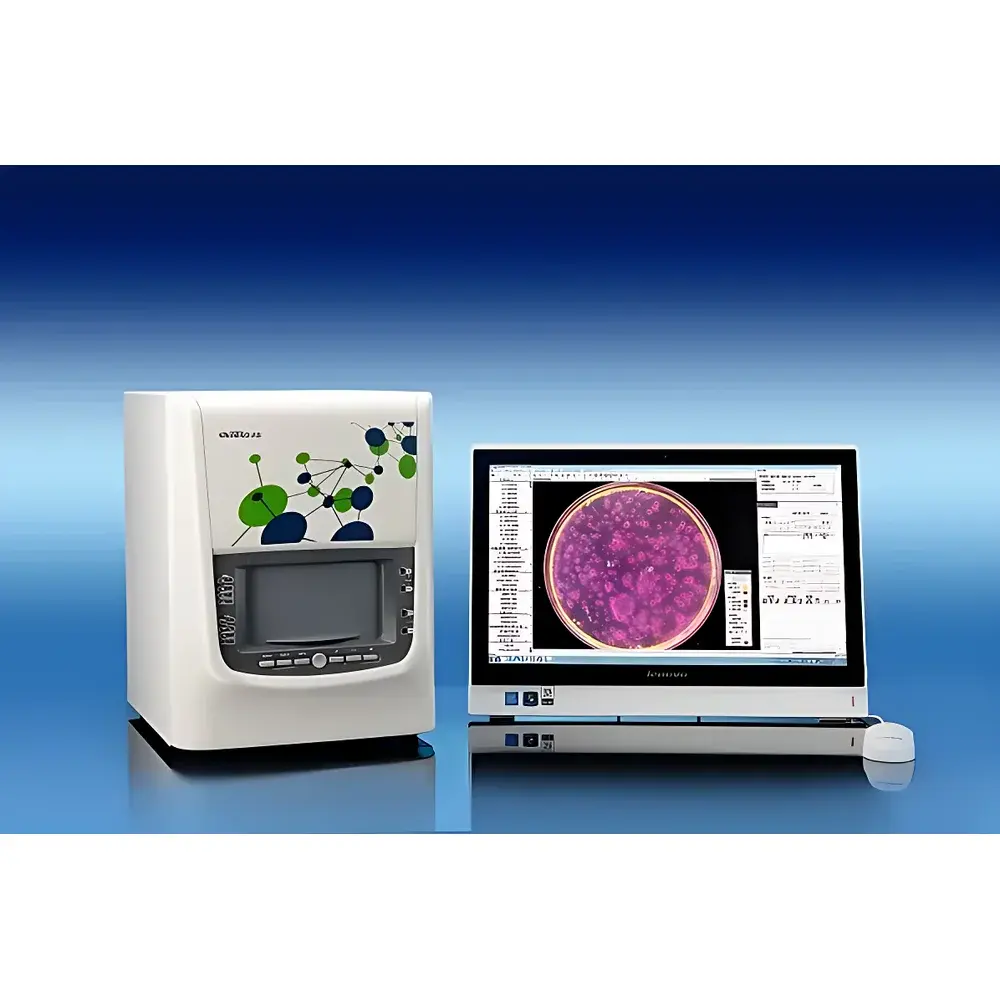
Xunsu Czone 8 Automated Colony Counter and Antibiotic Zone-of-Inhibition Analyzer
| Brand | Xunsu |
|---|---|
| Origin | Zhejiang, China |
| Manufacturer Type | Direct Manufacturer |
| Instrument Type | Fully Automated Colony Counter & Zone-of-Inhibition Measurement System |
| Counting Speed | <1 second for up to 500 colonies |
| Camera Resolution | 16 MP CMOS sensor |
| Lens | Fixed-focus industrial lens (8 mm focal length, 150 lp/mm resolution) |
| Illumination | Triple-color LED structural light (3500–8500 K adjustable color temperature), 360° diffuse top lighting, crystal-sharp suspended dark-field bottom lighting, 254 nm UV disinfection lamp |
| Compliance | Designed to meet GMP audit trail requirements per China NMPA regulations, USP <1225>, ISO/IEC 17025, and FDA 21 CFR Part 11 principles (electronic signatures, immutable audit logs, role-based access control) |
Overview
The Xunsu Czone 8 is a fully automated, regulatory-compliant colony counter and antibiotic zone-of-inhibition analyzer engineered for high-integrity microbiological testing in pharmaceutical quality control, food safety laboratories, environmental monitoring, and clinical research settings. It operates on dual-core image analysis principles: high-fidelity digital imaging combined with deterministic segmentation algorithms—specifically, multi-level level-set framework modeling and topology-aware morphological processing—to resolve complex colony morphologies, including overlapping, chain-forming, and heterogeneous microbial populations (e.g., mixed bacterial, fungal, and actinomycete growth). The system supports standardized plating methods—including pour plates, spread plates, membrane filtration, spiral plates (per SN/T 2098-2008 and FDA BAM protocols), and 3M™ Petrifilm™ rapid tests—and delivers quantitative measurements of colony-forming units (CFU), equivalent diameter, area, perimeter, circularity, and spatial distribution. Its integrated zone-of-inhibition module implements three complementary measurement algorithms—automated edge detection, circle-fitting approximation, and three-point manual definition—to accommodate variable inhibition zone morphology arising from agar diffusion variability, antibiotic stability, or inoculum age. All hardware and software components are co-engineered to ensure traceability, reproducibility, and data integrity across the full analytical workflow.
Key Features
- Fully enclosed optical dark chamber with ergonomic viewing port, eliminating ambient stray light and preventing halo artifacts from Petri dish refraction
- Triple-color LED structural illumination system with continuous 3500–8500 K color temperature adjustment for accurate colony color fidelity
- Dual-path lighting architecture: 360° flexible top illumination enhances surface texture and contour definition; suspended dark-field bottom illumination maximizes colony-to-medium contrast
- 16-megapixel industrial CMOS camera (1/2.33″ sensor) coupled with an 8 mm fixed-focus lens (150 lp/mm resolution) for sub-millimeter spatial accuracy
- Six pre-optimized counting modes: Planar Mode, 3D Texture Mode, Small-Colony Priority, Large-Colony Priority, Same-Color Grouping, and Medium Background Subtraction
- Advanced segmentation engine: Level-set active contour modeling for irregular or low-contrast colonies; topological morphological splitting for highly aggregated or filamentous clusters
- Native support for 3M™ Petrifilm™ assays—including Aerobic Count, Staphylococcus aureus, Yeast & Mold, and Coliform/E. coli plates—with auto-detection and optional bubble-assisted verification
- Spiral plate analysis compliant with FDA BAM, ISO 7218, and SN/T 2098-2008, supporting exponential, slow-exponential, uniform, proportional, and lawn-pattern interpolation models
- UV sterilization module (254 nm) for internal chamber decontamination and mutagenesis applications
Sample Compatibility & Compliance
The Czone 8 accommodates standard 35–150 mm Petri dishes, membrane filters with printed grids, and commercial rapid test formats including 3M™ Petrifilm™, Oxoid™ Translucent, and Bio-Rad™ Rapid’yeast™. It meets foundational data integrity requirements aligned with international regulatory frameworks: its four-tiered user architecture (System Administrator, Data Manager, Operator, Reviewer) enforces strict separation of duties and granular permission controls. All actions—including image acquisition, parameter selection, correction steps, dilution factor entry, and report generation—are immutably timestamped and logged in an encrypted relational database. Electronic signatures, auto-generated watermarked approval stamps, and computer-enforced prohibition of post-hoc edits satisfy core expectations of FDA 21 CFR Part 11, EU Annex 11, and Chinese GMP Annex 12. Audit trail reconstruction enables full procedural re-execution: reviewers can reload original images, replicate statistical parameters, and verify operator-modified counts without altering source records.
Software & Data Management
The embedded software suite comprises four validated modules: Colony Analysis, Zone-of-Inhibition Measurement, Antibiotic Potency Calculation (per Chinese Pharmacopoeia 2015 Edition, two- and three-dose methods), and Sulbactam-Sensitive β-Lactamase Assay. Data management follows ALCOA+ principles (Attributable, Legible, Contemporaneous, Original, Accurate, Complete, Consistent, Enduring, Available). Raw images, metadata (dilution factor, plate dimensions, operator ID), algorithmic parameters, and final results are stored as linked binary objects within a SQL-based repository. Export options include PDF reports with embedded electronic signatures and Excel-compatible .xlsx files containing full statistical outputs. Database backups, archival sealing, and role-gated export permissions are managed by the Data Manager. All user sessions require password authentication; failed login attempts trigger configurable alerts. System validation documentation—including IQ/OQ/PQ templates, traceability matrices, and change control logs—is provided for laboratory qualification.
Applications
The Czone 8 serves as a central platform for regulated microbiological testing across multiple domains: pharmaceutical sterility assurance (USP , , ), antimicrobial efficacy evaluation (ISO 22196, ASTM E2149), food and beverage pathogen enumeration (ISO 4833-1, ISO 6887), environmental bioburden assessment (ISO 14698), water quality compliance (ISO 9308-1), and clinical antimicrobial susceptibility testing (CLSI M02-A12). Its specialized tools support mold grading per anti-mildew standards (e.g., JIS Z 2801), OPKA/SBA assay quantification, and tandem analysis of non-uniform media backgrounds. Regulatory-grade reporting ensures readiness for inspections by NMPA, FDA, EMA, or accredited third-party auditors.
FAQ
Does the Czone 8 comply with FDA 21 CFR Part 11 requirements?
Yes—the system implements electronic signatures, audit trail immutability, role-based access control, and automated timestamping consistent with Part 11’s technical and procedural controls.
Can it process spiral plates according to FDA Bacteriological Analytical Manual (BAM) guidelines?
Yes—it supports all five FDA BAM spiral interpolation models (exponential, slow exponential, uniform, proportional, lawn) and is validated against SN/T 2098-2008.
What level of accuracy does it achieve for antibiotic potency determination?
Per internal validation per Chinese Pharmacopoeia 2015, repeatability relative error ≤0.01%, uniformity relative error ≤0.1%, and potency measurement accuracy >99.7% under controlled conditions.
Is raw image data retained alongside processed results?
Yes—original TIFF/JPEG images, unprocessed pixel arrays, and full metadata are archived in the encrypted database and cannot be deleted or overwritten after review approval.
How does the system handle mixed-culture plates with bacteria, yeast, and molds?
Using multi-color clustering, size-thresholded segmentation, and level-set boundary refinement, it differentiates morphologically and chromatically distinct colonies while suppressing debris and medium artifacts.





