
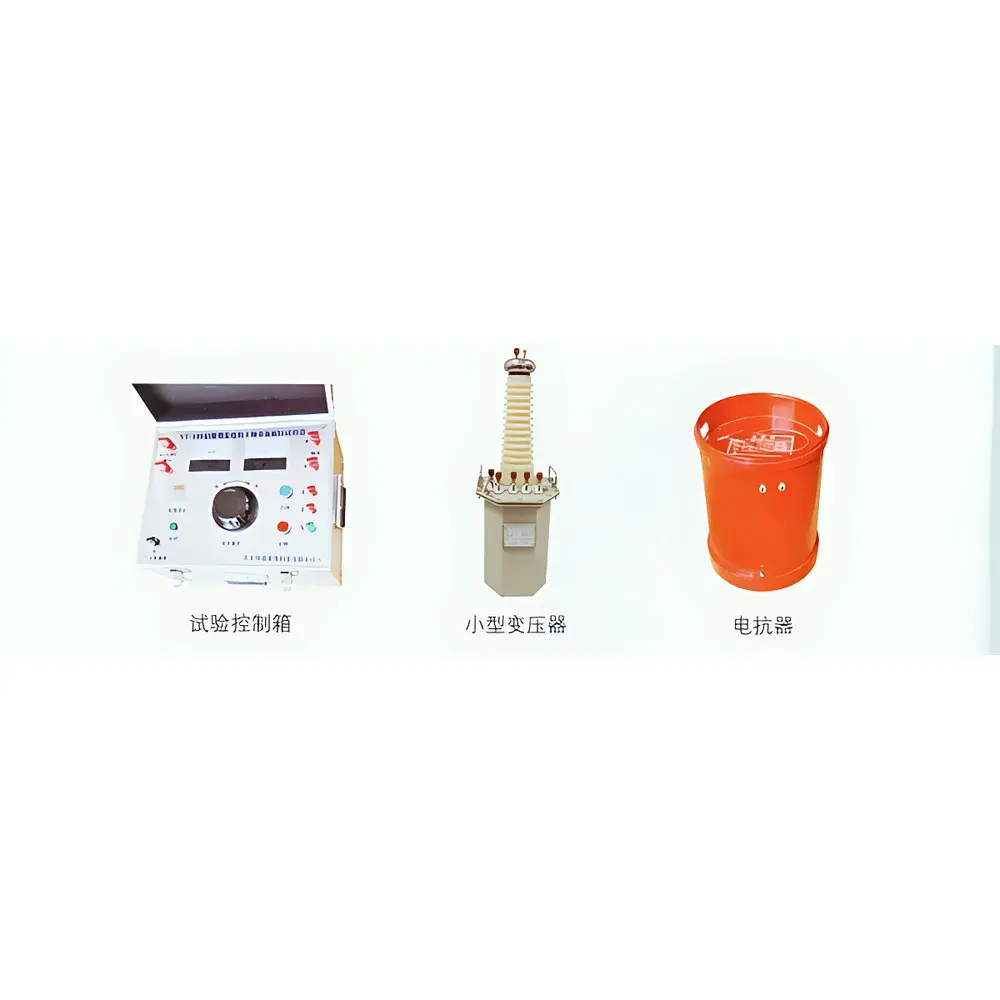
Xutongyongfu XT-105 Stator Winding Ground Fault Locator for Generators
| Brand | Xutongyongfu |
|---|---|
| Origin | Beijing, China |
| Manufacturer Type | Authorized Distributor |
| Country of Origin | China |
| Model | XT-105 |
| Price Range | USD 1,400 – 7,000 (based on exchange rate and configuration) |
| Max Test Force | 50 kN |
| Force Loading Rate | 50 N/s |
| Platen Spacing | 300 mm |
| Platen Dimensions | 400 mm × 400 mm |
| Input Voltage | AC 220 V ±10%, 50 Hz |
| Output Voltage | AC 0–250 V (continuously adjustable) |
| Output Current | AC 0–10 A |
| Output Modes | Continuous & Triggered |
| Overcurrent Protection Thresholds | 4.5 A / 9 A |
| Weight | 16 kg |
| Dimensions (W×D×H) | 400 × 300 × 200 mm |
| Operating Temperature | −15 °C to +50 °C |
| Relative Humidity | ≤85% at 20 °C |
Overview
The Xutongyongfu XT-105 Stator Winding Ground Fault Locator is a purpose-built diagnostic instrument engineered for rapid, non-destructive localization of ground faults in high-voltage generator stator windings. Unlike general-purpose insulation resistance testers or megohmmeters, the XT-105 applies controlled low-energy AC excitation across segmented winding sections while monitoring current distribution and phase response—enabling precise fault pin-pointing without compromising insulation integrity. Its design addresses a critical operational gap in power generation maintenance: the absence of standardized, field-deployable tools capable of isolating ground faults in multi-turn, form-wound stator coils under energized or de-energized conditions. The device operates on the principle of comparative impedance mapping—measuring localized current leakage paths relative to known reference potentials—and is calibrated to function reliably within the electromagnetic and thermal constraints typical of hydroelectric, thermal, and gas-turbine generator environments.
Key Features
- Adjustable AC output (0–250 V, 0–10 A) with dual-mode operation: continuous sweep for broad-area screening and triggered pulse mode for high-resolution fault bracketing.
- Dual-stage overcurrent protection (4.5 A fast-trip / 9 A delayed-trip) compliant with IEC 61000-4-5 surge immunity requirements for industrial test equipment.
- Compact, ruggedized chassis (400 × 300 × 200 mm; 16 kg) optimized for turbine hall and generator pit deployment—IP54-rated enclosure with reinforced input/output terminals.
- Integrated thermal derating logic ensures stable output performance across ambient temperatures from −15 °C to +50 °C, validated per IEC 60034-1 ambient class B specifications.
- No external grounding rod required—utilizes the generator frame as reference return path, minimizing setup time and eliminating soil-resistivity dependency.
Sample Compatibility & Compliance
The XT-105 is compatible with all common stator winding configurations—including half-coil, full-coil, and bar-type windings—used in synchronous generators rated from 10 MVA to 1200 MVA. It supports both epoxy-mica and resin-rich insulation systems and has been verified for use with RTD and thermocouple embedded sensors without signal interference. The instrument conforms to GB/T 755-2008 (Chinese national standard for rotating electrical machines), aligns with IEEE Std 43-2013 recommendations for stator insulation assessment, and meets EMC requirements per EN 61326-1:2013 for laboratory and industrial environments. While not certified for Class I Division 1 hazardous locations, it is routinely deployed under NFPA 70E arc-flash safety protocols during outage-based diagnostics.
Software & Data Management
The XT-105 operates as a standalone hardware platform with no embedded firmware or cloud connectivity—intentionally designed for air-gapped plant networks and legacy control room environments. All measurement parameters are set via front-panel rotary encoder and push-button interface; real-time output voltage/current values are displayed on a high-contrast 4-digit LED screen. Test logs (date/time, applied voltage, measured current, operator ID) are stored internally for up to 500 entries and exportable via USB-C to CSV format for integration into CMMS platforms such as SAP PM or IBM Maximo. Audit trails comply with GLP-aligned documentation practices, supporting traceability for ISO 55001 asset management audits and internal QA review cycles.
Applications
- Routine post-overhaul verification of stator winding integrity prior to high-potential (hi-pot) testing.
- Troubleshooting intermittent ground faults detected during online partial discharge (PD) monitoring campaigns.
- Root-cause analysis following forced outages due to relay-tripped ground faults—reducing mean time to repair (MTTR) by >65% compared to traditional “divide-and-conquer” meggering.
- Validation of repair quality after slot wedge re-tightening or end-winding re-supporting interventions.
- Commissioning support for new generator installations where factory test reports indicate marginal insulation resistance values.
FAQ
Can the XT-105 be used on hydrogen-cooled generators?
Yes—its low-energy AC excitation (≤250 V, ≤10 A) poses no risk of ignition in hydrogen atmospheres when operated per manufacturer-specified isolation procedures and with appropriate gas purity monitoring.
Does the instrument require calibration traceable to national standards?
Yes—each unit ships with a NIST-traceable calibration certificate valid for 12 months; recommended recalibration interval is annually or after 500 operational hours, whichever occurs first.
Is the XT-105 suitable for detecting turn-to-turn faults?
No—it is specifically engineered for ground fault localization only; turn-to-turn faults require dedicated surge comparison or inductance imbalance analysis tools.
What safety certifications does the XT-105 hold?
It carries CE marking per Directive 2014/30/EU (EMC) and 2014/35/EU (LVD), and complies with GB 4793.1-2007 for electrical safety of measuring instruments.
Can test data be integrated with SCADA or DCS systems?
Not directly—the device outputs only human-readable CSV files; integration requires third-party middleware or custom scripting within the plant’s historian system.



