
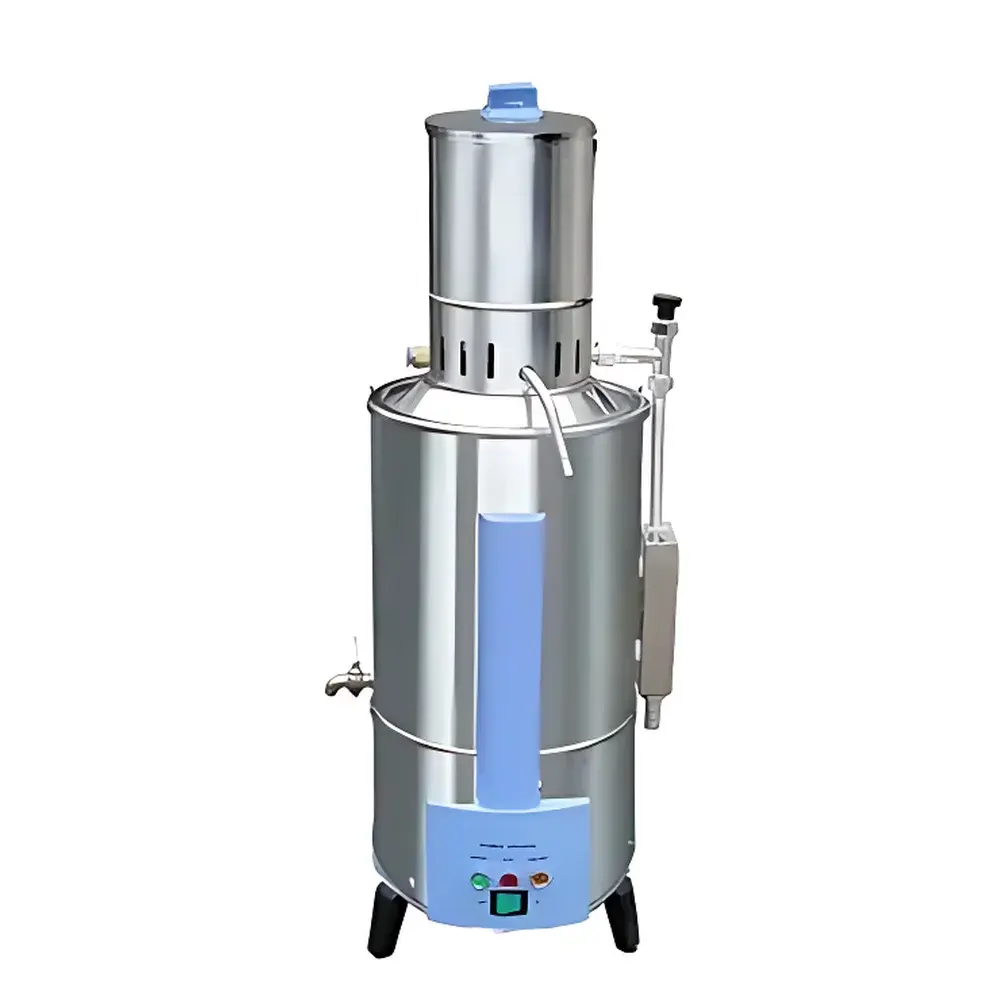
YA.ZDI Series Stainless Steel Electric Distillation Apparatus (Models YA.ZDI-5, YA.ZDI-10, YA.ZDI-20)
| Origin | Shanghai, China |
|---|---|
| Construction Material | 304 Stainless Steel |
| Power Supply | 220 V / 380 V AC |
| Output Capacity | 5 L/h, 10 L/h, 20 L/h |
| Heating Power | 4.5 kW, 7.5 kW, 15 kW |
| Dimensions (L×W×H) | 830×360×370 mm (YA.ZDI-5/YA.ZDI-10), 900×360×370 mm (YA.ZDI-20) |
| Net Weight | 9–10 kg |
| Safety Features | Automatic dry-run protection, float-controlled auto-refill system, thermal-insulated control panel, dual-direction pressure regulation, visual status indicator lights |
| Compliance | Designed for GLP-compliant laboratory environments |
Overview
The YA.ZDI Series Stainless Steel Electric Distillation Apparatus is a benchtop or floor-standing laboratory-grade distillation system engineered for the reliable, continuous production of purified water via thermal phase separation. Based on the principle of single-stage vaporization and condensation, the apparatus heats feed water to boiling, captures steam in a polished stainless steel condenser coil, and cools it back to liquid phase using ambient or optional recirculating coolant—yielding water with significantly reduced ionic, organic, and particulate contaminants. Designed for operation in regulated research, pharmaceutical QC, and clinical laboratory settings, the YA.ZDI series delivers consistent output meeting the specifications for Purified Water as defined in USP , EP 2.2.43, and ISO 3696 Grade 3. Its all-304 stainless steel construction ensures chemical inertness, resistance to chloride-induced pitting, and long-term structural integrity under repeated thermal cycling.
Key Features
- Full 304 stainless steel fabrication—including evaporator chamber, condenser coil, collection vessel, and external housing—for corrosion resistance and cleanability.
- Automatic dry-run protection circuitry that deactivates heating elements when water level falls below operational threshold, preventing heater burnout and ensuring equipment longevity.
- Float-actuated auto-refill system maintaining optimal water level in the boiler without manual intervention during extended runs.
- Thermally insulated control panel with integrated safety shield to minimize surface temperature exposure and reduce operator risk.
- Internally mounted分流-style (split-flow) vapor distribution structure promoting uniform steam generation and minimizing carryover of entrained droplets.
- Dual-direction adjustable pressure relief valve enabling fine-tuned control over internal vapor pressure and condensation kinetics.
- LED status indicators for power-on, heating active, and low-water alert—providing immediate visual feedback on operational state.
Sample Compatibility & Compliance
The YA.ZDI apparatus accepts municipal tap water, softened water, or pre-filtered feed water (e.g., from sediment + carbon + softener pretreatment) as input. It is not intended for direct use with seawater, high-TDS industrial effluent, or chemically spiked process streams without upstream conditioning. Output water quality is validated against pharmacopeial standards for Purified Water, including conductivity ≤ 5.1 µS/cm at 25 °C, total organic carbon (TOC) < 500 ppb, and bacterial endotoxin levels below detection limits when operated per validated protocols. The unit supports GLP documentation workflows through its deterministic operational logic and repeatable output profile. While not inherently 21 CFR Part 11 compliant (as it lacks electronic audit trail functionality), it may be integrated into Part 11–compliant environments when paired with external data loggers and procedural SOPs.
Software & Data Management
The YA.ZDI Series operates via hardwired electromechanical controls with no embedded firmware or digital interface. All operational parameters—including voltage, current draw, and runtime—are monitored externally using calibrated multimeters or facility-installed power meters. For traceability in regulated labs, users are advised to record start/stop times, feed water source lot numbers, and output volume in bound logbooks or validated electronic lab notebooks (ELN). Optional analog chart recorders or USB-enabled temperature/data loggers (e.g., Omega OM-DAQPRO-5300) can be connected to the boiler thermocouple output (if equipped) to generate time-stamped thermal profiles supporting validation reports.
Applications
- Preparation of purified water for reagent preparation, buffer formulation, and instrument rinsing in analytical chemistry laboratories.
- Supply of feed water for ultra-pure water systems (e.g., Type I water generators) requiring low-ionic-input source water.
- Production of secondary distilled water for trace-metal analysis, HPLC mobile phase preparation, and cell culture media sterilization support.
- On-site purified water generation in hospital central sterile supply departments (CSSD) and pharmacy compounding units where RO-only water fails conductivity specifications.
- Teaching laboratories demonstrating phase-change purification principles, heat transfer efficiency, and thermal safety interlocks.
FAQ
What feed water quality is recommended for optimal performance and service life?
Feed water should have hardness < 100 ppm CaCO₃ equivalent and free chlorine < 0.5 mg/L. Pre-filtration through activated carbon and softening is strongly advised to minimize scale formation and extend maintenance intervals.
Can the YA.ZDI series produce water suitable for HPLC or cell culture applications?
No—the YA.ZDI generates Purified Water (USP ), not Water for Injection (WFI) or Ultra-Pure Water (Type I). For HPLC or mammalian cell culture, further polishing via deionization, UV oxidation, and 0.22 µm filtration is required.
Is validation support documentation available from the manufacturer?
The unit ships with a basic technical specification sheet and electrical safety certification (CE-marked equivalents per GB 4793.1). Full IQ/OQ/PQ protocol templates and calibration certificates must be developed internally or by third-party validation specialists.
How often does descaling maintenance need to be performed?
Under typical municipal feed conditions, descaling every 3–6 months is recommended. Frequency increases proportionally with feed water hardness and daily operating hours.
Are spare parts such as heating elements and float valves available separately?
Yes—standardized 304 SS heating assemblies, silicone-sealed float switches, and pressure relief valves are stocked and supplied with part numbers traceable to OEM specifications.



