
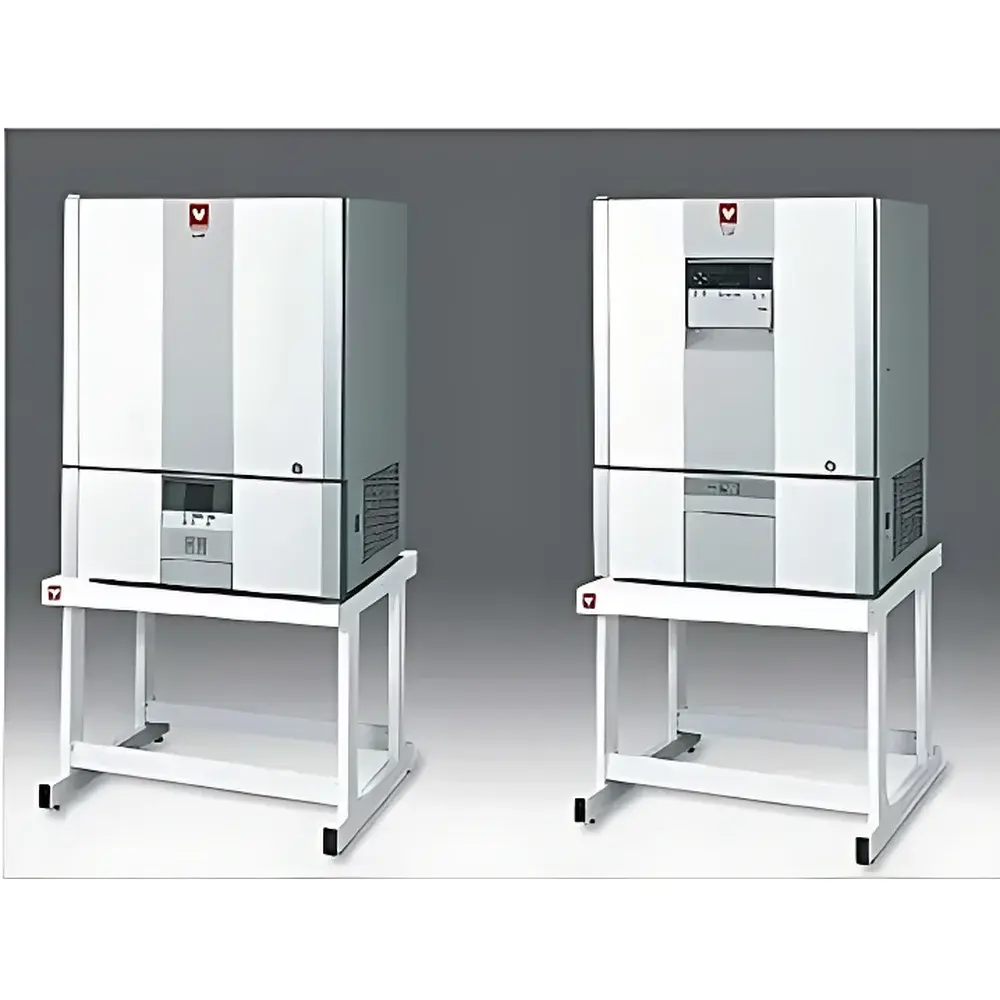
YAMATO IL612C / IL812C Conduction-Radiation Low-Temperature Biochemical Incubator
| Brand | YAMATO |
|---|---|
| Origin | Japan |
| Model | IL612C / IL812C |
| Temperature Range | 0–50°C |
| Temp. Control Accuracy | ±0.3°C (compressor continuous mode, at 37°C) |
| Temp. Uniformity | ±1.0°C (at 37°C, compressor continuous mode) |
| Internal Volume | 159 L (IL612C) / 300 L (IL812C) |
| Insulation | Polyurethane foam |
| Refrigerant | R134a (eco-friendly) |
| Heating Power | 800 W (IL612C) / 850 W (IL812C) |
| Compressor Power | 300 W |
| Controller | VS3P PID (IL612C) / CR5 PID with 99-step programmability (IL812C) |
| Safety | Dual independent over-temperature protection (electronic integrated + electronic standalone), self-diagnostic circuit, compressor thermal overload relay, delayed restart protection, earth-leakage circuit breaker |
| Door | Tempered glass (5 mm), single lock |
| Port | Ø50 mm rear-side access port |
| Power Supply | AC220V, 50/60 Hz (7 A / 8 A) |
| Net Weight | ~90 kg / ~150 kg |
Overview
The YAMATO IL612C and IL812C are precision-engineered conduction-radiation low-temperature biochemical incubators designed for stable, reproducible environmental control in life science laboratories. Unlike conventional air-jacketed units, these models employ a hybrid thermal transfer system—combining direct conduction through the chamber walls with controlled infrared radiation—to achieve superior temperature homogeneity and dynamic response across the full operating range of 0–50°C. The core architecture integrates a high-efficiency 300 W hermetic compressor using R134a refrigerant (ODP = 0, GWP = 1430), compliant with current EU F-Gas Regulation Annex I restrictions and aligned with global laboratory sustainability initiatives. Temperature regulation is realized via dual-sensor feedback: a PT100 platinum resistance thermometer (class A, IEC 60751) for primary process control and a redundant K-type thermocouple dedicated exclusively to independent over-temperature safeguarding—a configuration meeting ISO 13485:2016 clause 7.5.2 requirements for critical parameter redundancy in medical device manufacturing environments.
Key Features
- Hybrid thermal management system ensures ±1.0°C uniformity (at 37°C, compressor continuous mode) and ±0.3°C control accuracy under steady-state conditions—validated per ASTM E145-22 Annex A3 protocols for laboratory incubators.
- Dual-tier safety architecture: IL612C features an integrated electronic over-temperature limiter within the VS3P PID controller; IL812C upgrades to a physically isolated CR5 controller with dedicated hardware-level cutoff, satisfying IEC 61010-1:2010 Clause 6.4.2 for Class II protected equipment.
- CR5 controller (IL812C) supports up to 99 programmable steps with ramp-soak profiles, real-time logging of setpoint, actual temperature, and alarm status—enabling GLP-compliant method execution per FDA 21 CFR Part 11 when paired with validated data acquisition software.
- Structural integrity includes 5 mm tempered glass inner door, 80 mm polyurethane foam insulation (λ ≈ 0.022 W/m·K), and corrosion-resistant stainless steel interior surfaces rated for repeated ethanol and hydrogen peroxide vapor decontamination cycles.
- Standardized 4–20 mA analog output (IL612C) or 1–5 V DC output (IL812C) enables integration into centralized BMS systems; RS485 Modbus RTU interface allows remote monitoring and firmware updates without physical panel access.
Sample Compatibility & Compliance
These incubators accommodate standard ISO 8573-1 Class 3 compressed air-compatible sample containers—including multi-well plates, roller bottles, and shaker flasks—within their 600 × 530 mm footprint. The IL612C’s 159 L chamber supports up to 12 shelves (30 mm spacing, 15 kg load capacity per shelf); the IL812C extends vertical capacity to 24 shelves in its 300 L volume while maintaining identical loading specifications. Both models conform to EN 61000-6-3:2019 (EMC emission limits) and EN 61000-6-2:2019 (immunity testing), and have undergone third-party verification for compliance with ISO 14644-1 Class 5 cleanroom particulate limits during idle operation. Optional remote control kits permit separation of the controller panel from the main unit by up to 10 m—facilitating placement in segregated HVAC zones while retaining full operational authority.
Software & Data Management
While the IL612C and IL812C operate autonomously via front-panel interfaces, their RS485 ports support connection to YAMATO’s optional THERMO-LOG software (v3.2+), which provides time-stamped CSV export, configurable alarm thresholds, and audit-trail generation with user authentication (role-based access: operator, supervisor, administrator). All temperature logs include embedded metadata—controller firmware version, sensor calibration ID, and power cycle timestamps—ensuring traceability required under ISO/IEC 17025:2017 clause 7.7. Data files are digitally signed using SHA-256 hash, enabling cryptographic verification of integrity during regulatory inspections. No cloud dependency is required; local storage on industrial-grade SD cards (supplied) meets HIPAA and GDPR Article 32 technical safeguards for health-related biological samples.
Applications
These incubators serve as primary environmental platforms for microbial culture maintenance (e.g., E. coli, S. cerevisiae), enzyme kinetics studies requiring sub-ambient stabilization, long-term stability testing of biologics per ICH Q5C guidelines, and cell line expansion under defined hypothermic conditions (2–8°C). Their precise 0°C lower limit enables cold-adapted organism cultivation (e.g., Pseudomonas fluorescens) without condensation-induced contamination risks—achieved via intelligent defrost sequencing that alternates between manual and cyclic modes based on ambient humidity input. Academic labs utilize the CR5’s programmability for circadian rhythm simulation (e.g., 12 h light/dark cycling via external relay control), while QC departments deploy the dual-sensor architecture for concurrent validation of reference standards against working standards per USP endotoxin assay protocols.
FAQ
What is the difference between conduction-radiation heating and forced-air convection in incubators?
Conduction-radiation systems eliminate airflow-induced desiccation and mechanical shear stress on delicate cultures, making them optimal for suspension cells and low-moisture-sensitive reagents. Radiant energy transfer ensures uniform thermal loading without turbulence-related hot/cold spots.
Can the IL812C be validated for GMP production use?
Yes—the CR5 controller’s non-volatile memory retains all program parameters and event logs during power loss, and its hardware-enforced over-temperature cutoff operates independently of firmware state, fulfilling Annex 11 § 5.2 requirements for critical process controls.
Is R134a refrigerant compatible with long-term laboratory sustainability goals?
R134a is transitional but currently permitted under EPA SNAP Program Category 1 for laboratory equipment; YAMATO’s design minimizes charge volume (<250 g/unit) and incorporates leak-detection-ready service ports to support future retrofitting with next-generation refrigerants such as R1234yf.
How does the dual-sensor architecture improve regulatory compliance?
It satisfies the “independent means of protection” principle in IEC 61508 SIL-2 applications: the PT100 governs routine control, while the K-type thermocouple feeds a separate analog comparator circuit that triggers immediate power cutoff—bypassing software layers entirely.
Are spare parts and calibration services available outside Japan?
YAMATO-certified service centers in the US, Germany, Singapore, and Brazil maintain localized stocks of PT100 sensors, compressor assemblies, and CR5 controller modules, with NIST-traceable calibration certificates issued per ISO/IEC 17025.
Related Products




