
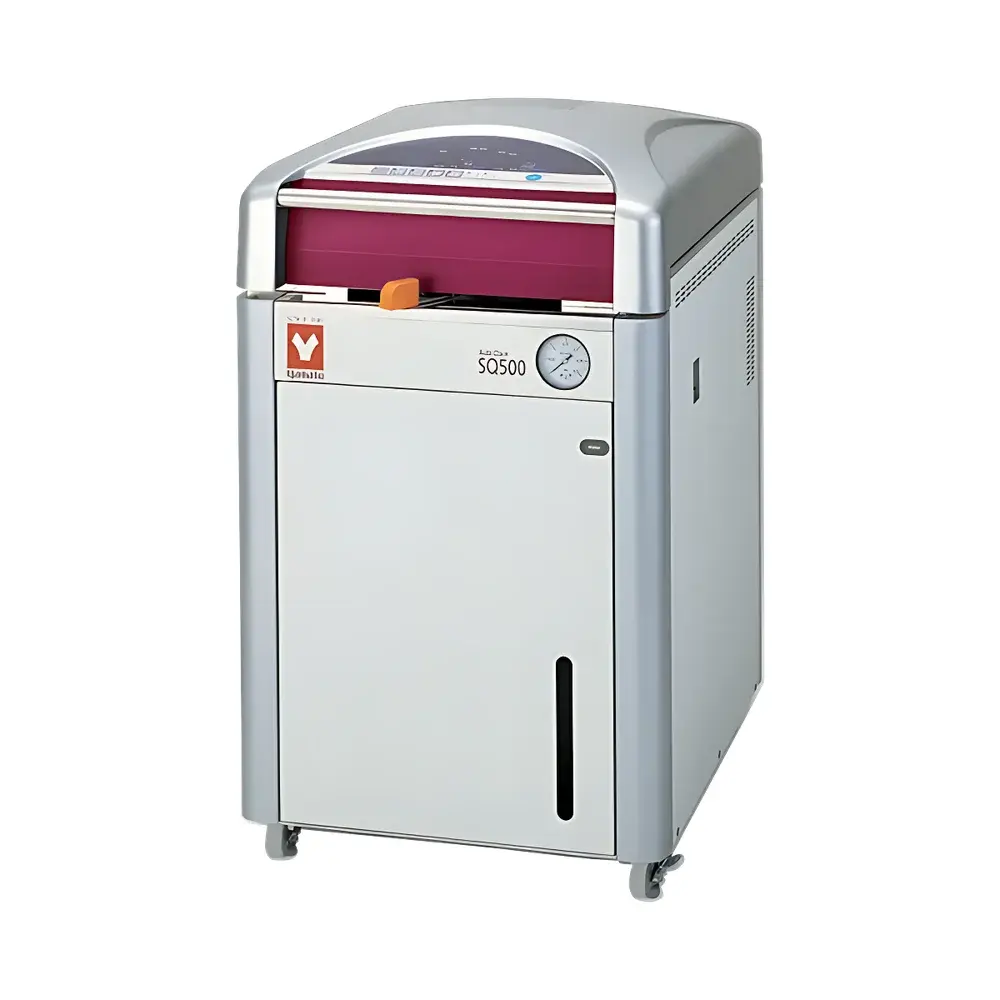
Yamato SN/SQ Series Vertical Steam Sterilizer
| Brand | Yamato |
|---|---|
| Model | SN210C / SN310C / SN510C / SQ510C / SQ810C |
| Type | Benchtop Vertical Autoclave |
| Max Temperature | 140 °C |
| Max Pressure | 4 bar (g) |
| Chamber Dimensions | 500 × 1000 mm (D × H) |
| External Dimensions | 730 × 850 × 1300 mm (W × D × H) |
| Chamber Volume | 200 L |
| Power Supply | AC 100–120 V or 200–240 V, 50/60 Hz |
| Cooling Fan | Standard Integrated |
| Safety Locks | Multi-stage pressure-actuated lid interlock system |
| Compliance | Designed to meet ISO 17665-1 (Moist Heat Sterilization), EN 285, and JIS T 0601-1 requirements for laboratory steam sterilizers |
Overview
The Yamato SN/SQ Series Vertical Steam Sterilizer is a benchtop-class, microprocessor-controlled autoclave engineered for precise, repeatable moist-heat sterilization in research laboratories, quality control facilities, and clinical support environments. Operating on the principle of saturated steam under controlled pressure, it achieves microbial inactivation—including spores—by exposing materials to defined temperature–time profiles at elevated pressures. The system complies with internationally recognized sterilization validation frameworks, including ISO 17665-1 (Sterilization of health care products — Moist heat — Part 1: Requirements for the development, validation and routine control of a sterilization process for medical devices) and EN 285 (Large steam sterilizers). Its vertical orientation optimizes floor space while maintaining full accessibility to the 200 L chamber—particularly in the low-profile SQ models, which reduce loading/unloading height without compromising internal volume or thermal uniformity.
Key Features
- Microprocessor-based control system with programmable cycle parameters—including temperature (up to 140 °C), hold time, exhaust rate, and cooling fan activation timing—enabling customization for both solid instrument and liquid media sterilization protocols.
- Dual-mode operation logic: Distinct preconfigured cycles for instruments (rapid air removal and fast cooldown) and liquids (delayed exhaust and controlled depressurization) to prevent boil-over and container rupture.
- Integrated axial cooling fan significantly reduces post-cycle cooling time, improving throughput without compromising chamber integrity or condensate management.
- Multi-stage mechanical and electronic lid interlock system prevents accidental opening during pressurized operation; release is governed by real-time chamber temperature and pressure monitoring relative to the dynamically calculated saturation temperature threshold.
- Wide-input voltage compatibility (AC 100–120 V / 200–240 V, 50/60 Hz) ensures stable operation across global laboratory power infrastructures, including regions with fluctuating grid conditions.
- Robust stainless-steel chamber (SUS304) with reinforced door sealing and dual redundant safety valves certified per ASME BPVC Section VIII and PED 2014/68/EU.
Sample Compatibility & Compliance
The SN/SQ series accommodates a broad range of sterilizable loads: surgical instruments, glassware, culture media (agar, broth), buffered saline solutions, and polymer-based labware. Chamber dimensions (500 mm diameter × 1000 mm height) allow vertical stacking of standard autoclave baskets and multi-tier trays. All sterilization cycles are designed to satisfy the minimum F0 values required by pharmacopoeial standards (e.g., USP , EP 5.1.1) when validated per ISO 13408-2. The system supports GLP/GMP-aligned documentation practices via optional RS-232/USB data export and audit-trail-capable software integration. Pressure gauges and safety valves undergo mandatory periodic metrological verification—gauges every 6 months, valves annually—as stipulated in national regulatory guidance (e.g., China NMPA Technical Guidance on Sterilizer Maintenance, JIS B 8225).
Software & Data Management
Embedded firmware provides non-volatile cycle memory storage (≥100 programs), real-time graphical display of chamber temperature and pressure, and automatic logging of critical event timestamps (start, sterilization phase entry, exhaust initiation, lid unlock). Optional PC interface enables CSV export of full cycle logs—including deviation alerts—for inclusion in validation reports. The system implements power-failure recovery: upon resumption of supply, it displays “bLAc” (blackout active) and “oUt” (out-of-cycle state), then executes a safe venting sequence before returning to standby—preserving data integrity and preventing uncontrolled pressure release. No proprietary cloud platform is required; all configuration and diagnostics remain local and auditable.
Applications
- Routine sterilization of reusable metal and silicone instruments in university core facilities and hospital central sterile supply departments (CSSD).
- Preparation of microbiological growth media, including heat-labile formulations requiring precise dwell-time control below 135 °C (e.g., protein denaturation studies or enzyme-inactivation protocols).
- Validation-grade sterilization for ISO 13485-certified medical device manufacturers performing bioburden reduction on non-implantable components.
- Research applications involving thermosensitive biological samples where steam penetration kinetics and condensate distribution must be reproducibly managed.
- Compliance-driven environments requiring traceable records for FDA 21 CFR Part 11, EU Annex 15, or WHO TRS 977 audit readiness.
FAQ
At what temperature does the lid safety interlock disengage?
The interlock releases only when chamber temperature falls below the dynamic saturation temperature threshold—calculated in real time based on measured pressure and ambient barometric conditions. Under standard atmospheric pressure (101.3 kPa), this threshold typically falls between 95 °C and 100 °C. The exact offset is system-specific and not disclosed for safety-critical firmware integrity.
What does “bLAc” and “oUt” on the display indicate?
This indicates activation of the blackout recovery function following an unintentional power interruption. The unit automatically initiates controlled venting, then enters standby mode. Press any key to resume normal display; verify cycle status and restart as needed after confirming operational continuity.
How do instrument and liquid sterilization cycles differ mechanically?
Liquid cycles delay main exhaust valve opening and cooling fan activation to minimize thermal shock and hydrostatic pressure differentials—preventing boil-over. Instrument cycles prioritize rapid air removal and faster cooldown, leveraging gravity-assisted steam penetration into lumened devices.
What should be done if Er.20 (“empty chamber heating”) appears and the lid remains locked?
Do not force the lid. Allow natural cooldown to ambient temperature (~20–25 °C), then power-cycle via circuit breaker. Confirm water level meets minimum fill line before reinitiating. Persistent recurrence warrants inspection of water-level sensor calibration or fill solenoid function.
Why won’t the lid open during initial commissioning?
The interlock requires stable AC power input. Ensure the unit is connected to a live outlet, the main circuit breaker is ON, and the front-panel power switch is engaged. Refer to Section 2 (“Pre-Operation Preparation”) of the user manual affixed to the lid interior.
Are drain bottles interchangeable across SN/SQ and SM series models?
No. SN/SQ-series drain bottles (P/N LT00014596) feature a distinct geometry and mounting interface versus SM-series units (P/N 7260000006). Substitution may compromise leak-tightness and condensate containment.



