
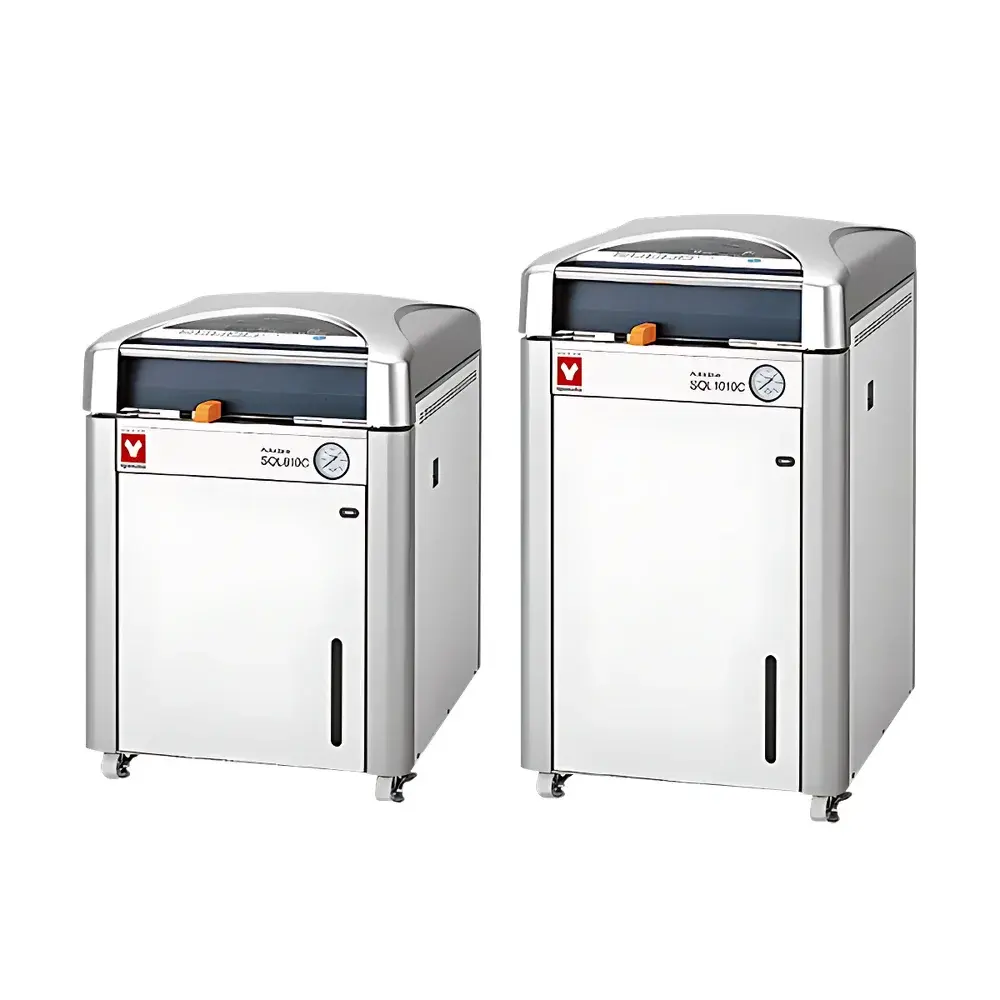
Yamato SQL810C Vertical Steam Sterilizer
| Brand | Yamato |
|---|---|
| Origin | Chongqing, China |
| Manufacturer Type | Authorized Distributor |
| Product Category | Domestic |
| Model | SQL810C |
| Instrument Type | Vertical |
| Maximum Temperature | 135 °C |
| Maximum Pressure | 0.212 MPa |
| Chamber Diameter × Height | Ø450 mm × 535 mm |
| External Dimensions (W×D×H) | 680 mm × 760 mm × 997 mm |
| Chamber Volume | 85 L |
| Cooling Fan | Standard Integrated |
| Safety Locks | Multi-stage Interlocked Lid Opening Protection |
| Control Interface | Front-mounted Touch Panel with Backlit LCD Display |
Overview
The Yamato SQL810C Vertical Steam Sterilizer is a CE-compliant, Class B vacuum-assisted steam sterilization system engineered for reproducible, traceable, and validation-ready operation in research laboratories, clinical diagnostics facilities, and pharmaceutical QC environments. It operates on the fundamental principle of saturated steam under controlled pressure and temperature to achieve microbial inactivation through protein denaturation and nucleic acid hydrolysis. With a certified maximum operating temperature of 135 °C at 0.212 MPa (≈2.12 bar gauge), the unit supports both standard gravity-displacement cycles (e.g., 121 °C/15–20 min) and extended high-temperature protocols required for prion-resistant material decontamination or thermal modification of proteins and enzymes. Its vertical orientation optimizes floor space utilization while enabling efficient chamber loading via top-hinged door access—critical for labs handling large volumes of glassware, media bottles, or autoclavable waste containers.
Key Features
- 85-liter stainless steel (SUS304) sterilization chamber with polished interior surface and radial steam distribution manifold for uniform heat penetration and minimal cold-spot formation.
- Integrated axial cooling fan system reduces post-cycle cooldown time by up to 40% compared to passive air-cooling models—enabling faster turnaround without compromising condensate management.
- Front-mounted, backlit LCD touchscreen interface with intuitive icon-based navigation; all critical parameters—including temperature, pressure, elapsed time, and phase status—are displayed in real time with dual-unit support (°C / °F, MPa / bar).
- Multi-stage interlocked lid safety system: mechanical overpressure release valve, redundant electronic pressure cutoff (0.23 MPa), thermal cutout at 145 °C, and motorized lid lock that remains engaged until chamber pressure drops below 0.02 MPa and internal temperature falls below 80 °C.
- Programmable cycle architecture supporting up to 10 user-defined protocols, each configurable with pre-vacuum pulses, heating ramp rate, sterilization hold duration, exhaust mode (fast/slow/dry), and post-cycle fan activation.
- Compliance-ready design: meets ISO 17665-1:2017 (sterilization of health care products — moist heat), EN 285:2015 (large steam sterilizers), and JIS T 0601-1 (Japanese medical device standards).
Sample Compatibility & Compliance
The SQL810C accommodates a broad range of load types—including wrapped/unwrapped instruments, porous loads (e.g., gauze, tubing), liquids (up to 3 L per container), agar-based culture media, and polymer-based labware—provided they are validated for steam sterilization. Chamber geometry (Ø450 mm × 535 mm) allows vertical stacking of standard 1-L Erlenmeyer flasks or nested Petri dish carriers. All cycles are fully documentable for GLP/GMP alignment: integrated RS-232 and optional USB data logging enable export of timestamped cycle reports compliant with FDA 21 CFR Part 11 requirements when paired with validated software. The system supports IQ/OQ documentation packages and is compatible with biological indicators (e.g., Geobacillus stearothermophilus spore strips) for routine performance verification per ISO 11140 series.
Software & Data Management
While the SQL810C operates autonomously via its embedded microcontroller, it supports external data capture through standardized serial communication. Cycle logs—including start/stop timestamps, temperature/pressure profiles, alarm events, and operator ID (if configured)—can be retrieved via ASCII-formatted text files. Optional PC-based software (Yamato SteriLog v3.2) provides graphical trend analysis, PDF report generation, digital signature capability, and audit trail functionality meeting ALCOA+ principles. All firmware updates are delivered via secure encrypted USB key to maintain integrity and prevent unauthorized modification.
Applications
- Routine sterilization of reusable surgical instruments, pipette tips, and glassware in university teaching labs and hospital central sterile supply departments (CSSD).
- Preparation and sterilization of microbiological growth media—including nutrient broths, selective agars, and antibiotic-supplemented formulations—without caramelization or pH drift.
- Thermal processing of recombinant proteins and enzyme solutions where controlled 135 °C exposure induces conformational stabilization or partial unfolding for structural studies.
- Decontamination of biohazardous waste streams in BSL-2 and BSL-3 containment laboratories prior to disposal or downstream processing.
- Validation support for sterilization process development in early-phase biopharmaceutical manufacturing, including mapping studies and worst-case load qualification.
FAQ
Does the SQL810C support vacuum-assisted air removal for porous load sterilization?
Yes—it performs up to three programmable pre-vacuum pulses to achieve ≥99% air removal, satisfying EN 285 requirements for Class B sterilizer classification.
Is the chamber volume verified per ISO 17665 Annex C?
Chamber volume is determined by water-fill calibration and documented in the factory acceptance test (FAT) report; users may perform periodic re-verification using calibrated volumetric flasks.
Can liquid cycles be validated for fill volume and container orientation?
Yes—cycle parameters must be qualified per load configuration; Yamato provides guidance documents for liquid sterilization validation per USP and ISO 17665-2.
What maintenance intervals are recommended for steam trap and safety valves?
Steam trap inspection every 6 months; pressure relief valve certification annually by an accredited third-party body per ASME BPVC Section VIII requirements.
Is remote monitoring supported via Ethernet or Wi-Fi?
No native Ethernet/Wi-Fi module is included; however, RS-232 output can be interfaced with industrial gateways for integration into building management systems (BMS) or centralized lab equipment dashboards.



