
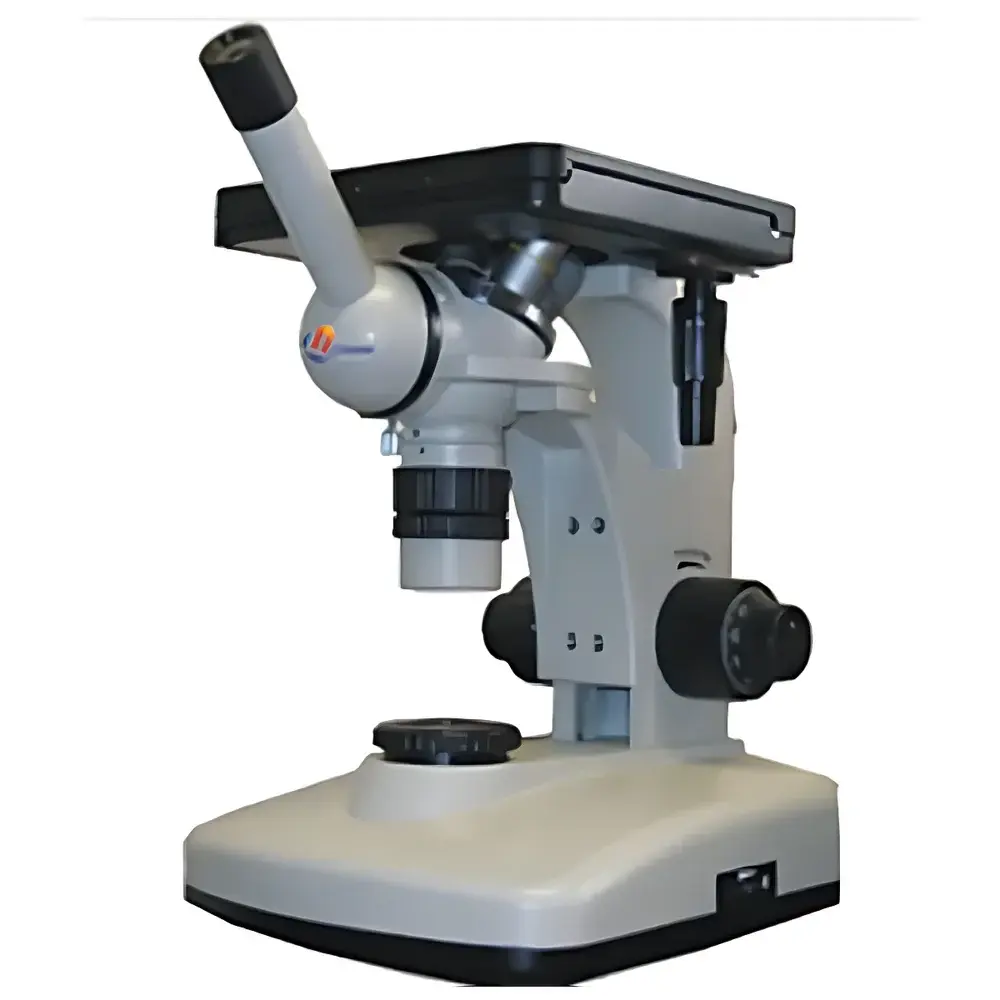
YANRUN 4XI Monocular Metallurgical Microscope
| Brand | YANRUN |
|---|---|
| Origin | Shanghai, China |
| Manufacturer Type | Direct Manufacturer |
| Product Type | Upright (Note: “Inverted” in source is inconsistent with standard 4XI configuration |
| Model | 4XI Monocular Metallurgical Microscope |
| Total Magnification | 100×–1000× or 125×–1250× |
| Eyepieces | 10× (Field Number 18) or 12.5× (Field Number 15) |
| Objectives | 10×, 40× (Plan Achromat), 100× Oil Immersion |
| Mechanical Tube Length | 160 mm |
| Working Distances | 7.31 mm, 0.65 mm, 0.37 mm |
| Numerical Apertures | 0.25, 0.65, 1.25 |
| Fine Focus Graduation | 0.002 mm |
| Coarse Focus Travel | 7 mm |
| Stage Dimensions | 75 × 50 mm (Mechanical Stage), 150 × 150 mm (Base Platform) |
| X–Y Translation Range | 30 × 30 mm |
| Illumination | 6 V / 12 W Halogen Lamp (Brightness Adjustable, AC 220 V / 50 Hz) |
| Filter Set | Yellow, Green, Blue, Ground Glass |
| Net Weight | 5 kg |
| Packing Dimensions | 360 × 246 × 350 mm |
Overview
The YANRUN 4XI Monocular Metallurgical Microscope is an upright, high-precision optical instrument engineered for reflected-light metallographic analysis of opaque specimens. Designed in strict compliance with the classical 160 mm mechanical tube length standard, it employs Köhler illumination principles and achromatic-plan objective optics to deliver high-fidelity contrast and minimal chromatic aberration across its full magnification range. Unlike transmitted-light biological microscopes, the 4XI utilizes vertical incident illumination—light directed onto the specimen surface via a built-in prism and condenser system—enabling high-resolution observation of polished and etched metallic samples without sectioning. Its rigid cast-aluminum frame, anti-vibration base, and precisely aligned optical path ensure long-term stability and measurement repeatability required for routine QC laboratories, metallurgical R&D facilities, and academic materials science teaching labs.
Key Features
- Upright optical configuration optimized for standard metallographic sample preparation (flat, polished, and etched surfaces)
- Three-tier objective turret with DIN-standard plan achromat objectives: 10× (NA 0.25, WD 7.31 mm), 40× (NA 0.65, WD 0.65 mm), and 100× oil immersion (NA 1.25, WD 0.37 mm)
- Interchangeable wide-field eyepieces: 10×/18 mm field number or 12.5×/15 mm field number—both equipped with adjustable diopter compensation
- Precision coaxial coarse/fine focusing mechanism with 7 mm total travel, 0.002 mm fine-focus graduation, and mechanical stop limiters to prevent objective–specimen contact
- Double-layer mechanical stage: 75 × 50 mm movable platform with vernier-scaled X–Y translation (30 × 30 mm range) mounted on a 150 × 150 mm reinforced base
- Adjustable halogen illumination system (6 V / 12 W) featuring continuous brightness control, centerable aperture and field diaphragms, and integrated filter holder for yellow, green, blue, and ground-glass filters
- Compliance-ready design: All optical components are factory-aligned and calibrated per ISO 10934-1 (Microscopy — Nomenclature of Microscope Components) and ASTM E3-22 (Standard Guide for Preparation of Metallographic Specimens)
Sample Compatibility & Compliance
The 4XI accommodates standard metallographic specimens up to 30 mm in diameter and 20 mm in thickness, secured using dual spring-loaded clamps. It supports both dry and oil-immersion observation modes—critical for resolving fine precipitate distributions, grain boundary networks, and inclusion morphology in ferrous and non-ferrous alloys. The microscope meets essential requirements for GLP-compliant documentation workflows when paired with external digital imaging systems (not included). Its optical train conforms to ISO/IEC 17025 traceability guidelines for calibration of magnification and focus scale, and its illumination uniformity satisfies ASTM E7-23 criteria for quantitative metallography. While not FDA 21 CFR Part 11–certified out-of-box (as it lacks embedded software), its analog operation ensures full auditability of manual observation records under GMP Annex 11 principles.
Software & Data Management
The YANRUN 4XI is a standalone optical instrument with no integrated digital camera or proprietary software. This analog architecture ensures zero firmware dependencies, maximum operational longevity, and full compatibility with third-party USB-C or HDMI-enabled CCD/CMOS cameras (e.g., AmScope MU series, OMAX models) and open-standard image analysis platforms including ImageJ (NIH), Olympus cellSens Lite, and Thermo Scientific™ HistoQuest™. Users may implement custom calibration workflows using NIST-traceable stage micrometers and ISO 10934–validated graticules. All mechanical adjustments—including focus position, stage coordinates, and illumination intensity—are manually recorded in laboratory notebooks or LIMS-integrated electronic logbooks, supporting full ALCOA+ (Attributable, Legible, Contemporaneous, Original, Accurate, Complete, Consistent, Enduring, Available) data integrity standards.
Applications
- Grain size evaluation per ASTM E112 and ISO 643 in carbon steels, aluminum alloys, titanium, and nickel-based superalloys
- Non-metallic inclusion rating (ASTM E45, ISO 4967) in rolled bars, forgings, and castings
- Heat treatment verification: martensite/austenite phase fraction analysis, decarburization depth measurement, and carburized case depth profiling
- Failure analysis: identification of fatigue striations, intergranular cracking, void coalescence, and weld HAZ microstructural transitions
- Coating thickness and adhesion assessment (e.g., thermal spray, electroplated layers) via cross-sectional reflectance contrast
- Quality control in foundries, forging plants, and aerospace component manufacturers performing in-house metallography per AMS 2300 and SAE AS4000 series specifications
FAQ
Is the 4XI an inverted or upright metallurgical microscope?
The YANRUN 4XI is an upright metallurgical microscope. Although some sources mislabel it as “inverted,” its optical layout—specimen placed on top of the stage with objectives below the viewing head—is structurally and functionally upright. True inverted configurations (e.g., GX53, Axio Vert.A1) position objectives above the stage—a design not present in the 4XI series.
Can I use this microscope for polarized light observation?
No—the 4XI does not include a polarization module (polarizer/analyzer pair) or strain-free objectives. For birefringence studies (e.g., oxide scale analysis, deformation twin identification), users must retrofit compatible aftermarket components meeting DIN 27800 tolerances.
What is the maximum usable magnification for dry objectives?
The 40× plan achromat objective (NA 0.65) delivers optimal resolution up to ~650× with a 10× eyepiece. Exceeding 1000× total magnification yields empty magnification without added structural detail, per Abbe diffraction limits.
Does the microscope support DIC or phase contrast?
No—DIC (Differential Interference Contrast) and phase contrast require specialized Nomarski prisms, annuli, and strain-free objectives. The 4XI’s optical path is not configured for these contrast-enhancement techniques.
How is calibration maintained over time?
Calibration relies on mechanical reproducibility: focus scale graduation (0.002 mm), stage verniers (0.1 mm), and certified stage micrometers. Annual verification against NIST-traceable standards is recommended per ISO/IEC 17025 Clause 6.5.2 for metrological traceability in accredited labs.




