
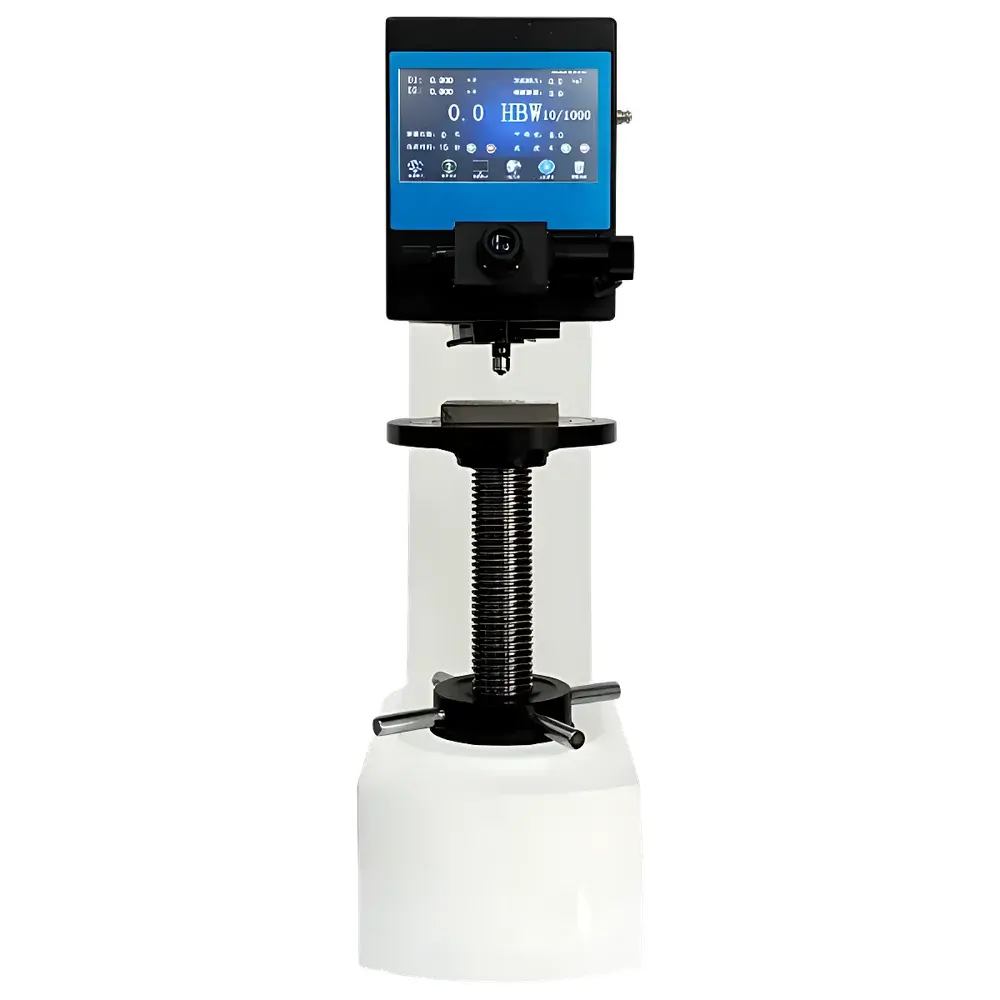
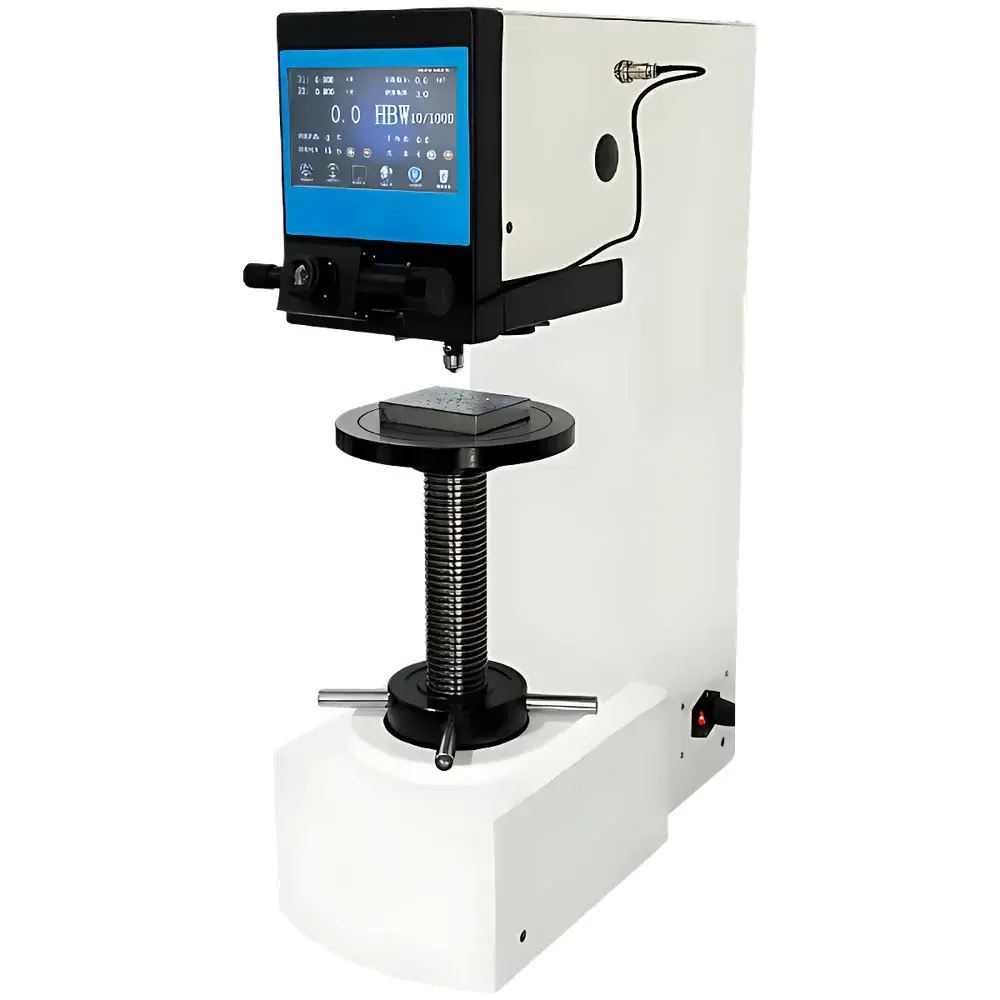
YANRUN HBS-D3000M7 Touchscreen Brinell Hardness Tester
| Brand | YANRUN |
|---|---|
| Origin | Shanghai, China |
| Manufacturer Type | Manufacturer |
| Product Origin | Domestic (China) |
| Model | HBS-D3000M7 |
| Instrument Type | Brinell Hardness Tester |
| Measurement Range | 8–650 HBW |
| Test Force Levels | 62.5 kgf (612.5 N) to 3000 kgf (29,400 N) |
| Indentation Scales | HBW 2.5/62.5 to HBW 10/3000 |
| Hardness Conversion | HRC, HV, HK, HRA, HRD, HR15N–HR45N, HR15T–HR45T, HRB, HRF |
| Load Application | Fully Automatic (Loading–Dwell–Unloading) |
| Dwell Time | 0–60 s (1 s increments) |
| Optical Magnification | 20× Digital Eyepiece |
| Eyepiece Resolution | 0.5 µm |
| Specimen Max Height | 230 mm |
| Distance from Indenter Center to Chamber Wall | 155 mm |
| Data Storage | Up to 30 Test Records |
| Standard Conformance | GB/T 231.1, GB/T 231.2, JJG 150 |
| Power Supply | AC 220 V / 50 Hz |
| Dimensions (L×W×H) | 535 × 185 × 750 mm |
| Net Weight | 116.5 kg |
| Gross Weight | 142.0 kg |
Overview
The YANRUN HBS-D3000M7 is a fully automated Brinell hardness tester engineered for precision, repeatability, and compliance with international mechanical testing standards. It operates on the fundamental principle of Brinell hardness measurement—applying a precisely controlled spherical indenter (tungsten carbide ball) under standardized load to produce a permanent indentation in metallic or other solid materials, followed by optical measurement of the indentation diameter to calculate HBW (Hardness Brinell, tungsten carbide ball). Designed for quality control laboratories, metallurgical R&D facilities, and third-party testing centers, the HBS-D3000M7 supports all standard Brinell test forces (62.5–3000 kgf) and ball diameters (2.5 mm, 5 mm, and 10 mm), enabling full coverage of the ISO 6506-1 and GB/T 231.1 compliant test matrix. Its robust cast-iron frame minimizes vibration-induced measurement error, while the closed-loop load system ensures high reproducibility across extended operational cycles.
Key Features
- Fully automatic loading, dwell, and unloading sequence with programmable dwell time (0–60 s, adjustable in 1-second increments)
- Integrated 20× digital eyepiece with 0.5 µm resolution and encoder-based automatic indentation diameter acquisition
- Multi-scale hardness conversion capability—including HRC, HV, HK, HRA, HRD, HR15N/30N/45N, HR15T/30T/45T, HRB, and HRF—calculated per ASTM E140 and ISO 18265
- High-resolution 7-inch capacitive touchscreen interface with intuitive navigation, real-time load curve display, and on-screen result validation
- Built-in thermal printer for immediate hard-copy reporting with timestamp, operator ID, test parameters, and raw measurement data
- Comprehensive specimen handling: accommodates specimens up to 230 mm in height; 155 mm clearance from indenter center to chamber interior wall
- Three interchangeable worktables (large φ197 mm, medium φ75 mm, V-groove φ75 mm) for flat, cylindrical, and irregular geometries
- Pre-calibrated tungsten carbide ball indenters (φ2.5 mm, φ5 mm, φ10 mm) supplied with traceable certification per JJG 150
Sample Compatibility & Compliance
The HBS-D3000M7 is validated for use with ferrous and non-ferrous metals, sintered alloys, castings, forgings, and heat-treated components. Its test force range (62.5–3000 kgf) and ball size combinations satisfy the dimensional requirements of ISO 6506-1 for material thickness ≥10× indentation depth and surface flatness ≤0.05 mm. All measurements comply with GB/T 231.1 (equivalent to ISO 6506-1) for test method, GB/T 231.2 (equivalent to ISO 6506-2) for verification of testing machines, and JJG 150 for metrological verification in China. The instrument’s mechanical design and calibration protocol support audit readiness for GLP and GMP environments, with full traceability to national standards via included certified reference blocks (three HBW values, each with certificate of calibration).
Software & Data Management
While the HBS-D3000M7 operates as a standalone instrument with embedded firmware, its data architecture supports regulatory-compliant recordkeeping. Each test record stores load magnitude, dwell time, ball diameter, measured indentation diameter (d₁, d₂), calculated HBW value, temperature-compensated result (if ambient sensor enabled), and operator identifier. Up to 30 test records are retained in non-volatile memory with timestamp and sequential indexing. Export is supported via thermal printout only—no USB or network interface is provided, aligning with environments requiring physical audit trails and minimal cybersecurity exposure. All internal calculations adhere to the HBW formula defined in ISO 6506-1: HBW = 0.102 × (2F) / [πD(D − √(D² − d²))], where F is applied force (N), D is ball diameter (mm), and d is mean indentation diameter (mm).
Applications
- Metallurgical QC in foundries and rolling mills: verification of annealed, normalized, quenched & tempered steels
- Supplier qualification testing for automotive and aerospace structural components
- Failure analysis labs assessing microstructural homogeneity and case depth consistency
- Academic research on alloy development, including aluminum, copper, titanium, and magnesium systems
- Third-party certification bodies performing accredited hardness testing per CNAS-CL01 (equivalent to ISO/IEC 17025)
- Heat treatment process validation where Brinell hardness serves as primary acceptance criterion per ASTM A370 or EN 10002-1
FAQ
What standards does the HBS-D3000M7 comply with?
It conforms to GB/T 231.1, GB/T 231.2, and JJG 150—Chinese national standards aligned with ISO 6506-1, ISO 6506-2, and ISO 6506-3.
Can the instrument measure non-metallic materials?
No—it is designed exclusively for metallic and sintered metallic materials per Brinell methodology; polymers, ceramics, or composites require alternative hardness scales (e.g., Rockwell superficial or Vickers microhardness).
Is remote data export or PC connectivity available?
No. Data output is limited to the built-in thermal printer; no USB, Ethernet, or Bluetooth interfaces are integrated.
How is calibration verified during routine operation?
Users perform daily verification using the three supplied certified Brinell reference blocks; annual third-party recalibration against national metrology standards is recommended.
What maintenance is required for long-term accuracy?
Regular cleaning of the indenter path and optical path, periodic verification of load cell linearity, and annual mechanical alignment check of the loading axis and specimen stage.



