
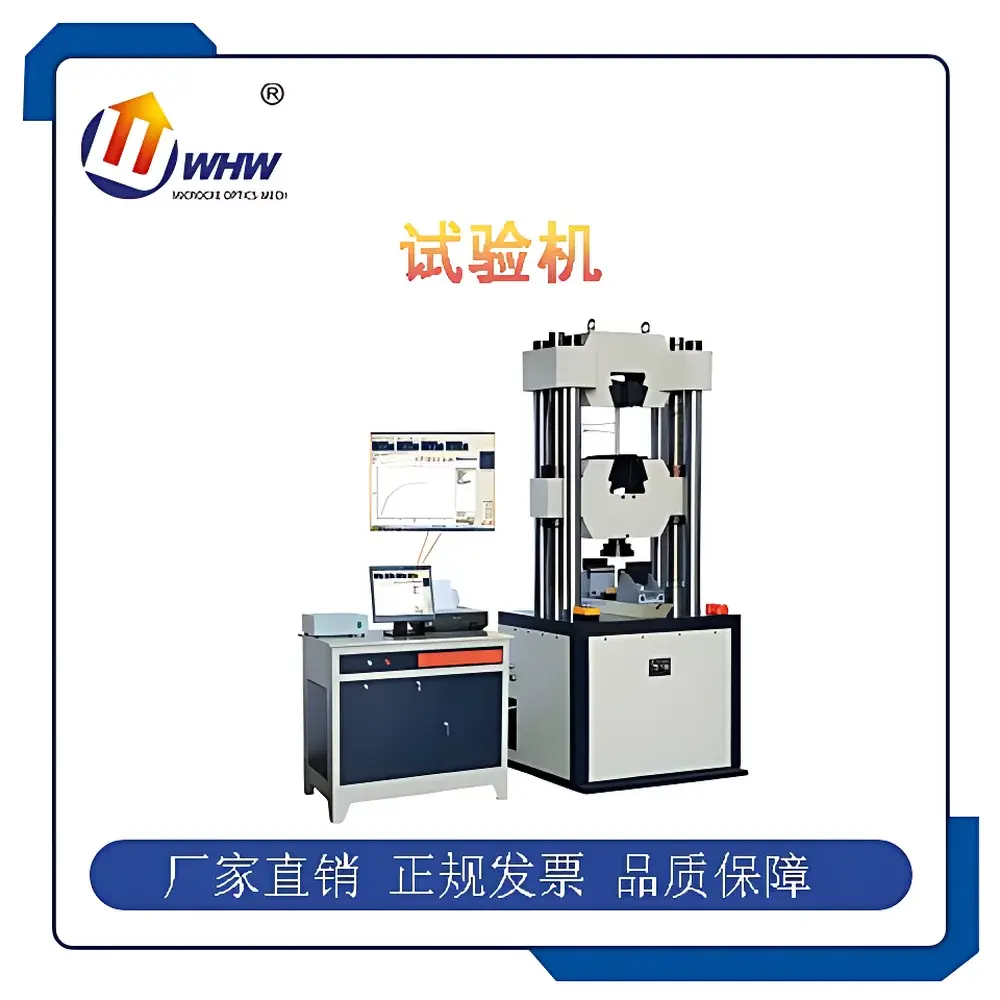
YANRUN MC009 Series Microcomputer-Controlled Electro-Hydraulic Servo Universal Testing Machine WAW-600C
| Brand | YANRUN |
|---|---|
| Origin | Shanghai, China |
| Manufacturer Type | Direct Manufacturer |
| Country of Origin | China |
| Model | MC009-WAW-600C |
| Instrument Type | Electro-Hydraulic Servo Testing Machine |
| Load Capacity Range | 12–600 kN |
| Load Accuracy | ±1% or ±0.5% FS |
| Test Force Resolution | 0.002 kN |
| Displacement Measurement Resolution | 0.01 mm |
| Deformation Measurement Accuracy | 0.005 mm |
| Control Modes | Constant Load / Constant Displacement / Constant Strain (0.4–100% FS) |
| Control Precision | ±1.0% of set value (<10% FS) |
| Tensile Space | 850 mm |
| Compression Space | 700 mm |
| Piston Stroke | 250 mm |
| Round Specimen Clamping Diameter | Φ13–Φ40 mm |
| Flat Specimen Clamping Thickness | 0–30 mm |
| Bending Span | 450 mm |
| Bending Roller Width | 140 mm |
| Bending Roller Diameter | Φ30 mm |
| Max Bending Deflection | 150 mm |
| Max Piston Speed | 50 mm/min |
| Clamping Method | Integrated Hydraulic Clamping |
| Host Dimensions (W×D×H) | 1100×780×2500 mm |
| Oil Source Dimensions (W×D×H) | 1100×700×1100 mm |
| Weight | 3050 kg |
Overview
The YANRUN MC009 Series Microcomputer-Controlled Electro-Hydraulic Servo Universal Testing Machine WAW-600C is a high-capacity, precision-engineered mechanical testing system designed for static mechanical property evaluation of metallic and non-metallic materials under tension, compression, bending, and shear loading conditions. Based on the fundamental principles of servo-controlled hydraulic actuation and closed-loop feedback regulation, the WAW-600C employs a four-column, bottom-mounted load frame architecture with an upper tensile zone and lower compression/bending workspace—enabling optimal specimen accessibility and thermal compatibility (e.g., integration with high-temperature furnaces). Its electro-hydraulic servo system delivers precise force and displacement control via a high-bandwidth servo valve, regulated by real-time digital signals from the embedded control unit. The system complies with international standard test methodologies including ISO 6892-1 (tensile testing of metallic materials), ASTM E4 (load verification), ASTM E8/E8M (tension testing), and ISO 15630-1 (reinforcing steels), supporting traceable calibration and audit-ready operation in GLP and ISO/IEC 17025 environments.
Key Features
- Four-column, bottom-actuated load frame with optimized stiffness-to-mass ratio for minimal deflection during high-load testing (up to 600 kN).
- Full-range, unsegmented force measurement with 1/500,000 A/D resolution and dual accuracy options (±0.5% or ±1% FS), meeting ISO 7500-1 Class 0.5 and Class 1 requirements.
- Integrated hydraulic clamping system with automatic pressure maintenance, ensuring consistent grip force across variable specimen geometries (round: Φ13–Φ40 mm; flat: 0–30 mm thickness).
- Three-zone adjustable test space: configurable vertical clearance (up to 850 mm tensile height) facilitates ancillary equipment integration—including environmental chambers, extensometers, and high-temperature furnaces.
- Dual-closed-loop control architecture managing test force, crosshead displacement, and axial strain simultaneously—enabling complex multi-step protocols (e.g., preload → hold → ramp → relaxation) per ASTM D695 and ISO 604.
- Comprehensive hardware safety interlocks: overload cutoff (>103% FS), upper/lower stroke limit detection, and emergency hydraulic pressure dump—fully compliant with ISO 12100 and EN 60204-1 machine safety directives.
Sample Compatibility & Compliance
The WAW-600C accommodates standardized and custom specimens per ISO, ASTM, GB/T, and JIS dimensional specifications. Its modular jaw design supports round bars, flat sheets, welded joints, castings, composites, and polymer rods. For regulatory compliance, the system supports 21 CFR Part 11–compliant electronic records when paired with validated software (audit trail, user authentication, electronic signatures). Calibration certificates are traceable to NIM (National Institute of Metrology, China) or equivalent national metrology institutes (NMIs), satisfying ISO/IEC 17025 Clause 6.5 and ASTM E74 requirements. Routine verification follows ISO 7500-1 procedures using certified reference load cells, with annual recalibration recommended for GMP/QA laboratories.
Software & Data Management
The embedded Windows-based control software provides real-time acquisition of force, displacement, and strain data at up to 100 Hz sampling rate. It supports automated test sequence programming—including cyclic loading, creep, stress relaxation, and fracture toughness pre-cracking routines. All raw data are stored in vendor-neutral ASCII or CSV formats, enabling direct import into MATLAB, Python (NumPy/Pandas), or third-party LIMS platforms. Built-in report generation complies with ISO 5893 and ASTM E139 formats, including stress–strain curves, modulus calculations (secant/tangent), yield point determination (0.2% offset), ultimate tensile strength, and elongation at break. Optional add-ons include DIC (Digital Image Correlation) interface support and API-based integration with MES/ERP systems.
Applications
This system serves quality assurance labs in steel manufacturing, aerospace component validation (e.g., fasteners, landing gear alloys), civil engineering (rebar, prestressed concrete), automotive R&D (crash-relevant structural parts), and academic materials science departments. Typical use cases include: tensile testing of high-strength low-alloy (HSLA) steels per ASTM A615; compressive strength evaluation of ultra-high-performance concrete (UHPC); three-point bending of fiber-reinforced polymer (FRP) laminates per ISO 14125; shear testing of adhesive bonds per ASTM D1002; and proof loading of forged turbine discs. Its robust mechanical architecture ensures long-term repeatability across >10,000 test cycles under industrial QA workflows.
FAQ
What standards does the WAW-600C comply with for force calibration?
It conforms to ISO 7500-1 Class 0.5 and Class 1, with factory calibration traceable to NIM-certified reference standards.
Can the system be integrated with external environmental chambers?
Yes—the 850 mm tensile space and open-frame geometry support chamber mounting with feedthroughs for thermocouples and LVDTs.
Is remote diagnostics and firmware update supported?
Yes, via secure Ethernet connection and authenticated web interface; updates follow IEC 62443-3-3 cybersecurity guidelines.
Does the software support automated pass/fail evaluation against specification limits?
Yes—customizable acceptance criteria can be defined per test method, triggering visual alerts and auto-flagging nonconforming results.
What maintenance intervals are recommended for hydraulic oil and filters?
Hydraulic oil replacement every 2,000 operating hours or biannually; high-pressure filter elements replaced every 1,000 hours or annually, whichever occurs first.



