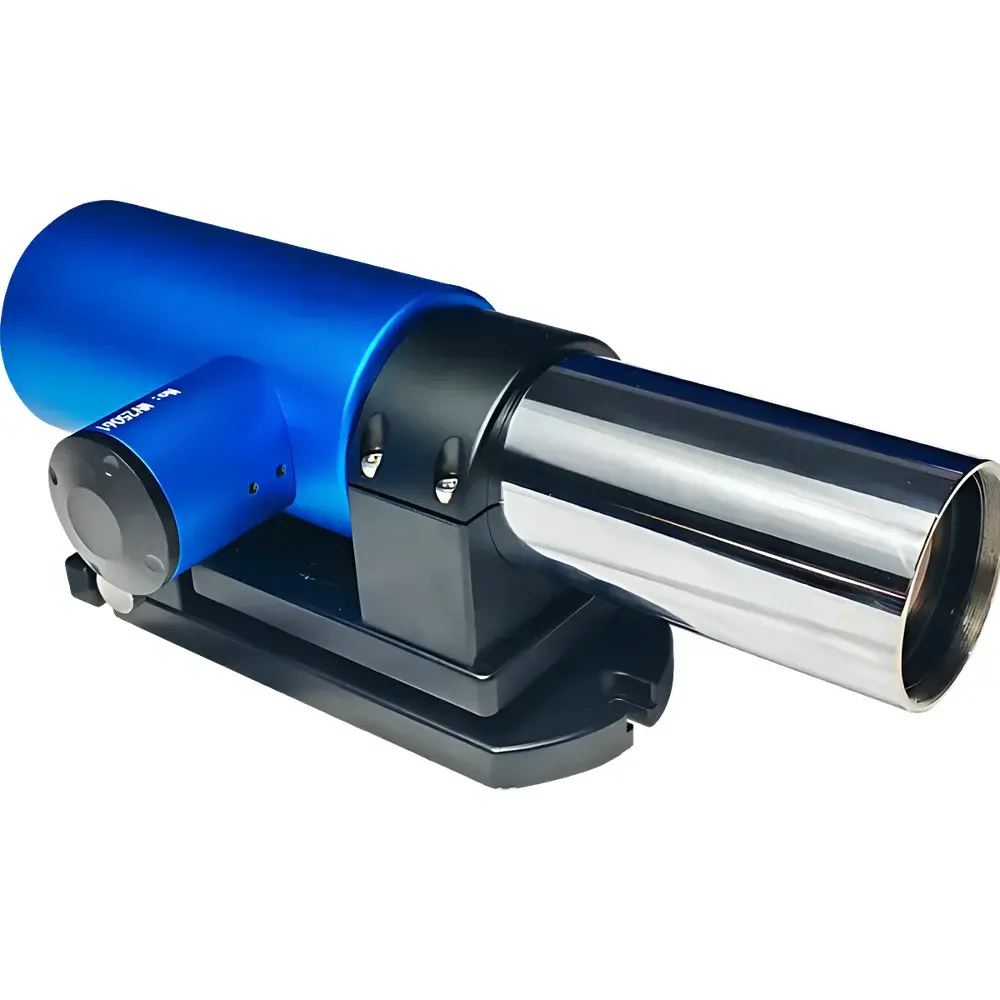
YANRUN MC030-MAT200/48/1 Auto-Collimator
| Brand | YANRUN |
|---|---|
| Origin | Shanghai, China |
| Manufacturer Type | Direct Manufacturer |
| Country of Origin | China |
| Model | MAT200/48/1 |
| Focal Length | 200 mm |
| Aperture Diameter | 48 mm |
| Light Source | Imported Semiconductor LED |
| Measurement Range | 0–20 m |
| Detector | High-Precision Photodetector |
| Angular Resolution | Adjustable to 0.1″ / 0.01″ / 0.001″ / 0.0001″ (arc seconds) |
| Field of View (X × Y) | 3200″ × 2400″ (arc seconds) |
| Accuracy (Center Region, ±1000″) | ±1″ (arc seconds) |
| Frequency Response | ≤30 Hz (typ.) |
| Interface | USB 2.0 |
| OS Compatibility | Windows 7 or later, 64-bit |
Overview
The YANRUN MC030-MAT200/48/1 Auto-Collimator is a high-precision optical angular metrology instrument engineered for non-contact measurement of minute angular deviations in reflective surfaces. It operates on the fundamental principle of optical autocollimation: a collimated beam—generated by imaging a reticle located at the focal plane of a high-stability 200 mm focal length objective lens—is directed toward a planar mirror under test. The reflected beam retraces its path and reimages the reticle onto a co-located photodetector array. Any angular tilt α of the mirror induces a linear displacement ΔS on the detector surface, proportional to 2α (in radians), enabling sub-arcsecond angular quantification through calibrated centroid detection algorithms. This first-order linear relationship forms the basis for traceable, repeatable angular metrology in alignment-critical environments such as precision optics assembly, telescope collimation, laser cavity alignment, and inertial sensor calibration.
Key Features
- Optically optimized 200 mm focal length objective with 48 mm clear aperture, delivering high light throughput and minimal wavefront distortion across the full field.
- Stable, low-noise imported semiconductor LED light source with spectral stability and >50,000-hour lifetime—eliminating thermal drift associated with halogen or arc lamps.
- Adjustable angular resolution down to 0.0001 arc seconds (≈48.5 nrad), selectable via software to match application-specific signal-to-noise requirements.
- Full-field photodetector array with 3200″ × 2400″ angular field of view—enabling rapid coarse alignment prior to fine measurement without mechanical repositioning.
- Real-time measurement capability up to 30 Hz (typ.), supporting dynamic tracking of slow mechanical drift or thermal-induced tilts in environmental testing chambers.
- USB 2.0 interface with deterministic latency and driver-level compatibility with Windows 7+ (64-bit), ensuring seamless integration into existing metrology workstations.
- Ruggedized aluminum alloy housing with passive thermal management, rated for continuous operation in laboratory environments (20–25 °C, <60% RH).
Sample Compatibility & Compliance
The MC030-MAT200/48/1 is designed for use with any optically flat, specularly reflective surface—typically polished metal mirrors, silicon wafers, fused silica substrates, or coated optical flats—provided surface roughness remains below λ/10 (RMS) at 633 nm. It complies with core dimensional metrology practices defined in ISO 21098:2021 (Optical instruments — Auto-collimators — Vocabulary and metrological characteristics) and supports traceability pathways aligned with ISO/IEC 17025:2017 requirements for calibration laboratories. While not certified to FDA 21 CFR Part 11, its data logging architecture—including timestamped raw detector frames, user metadata fields, and exportable ASCII/CSV datasets—facilitates GLP/GMP-aligned documentation when deployed in regulated manufacturing settings (e.g., aerospace component alignment or semiconductor lithography tool setup).
Software & Data Management
The instrument ships with YANRUN AutoAlign Suite v3.x—a native Windows application providing real-time angular vector display (X/Y components), statistical process monitoring (mean, σ, min/max over user-defined intervals), and automated report generation (PDF/HTML). All measurements are stored with embedded calibration coefficients, system configuration snapshots, and operator annotations. Raw photodetector frame data (16-bit grayscale TIFF) is accessible for third-party analysis in MATLAB, Python (NumPy/SciPy), or LabVIEW. Audit trail functionality records all parameter changes, measurement triggers, and user logins—meeting minimum ALCOA+ principles for data integrity in industrial QA/QC workflows.
Applications
- Precision alignment of optical benches, interferometer arms, and multi-axis motion stages.
- Calibration of tilt sensors, MEMS gyroscopes, and electro-optic deflectors.
- Verification of straightness and flatness in granite surface plates using reversal techniques per ASME B89.3.7.
- Monitoring angular stability of astronomical mounts and satellite attitude control reference systems.
- Characterizing thermal expansion-induced misalignment in high-power laser resonators.
- Supporting ISO 10110-7 compliance testing for optical component wedge and orientation tolerance verification.
FAQ
What is the maximum usable measurement distance, and does accuracy degrade with range?
The instrument maintains specified accuracy (±1″ within ±1000″ range) up to 20 meters when used with a high-quality front-surface mirror (R > 95%, λ/20 flatness). Beyond 15 m, beam divergence and air turbulence may require averaging over ≥10 frames to sustain repeatability; no intrinsic range-dependent bias is introduced by the optical design.
Can the system measure rotation about both X and Y axes simultaneously?
Yes—the photodetector captures the full 2D centroid displacement vector in real time, enabling independent calculation of pitch and yaw angles from a single reflection event.
Is factory recalibration required annually?
No scheduled recalibration is mandated, but YANRUN recommends annual verification against a NIST-traceable angle standard (e.g., precision polygon or calibrated wedge plate) to maintain ISO/IEC 17025 conformance in accredited labs.
Does the software support automated pass/fail decision logic based on user-defined tolerances?
Yes—AutoAlign Suite allows configurable tolerance bands per axis, with visual alerts, audible signals, and binary output via virtual COM port for integration with PLC-based production lines.
Is the detector sensitive to ambient light interference?
The system employs narrowband optical filtering centered on the LED emission wavelength (635 ±5 nm) and synchronous detection synchronized to the LED drive frequency, rendering it robust against typical laboratory ambient illumination (including fluorescent and LED room lighting).