
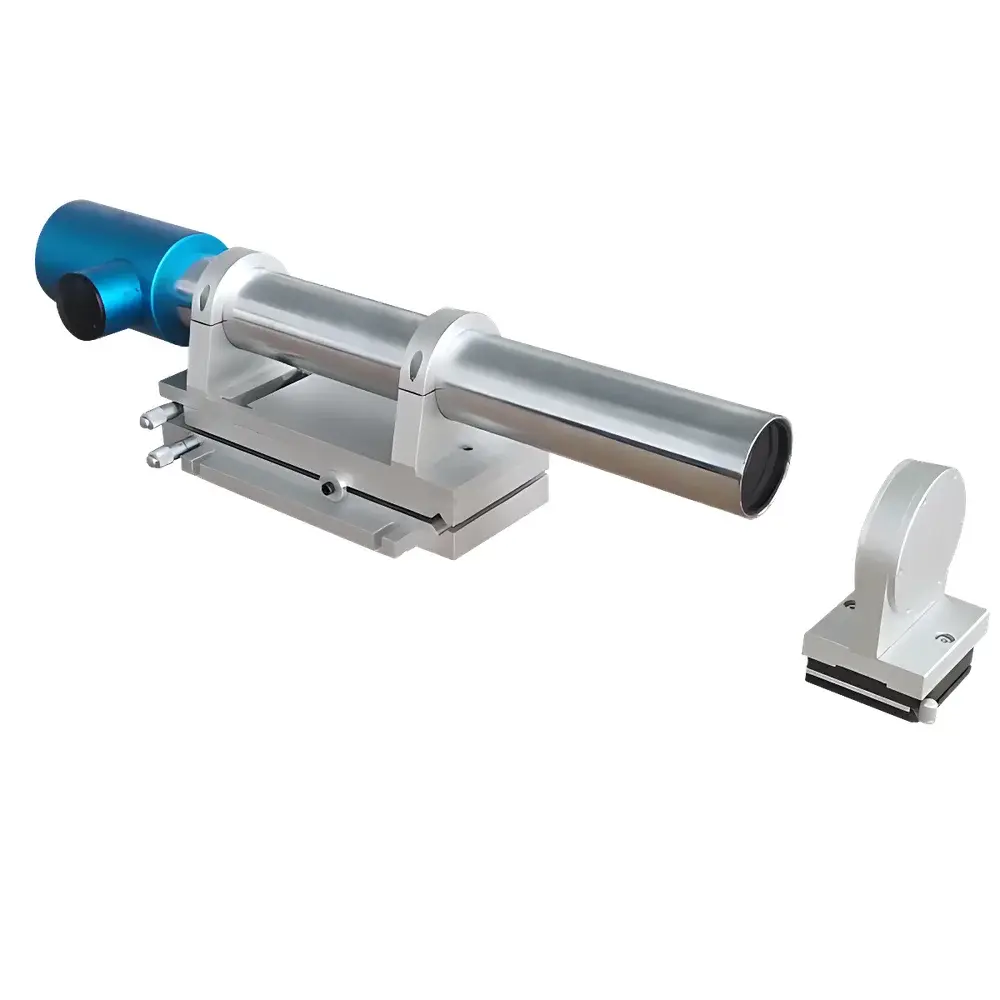
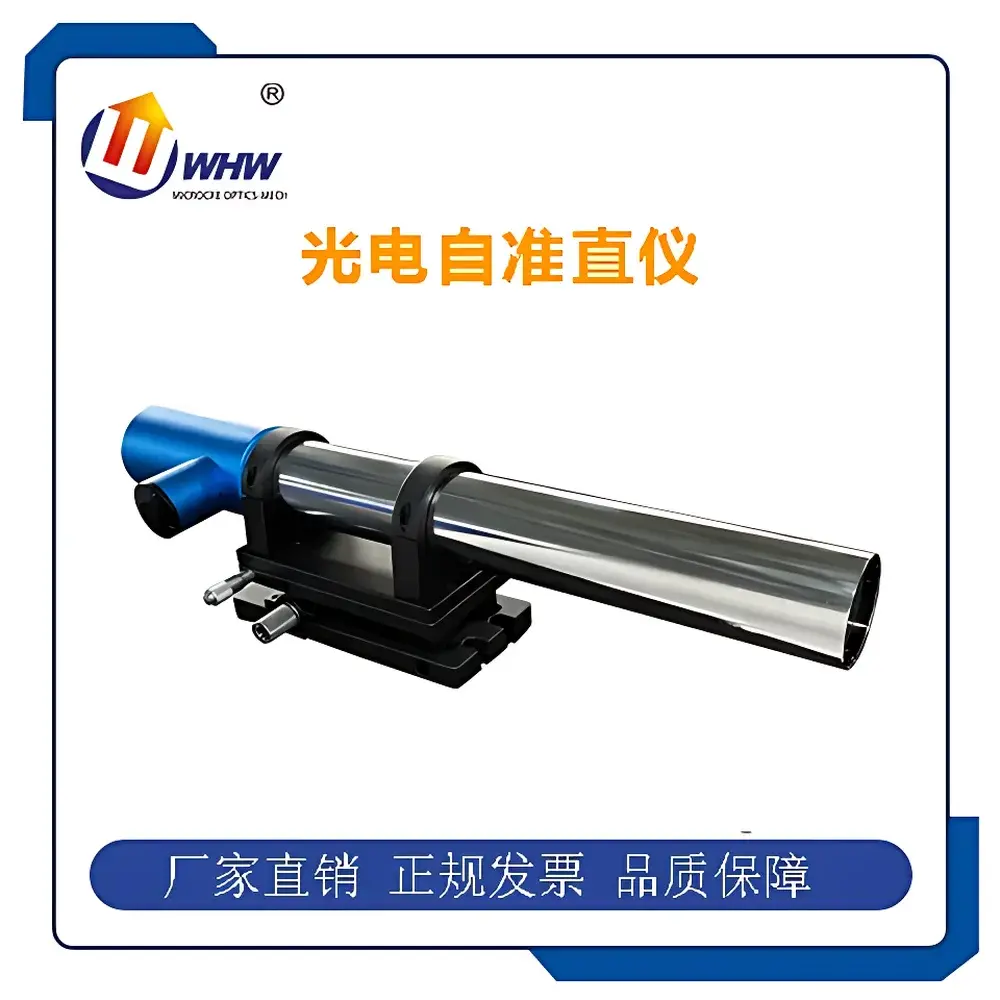
YANRUN MC030-YRMUT5000/0.2 Dual-Axis Photoelectric Autocollimator
| Brand | YANRUN |
|---|---|
| Origin | Shanghai, China |
| Manufacturer Type | Manufacturer |
| Product Origin | Domestic (China) |
| Model | MC030-YRMUT5000/0.2 |
| Quotation | Upon Request |
| Focal Length | 500 mm |
| Aperture | 50 mm |
| Light Source | High-Stability Semiconductor LED |
| Measurement Range | 0–50 m |
| Detector | High-Resolution Position-Sensitive Photodetector (PSD) or CMOS Imaging Sensor |
| Display Resolution | Adjustable from 1″ to 0.0001″ (arcsec) |
| Field of View (X/Y) | 1100″ × 850″ (arcsec) |
| Accuracy (Center) | ±0.2″ (0–±100″), ±0.5″ (0–±400″) |
| Frequency Response | ≤30 Hz (typ.) |
| Interface | USB 2.0/3.0 |
| OS Requirement | Windows 7 or later (64-bit) |
| Minimum PC Spec | Intel Core i5-9xxx or equivalent, ≥2.3 GHz, 8 GB RAM |
| Dimensions | 388 × 135 × 125 mm (L×W×H) |
| Weight | 5.0 kg |
Overview
The YANRUN MC030-YRMUT5000/0.2 Dual-Axis Photoelectric Autocollimator is a precision angular metrology instrument engineered for high-reproducibility measurement of minute angular deviations in two orthogonal axes (X and Y) simultaneously. It operates on the fundamental principle of optical autocollimation: a collimated beam—generated by projecting a reticle image through a high-quality objective lens with a 500 mm focal length—is reflected off a plane mirror and reimaged onto a calibrated photosensitive detector located at the same focal plane. When the mirror rotates by an angle α, the returned image shifts by ΔS = 2f·α (where f = 500 mm), enabling sub-arcsecond angular quantification via pixel-level displacement analysis. Unlike traditional visual autocollimators requiring manual eyepiece alignment, this system employs real-time digital imaging, eliminating parallax and observer-dependent error. Its compact monolithic architecture—integrating a 50 mm aperture objective, semiconductor LED illumination (rated for >20,000 h), and a thermally stabilized detector—ensures long-term stability under laboratory and shop-floor conditions. Designed for traceable metrology, it supports calibration against NIST-traceable angle standards and conforms to ISO 10110-5 (optical component testing) and ISO 230-1 (machine tool testing) angular assessment protocols.
Key Features
- Dual-axis synchronous acquisition: Simultaneous X/Y angular measurement with independent resolution control down to 0.0001 arcsecond, enabling full vectorial tilt characterization.
- Real-time electronic eyepiece interface: Eliminates human aiming variability; displays live crosshair image with dynamic centroid tracking and auto-correlation algorithms.
- High-stability illumination: Imported solid-state LED source with constant-current drive and thermal feedback loop ensures consistent intensity and spectral output over time.
- Modular hardware design: Interchangeable mounting bases (including kinematic and motorized stages), optional retroreflective targets, and auxiliary collimation optics extend functionality without recalibration.
- Onboard error compensation: Built-in algorithms correct for detector nonlinearity, lens distortion, and temperature-induced focal drift using factory-characterized lookup tables.
- USB 2.0/3.0 plug-and-play connectivity: No external power supply required; draws power and data via single cable to standard Windows PCs.
- Multi-language software environment: Supports English, Chinese, Russian, and Korean UIs with configurable report templates compliant with ISO/IEC 17025 documentation requirements.
Sample Compatibility & Compliance
The MC030-YRMUT5000/0.2 is compatible with all optically flat, specularly reflective surfaces meeting minimum reflectivity ≥85% in the visible spectrum (400–700 nm). Standard measurement targets include front-surface aluminum mirrors, fused silica flats, and precision-ground steel plates polished to Ra < 0.05 µm. It satisfies functional requirements for ASTM E1316 (nondestructive testing terminology), ISO 10791-6 (machining center geometric tests), and VDI/VDE 2617 Part 5 (angle measurement uncertainty evaluation). For regulated environments—including GLP-compliant calibration labs and medical device manufacturing QA/QC—the system supports audit-ready operation: all measurement sessions log timestamped raw images, detector coordinates, environmental metadata (ambient temperature/humidity if externally fed), and operator ID. Optional FDA 21 CFR Part 11-compliant software module provides electronic signatures, role-based access control, and immutable audit trails.
Software & Data Management
The bundled YANRUN Autocollimation Suite v4.x runs natively on 64-bit Windows platforms and features a deterministic real-time acquisition engine synchronized to the detector’s frame rate (up to 30 Hz). Raw image streams are processed using adaptive thresholding, sub-pixel centroid interpolation (Gaussian-weighted moment method), and outlier rejection based on SNR and spatial coherence metrics. Measurement results are stored in hierarchical HDF5 files containing metadata per ISO/IEC 17025 Annex A.3, including calibration certificate IDs, uncertainty budgets, and environmental logs. Export options include CSV, XML, and native Excel (.xlsx) formats with customizable headers and statistical summaries (mean, std dev, max deviation, Cg/Cgk). Batch processing scripts support automated sequence execution across multiple positions or time points—essential for thermal drift studies or multi-point straightness verification per ISO 230-2.
Applications
- Precision machine tool alignment: Real-time monitoring of spindle tilt, linear axis squareness, and rotary table wobble during installation and periodic verification.
- Optical assembly and alignment: Active feedback for interferometer cavity stabilization, laser resonator mirror positioning, and fiber coupling efficiency optimization.
- Aerospace component inspection: Angular verification of turbine blade root faces, wing spar interfaces, and inertial sensor mounts per AS9100 Rev D requirements.
- Coordinate measuring machine (CMM) performance validation: Independent assessment of angular errors contributing to volumetric uncertainty budgets.
- Research-grade physics experiments: Measurement of mirror thermal expansion coefficients, piezoelectric actuator linearity, and gravitational wave detector suspension alignment stability.
- Metrology lab intercomparisons: Participation in BIPM key comparisons (e.g., CCAUV.K3) as a transfer standard for angle metrology.
FAQ
What is the recommended warm-up time before high-accuracy measurements?
For measurements within ±0.2″ specification, preheat the instrument for ≥15 minutes in a stable ambient environment (±0.5°C variation). For metrological calibration, allow ≥24 hours of thermal equilibration at constant temperature prior to use.
Can the system measure angles beyond ±400″?
Yes—within its 1100″ × 850″ field of view—but accuracy degrades outside the ±400″ range due to higher-order optical aberrations; extended-range measurements require empirical correction via calibration mapping.
Is remote operation supported over Ethernet or Wi-Fi?
Standard configuration uses USB only; however, optional Ethernet-to-USB bridge modules enable networked operation in secure intranet environments with latency <10 ms.
Does the software support scripting for custom workflows?
Yes—Python API (via COM interface) and LabVIEW VI libraries are available under extended license agreement for integration into automated test systems.
How often does the system require recalibration?
Annual recalibration is recommended for ISO/IEC 17025 compliance; interim verification using certified angle artifacts (e.g., NIST SRM 2089a) should be performed quarterly or after mechanical shock events.






