
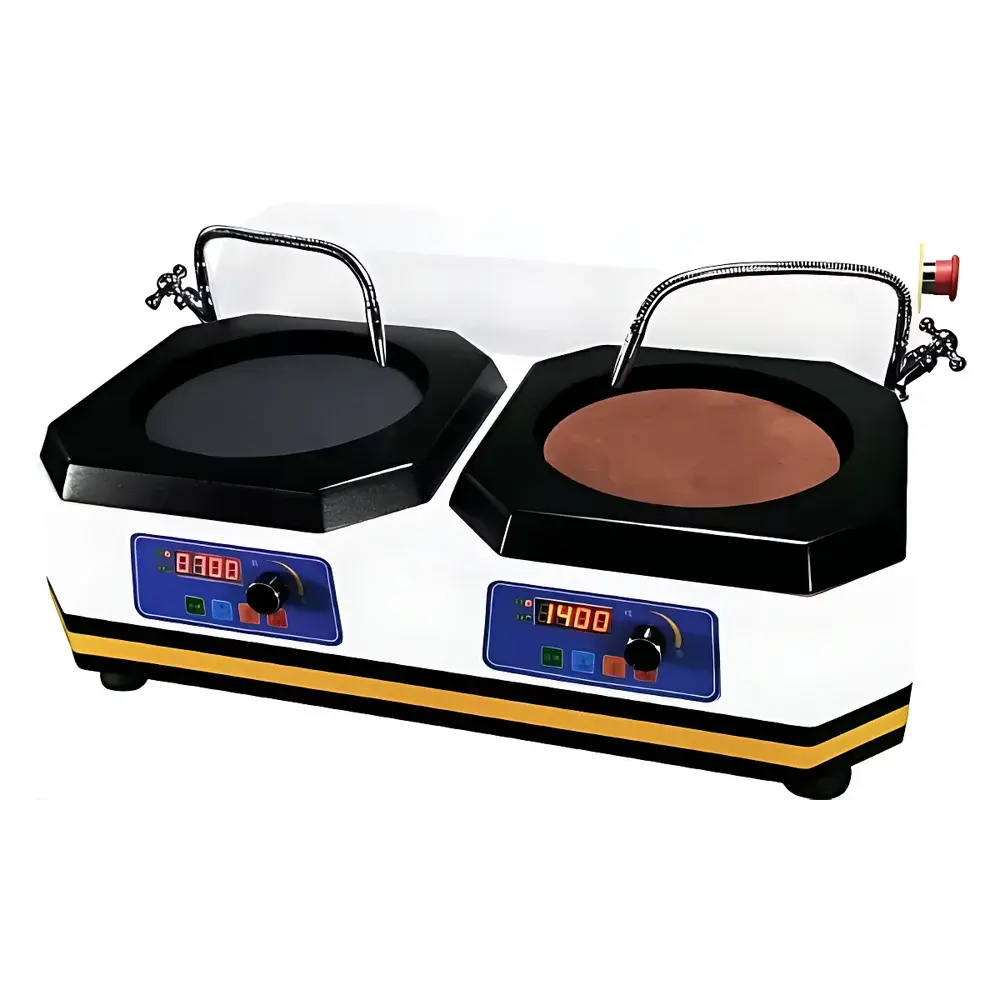
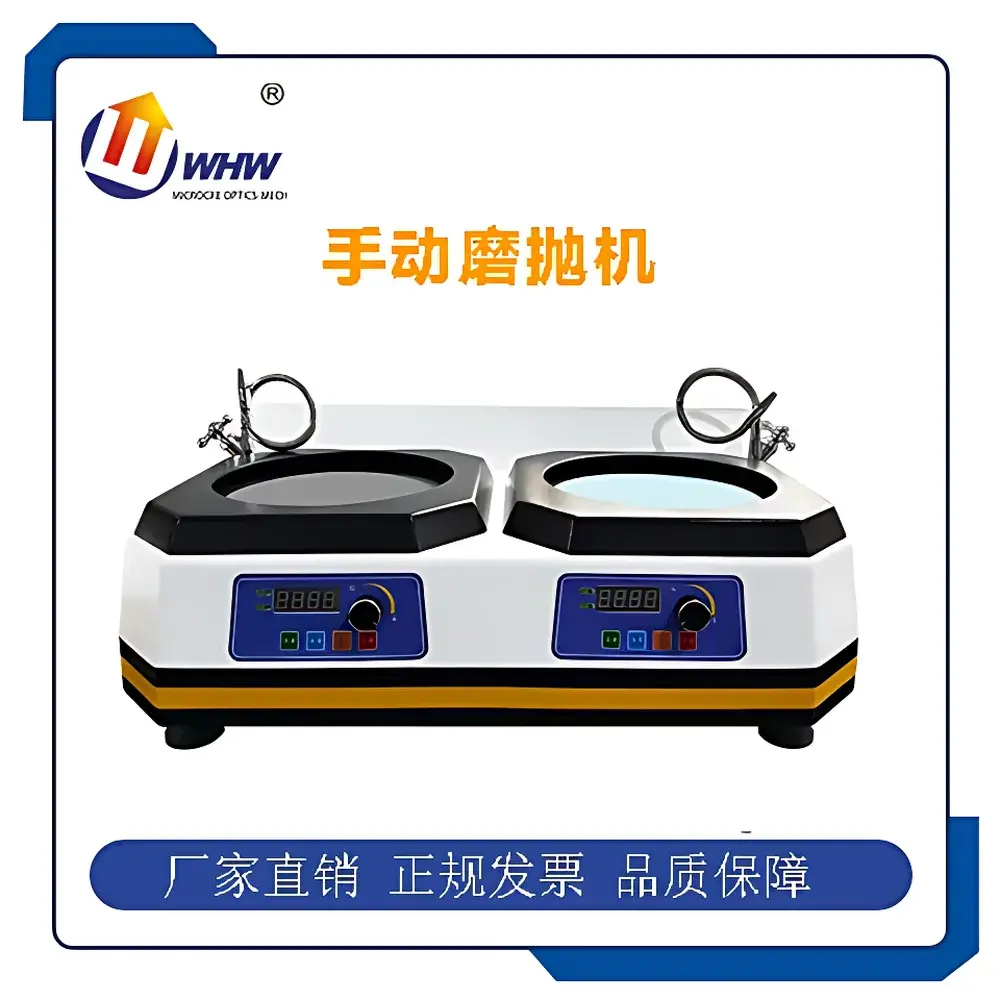
YANRUN MPD-2S Dual-Station Metallographic Grinding and Polishing Machine
| Brand | YANRUN |
|---|---|
| Origin | Shanghai, China |
| Manufacturer Type | Direct Manufacturer |
| Country of Origin | China |
| Model | MPD-2S |
| Price | Upon Request |
| Speed Range | 50–1500 rpm (Infinitely Variable + Two Fixed Speeds) |
| Platen Diameter | Ø200 mm |
| Number of Platens | 2 |
| Dimensions (L×W×D) | 670 × 560 × 260 mm |
Overview
The YANRUN MPD-2S is a dual-station, benchtop metallographic grinding and polishing machine engineered for high reproducibility in sample preparation workflows across metallurgy, materials science, geology, and microelectronics laboratories. It operates on the principle of controlled mechanical abrasion—using precisely regulated rotational motion, consistent pressure application, and optimized coolant delivery—to achieve planar, scratch-free surfaces required for subsequent optical or electron microscopy analysis. Unlike single-platen systems, the MPD-2S integrates two independently controlled platens on a rigid ABS-injected chassis, enabling simultaneous coarse grinding and fine polishing—or parallel processing of two distinct samples under identical environmental conditions. Its design prioritizes operator safety, process repeatability, and long-term mechanical stability—critical for labs adhering to ISO 14971 risk management principles and ASTM E3-22 standard practices for metallographic specimen preparation.
Key Features
- Dual-platen architecture with independent speed and direction control per station—supports concurrent grinding and polishing without cross-contamination or workflow interruption.
- ABS polymer monocoque housing: impact-resistant, chemically inert, and non-conductive; eliminates galvanic corrosion risks associated with metal enclosures while ensuring electrical isolation between water pathways and internal electronics.
- Hermetically sealed inlet/outlet water system: fully isolates fluid channels from PCBs and motor drivers, complying with IPX4-rated splash protection requirements for laboratory equipment.
- Deep-draw grinding chamber (≥85 mm depth): contains coolant splatter and abrasive slurry during high-torque operation—reducing maintenance frequency and improving lab hygiene.
- High-torque servo motors (2 × 750 W, 2.39 N·m nominal torque each): deliver stable rotational force across the full 50–1500 rpm range, essential for uniform material removal on hard ceramics, sintered carbides, and semiconductor wafers.
- Bi-directional rotation capability (clockwise/counter-clockwise): enables optimized abrasive wear distribution and mitigates edge rounding on brittle specimens such as geological thin sections or brittle intermetallic phases.
- 360° swivel faucet with adjustable flow rate: facilitates precise coolant targeting at the specimen–abrasive interface, minimizing thermal distortion and enhancing surface finish consistency.
Sample Compatibility & Compliance
The MPD-2S accommodates a broad spectrum of specimen geometries and material classes—including ferrous and non-ferrous metals, cemented carbides, oxide and nitride ceramics, silicate rocks, concrete aggregates, and packaged IC substrates—provided specimen dimensions fit within standard metallographic mounting cups (up to 40 mm diameter × 30 mm height). It supports industry-standard consumables: silicon carbide papers (P80–P2500), diamond-impregnated discs (15–3 µm), and woven/non-woven polishing cloths (e.g., synthetic napped fabrics for final alumina or colloidal silica suspension polishing). The machine’s mechanical design conforms to CE machinery directive 2006/42/EC for safety, and its operational parameters align with ASTM E3-22 Section 7.2 (grinding/polishing speed recommendations) and ISO 15510:2020 (metallographic specimen preparation terminology and procedural definitions).
Software & Data Management
The MPD-2S operates via hardware-based dual-channel analog/digital control—no embedded software or network interface is present. All operational parameters (speed setpoint, direction, runtime) are configured manually using front-panel rotary dials and tactile push buttons. This architecture ensures deterministic response time (<50 ms speed stabilization), immunity to firmware vulnerabilities, and compatibility with GLP/GMP environments where audit trails and electronic record integrity are governed by FDA 21 CFR Part 11. For laboratories requiring traceable process documentation, external timer-loggers or PLC-integrated SCADA systems may be interfaced via dry-contact relay outputs (optional accessory port).
Applications
- Routine metallographic sectioning validation in QC labs for aerospace alloys (e.g., Ti-6Al-4V, Inconel 718) and automotive cast irons.
- Preparation of cross-sectional samples for failure analysis of solder joints, wire bonds, and multilayer ceramic capacitors (MLCCs).
- Rock thin-section fabrication in geological core analysis, supporting polarized light microscopy and cathodoluminescence imaging.
- Surface planarization of additively manufactured (AM) metal parts prior to porosity quantification via SEM backscattered electron imaging.
- Standardized polishing protocols for ISO/IEC 17025-accredited testing laboratories performing hardness mapping or grain size evaluation per ASTM E112.
FAQ
Does the MPD-2S support automated timing or programmable multi-step protocols?
No—the MPD-2S is a manually operated, non-programmable instrument. Timing and step transitions must be managed externally using stopwatch or integrated lab timers.
Can 230 mm platens be retrofitted to an existing MPD-2S unit?
Yes—230 mm platen kits are available as optional accessories and require only mechanical re-mounting; no electrical modifications are needed.
What is the maximum recommended continuous duty cycle per platen?
For optimal motor longevity and thermal management, continuous operation should not exceed 45 minutes per hour per station under full-load conditions (e.g., coarse grinding of hardened steel at 1400 rpm).
Is the machine compatible with vacuum chuck fixtures or magnetic specimen holders?
Yes—the Ø200 mm platen surface features standardized M6 threaded mounting holes (12 mm pitch, 16 mm spacing) conforming to DIN 6499, allowing secure attachment of third-party fixturing solutions.
What maintenance intervals are recommended for the servo motor assemblies?
Motor brush inspection and bearing lubrication are advised every 1,200 operating hours; service logs should be retained per ISO/IEC 17025 Clause 6.4.8 for equipment maintenance traceability.



