
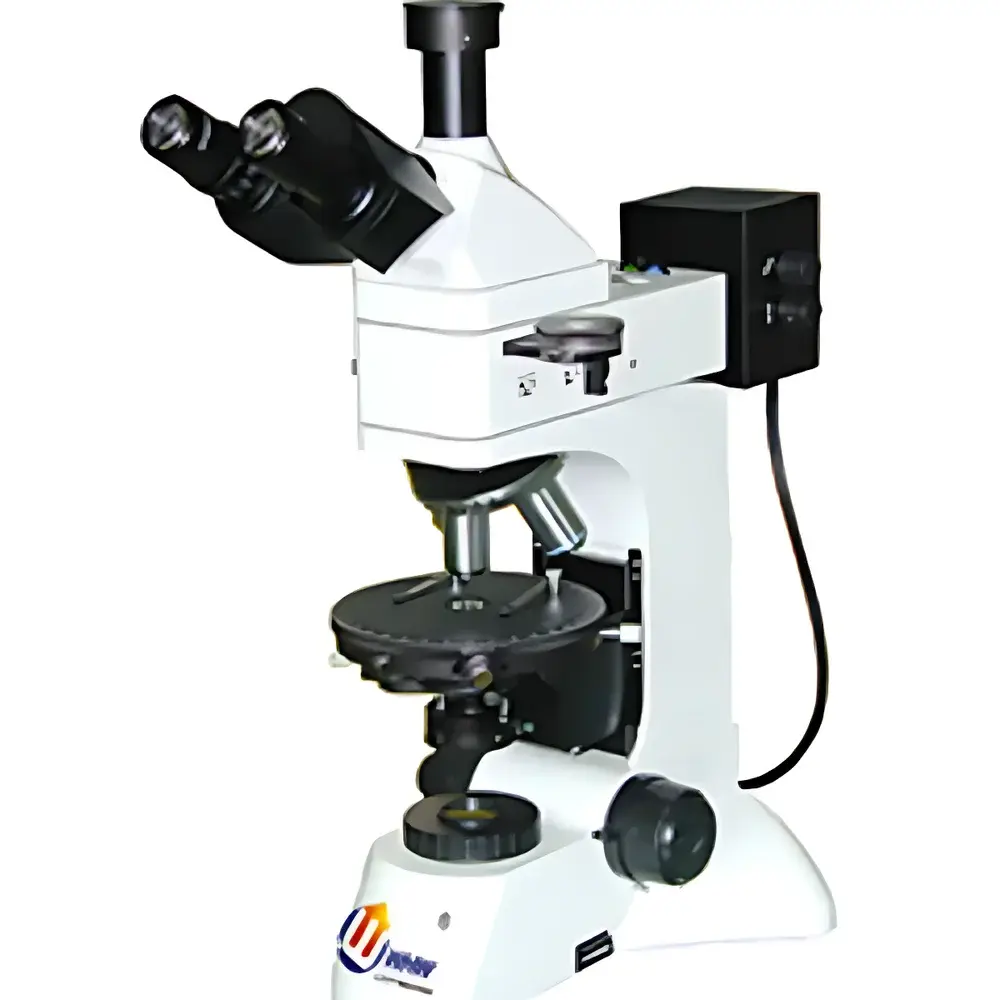
YANRUN PM-14 Infinity-Corrected Transmitted/Reflected Light Polarizing Microscope
| Brand | YANRUN |
|---|---|
| Origin | Shanghai, China |
| Manufacturer Type | Direct Manufacturer |
| Model | PM-14 Infinity-Corrected Transmitted/Reflected Light Polarizing Microscope |
| Optical Magnification | 50×–600× |
| Eyepieces | Widefield WF10× (Φ22 mm), Graticule Eyepiece 10× (0.10 mm/div) |
| Strain-Free Plan Achromatic Polarizing Objectives (Cover-Glass Free) | 5×/0.12/26.1 mm WD, 10×/0.25/20.2 mm, 40×/0.60/3.98 mm (spring-loaded), 60×/0.70/3.18 mm (spring-loaded) |
| Focusing Mechanism | Coaxial coarse/fine focus, fine focus graduation: 2 µm, with tension adjustment, limit stop & lock |
| Rotating Stage | Φ150 mm, 360° graduated scale, vernier resolution: 6 arcminutes, center-adjustable & lockable, vertical travel: 30 mm |
| Illumination | 6 V / 30 W halogen lamp (transmitted & reflected), brightness continuously adjustable |
| Polarizer & Analyzer | Both rotatable 360°, polarizer with four fixed positions (0°/90°/180°/270°) below aperture diaphragm |
| Tube | Trinocular, 30° inclination, 100% light path diversion for photomicrography |
| Accessories Included | Push-in Bertrand lens, λ plate, λ/4 plate, quartz wedge compensator |
Overview
The YANRUN PM-14 is an infinity-corrected, dual-mode polarizing microscope engineered for high-fidelity birefringence analysis in both transmitted and reflected light configurations. It implements classical polarized light microscopy (PLM) principles—based on the interaction of linearly polarized light with anisotropic crystalline or polymeric specimens—to enable quantitative evaluation of optical retardation, extinction angles, interference figures, and crystal symmetry. Designed for geological thin-section analysis, metallurgical inclusion characterization, pharmaceutical polymorph identification, and polymer phase morphology studies, the PM-14 integrates strain-free optical pathways, precision mechanical alignment, and modular contrast enhancement optics to ensure measurement repeatability and long-term calibration stability. Its dual-illumination architecture supports Köhler illumination in transmission mode and critical oblique illumination in incident-light mode—both compliant with ISO 10934-1 (optical microscopy — nomenclature and definitions) and ASTM D4124 (standard test method for determination of birefringence in polymeric films).
Key Features
- Infinity-corrected optical pathway with strain-free plan achromatic polarizing objectives (5×–60×), optimized for zero residual stress and minimal chromatic aberration across the visible spectrum (400–700 nm).
- Trinocular observation tube inclined at 30°, enabling simultaneous visual observation and 100% light-diverted photomicrography—critical for low-light CCD/CMOS imaging without exposure compromise.
- Coaxial coarse/fine focusing system with 2 µm fine-focus graduation, adjustable coarse-focus tension, mechanical upper/lower limit stops, and stage-locking capability for vibration-resistant operation during extended acquisition sequences.
- Rotating mechanical stage (Φ150 mm) featuring 360° vernier-scaled rotation (6 arcminute resolution), center-adjustable translation, and 30 mm vertical lift range—enabling precise orientation mapping of cleavage planes, twin boundaries, and optic axes.
- Dual independent polarization control: a fixed-position (0°/90°/180°/270°) rotatable polarizer beneath the condenser aperture, and a continuously rotatable, vernier-calibrated analyzer in the reflected-light path—supporting accurate extinction angle measurement per ASTM E1122.
- Broad-voltage power supply (85–265 V AC, 50/60 Hz) and thermally stabilized 6 V / 30 W halogen illumination with continuous intensity control for consistent color temperature (≈3200 K) and photometric stability over time.
Sample Compatibility & Compliance
The PM-14 accommodates standard 26 mm × 76 mm petrographic slides, metallurgical mounts up to 30 mm thickness, and polished cross-sections requiring incident illumination. Its strain-free objective design eliminates internal birefringence artifacts, ensuring compliance with ISO 9276-3 (representation of results of particle size analysis) when used with graticule eyepieces for linear dimension metrology. The instrument meets GLP documentation requirements for optical calibration traceability, and its modular compensator suite—including λ, λ/4, and quartz wedge plates—enables retardation measurements conforming to ISO 10934-2 (measurement of optical path difference). No software-driven automation is embedded; all adjustments remain manually actuated to preserve auditability in regulated environments (e.g., USP , FDA 21 CFR Part 11–compliant workflows when paired with validated third-party image capture systems).
Software & Data Management
The PM-14 operates as a hardware platform compatible with industry-standard digital imaging interfaces: USB 2.0/3.0 video output, analog VIDEO (NTSC/PAL), and C-mount adapter options (0.4×/0.5×/1× magnification). When integrated with validated third-party acquisition software (e.g., NIS-Elements, Stream Motion, or Olympus cellSens), it supports timestamped image capture, multi-channel fluorescence overlay (when equipped with optional filter cubes), and calibrated pixel-to-micron scaling via stage micrometer verification. All hardware controls—including polarizer/analyzer rotation, illumination intensity, and focus position—are manually indexed and documented externally, satisfying audit trail requirements under GMP Annex 11 and ISO/IEC 17025 clause 7.7.
Applications
- Geological petrography: Identification of mineral assemblages, optical sign determination, and interference figure analysis in thin sections.
- Materials science: Characterization of liquid crystal domains, polymer spherulite morphology, fiber orientation in composites, and thermal-induced birefringence in optical coatings.
- Metallurgy: Detection and classification of non-metallic inclusions (e.g., oxides, sulfides) in steel and aluminum alloys per ASTM E45.
- Pharmaceutical development: Polymorph screening, hydrate/anhydrate differentiation, and crystallinity assessment in active pharmaceutical ingredients (APIs).
- Forensic analysis: Fiber identification, paint layer stratigraphy, and refractive index matching of trace evidence.
FAQ
Does the PM-14 support DIC or phase contrast?
No—this model is dedicated exclusively to polarized light contrast mechanisms. DIC and phase contrast require separate condenser and objective modifications not included in the base configuration.
Can the microscope be upgraded to motorized stage or automated polarization control?
Not natively. The PM-14 is a manually operated platform; however, third-party motorized stages with encoder feedback and programmable rotation controllers may be mechanically interfaced using standard M4 mounting threads.
What is the maximum specimen height supported in reflected-light mode?
With the stage fully raised (30 mm vertical travel) and using the 5× objective (26.1 mm working distance), specimens up to ≈20 mm in height can be accommodated while maintaining focus and clearance.
Are compensation plates certified for traceable retardation values?
The included λ, λ/4, and quartz wedge plates are factory-aligned for nominal retardation but are not individually NIST-traceable. For metrological applications, users should perform in-house calibration using reference standards such as MgF₂ or mica wedges per ISO 10934-2.
Is the halogen lamp replaceable with LED illumination?
Yes—LED retrofit kits with 5600 K CCT and CRI >90 are commercially available and mechanically compatible, though intensity control requires external dimming circuitry due to absence of built-in PWM regulation.





