
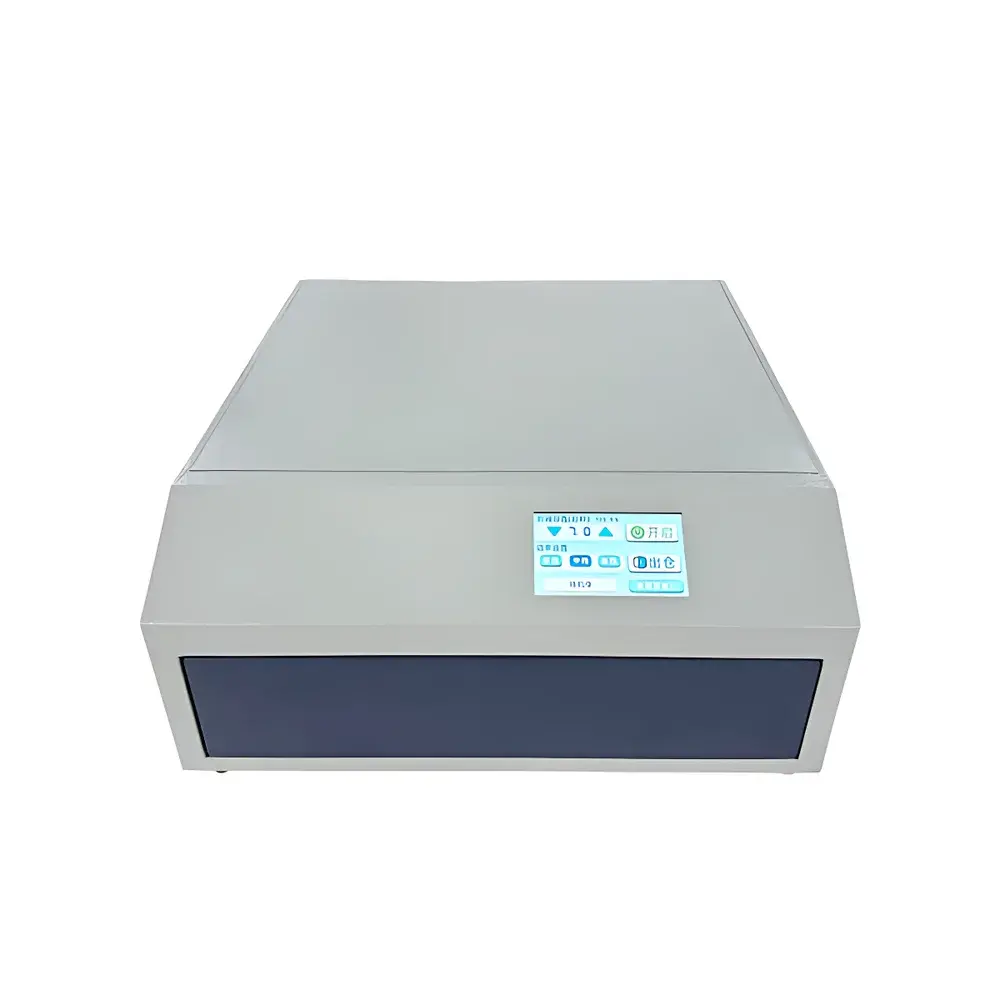
YANRUN UV-Curing Mounting Press
| Brand | YANRUN |
|---|---|
| Origin | Shanghai, China |
| Manufacturer Type | Direct Manufacturer |
| Region | Domestic (China) |
| Model | UV-Curing Mounting Press |
| Price | USD 1 (FOB Shanghai) |
| Max Sample Capacity | 24 × Ø30 mm or 15 × Ø40 mm molds |
| Max Sample Height | 40 mm |
| UV Wavelength | 365 nm |
| Curing Time | 60 s (with M789001 photoinitiator resin) |
| Curing Temp Range | 70–90 °C |
| Post-Cure Surface Temp | <50 °C |
| Control Power | 100–240 V, 50/60 Hz |
| Dimensions | 420 × 410 × 200 mm |
| Weight | 16 kg |
| Shore D Hardness (cured resin) | 83 |
Overview
The YANRUN UV-Curing Mounting Press is an engineered solution for rapid, repeatable, and contamination-free specimen encapsulation in metallurgical, materials science, and quality control laboratories. Unlike conventional thermosetting hot-mount presses that rely on elevated temperature and prolonged compression cycles (typically 5–15 minutes), this system employs high-intensity 365 nm ultraviolet irradiation to initiate polymerization of proprietary acrylate- or epoxy-based photopolymer resins—enabling full crosslinking in just 60 seconds. The dual-sided LED array ensures uniform photon flux across both top and bottom mold surfaces, minimizing shadowing effects and eliminating thermal gradients that commonly cause edge lifting, void formation, or interfacial delamination in traditional mounts. Designed for ISO/IEC 17025-compliant sample preparation workflows, the press delivers consistent embedment geometry and interfacial adhesion—critical for subsequent sectioning, polishing, and microstructural analysis per ASTM E3, ISO 14577, and EN 1071-2.
Key Features
- Dual-zone 365 nm UV-LED irradiation system with calibrated irradiance ≥120 mW/cm² at mold surface—optimized for high-efficiency photoinitiator activation without ozone generation
- PIC-based real-time process controller with embedded logic for sequential automation: auto-sample loading → UV exposure → forced-air cooling → ejection—eliminating operator-dependent timing variability
- 7-inch capacitive touchscreen HMI with multilingual interface (English, German, Japanese, Chinese), password-protected parameter locking, and audit-trail-capable event logging
- Integrated thermally regulated cooling stage maintaining post-cure surface temperature ≤50 °C—preventing heat-induced distortion of temperature-sensitive samples (e.g., polymers, composites, soft metals)
- Modular mold support platform accommodating up to 24 standard Ø30 mm or 15 Ø40 mm metal or silicone molds; maximum specimen height: 40 mm
- Structural frame fabricated from anodized aluminum alloy with reinforced steel base—ensuring mechanical stability during UV exposure and vibration-free operation near precision metrology instruments
Sample Compatibility & Compliance
The press is validated for use with commercially available UV-curable mounting resins—including YANRUN M789001 (acrylate-based, low odor, refractive index matched to glass), as well as third-party formulations compliant with ISO 15528 and ASTM D4292. It accommodates diverse specimen types: metallic alloys (ferrous/non-ferrous), ceramics, geological sections, electronic components, and biological hard tissues (when pre-dehydrated). All electrical subsystems conform to IEC 61000-6-3 (EMC emissions) and IEC 61000-6-2 (immunity); the enclosure meets IP20 ingress protection rating. Process documentation supports GLP/GMP traceability requirements, with timestamped cycle records exportable via USB for FDA 21 CFR Part 11–aligned data integrity protocols.
Software & Data Management
The embedded firmware includes non-volatile memory for storing ≥100 user-defined curing profiles—each configurable for UV intensity ramping, dwell time per zone, cooling duration, and ejection delay. Cycle data (start time, UV dose delivered, peak temperature, final surface temp, error flags) are logged automatically and exportable in CSV format. Optional Ethernet or RS-485 communication modules enable integration into LIMS environments or centralized lab automation systems. Firmware updates are performed via secure USB key with SHA-256 signature verification—ensuring regulatory-grade software change control.
Applications
- Routine metallographic preparation for optical microscopy and SEM imaging—reducing turnaround time from hours to minutes per batch
- Encapsulation of fragile or porous specimens (e.g., powder metallurgy compacts, additive-manufactured parts) where thermal stress must be avoided
- High-throughput QC labs performing ASTM E112 grain size analysis or ISO 643 inclusion rating on production lots
- Forensic labs embedding tool marks, fracture surfaces, or composite debris with minimal artifact introduction
- Academic research requiring reproducible mount geometry for nanoindentation calibration or EBSD orientation mapping
FAQ
What resin types are compatible with this press?
It is validated for acrylate- and epoxy-based photopolymer resins with primary absorption maxima near 365 nm—such as YANRUN M789001, Struers Epofix UV, and Buehler SimpliMet UV. Solvent-based or dual-cure resins require compatibility verification prior to use.
Does the system meet CE or UL safety certification?
The unit complies with IEC 61010-1:2010 for laboratory electrical equipment. CE marking is available upon request with EU Representative designation and DoC submission—UL 61010-1 listing requires regional factory audit and is offered as an optional certification path.
Can the curing profile be modified for non-standard resins?
Yes—UV intensity, exposure duration, and cooling parameters are fully adjustable via the touchscreen interface. Users may define custom profiles and assign them to specific mold configurations or material classes.
Is maintenance required for the UV-LED arrays?
The LEDs have a rated lifetime of ≥20,000 hours at nominal drive current. No periodic replacement is needed within typical lab service intervals; output stability is monitored continuously and reported in system diagnostics.
How is sample ejection force controlled?
A programmable pneumatic actuator delivers linear ejection force between 50–300 N—adjustable per mold size to prevent specimen fracture or resin chipping during demolding.



