
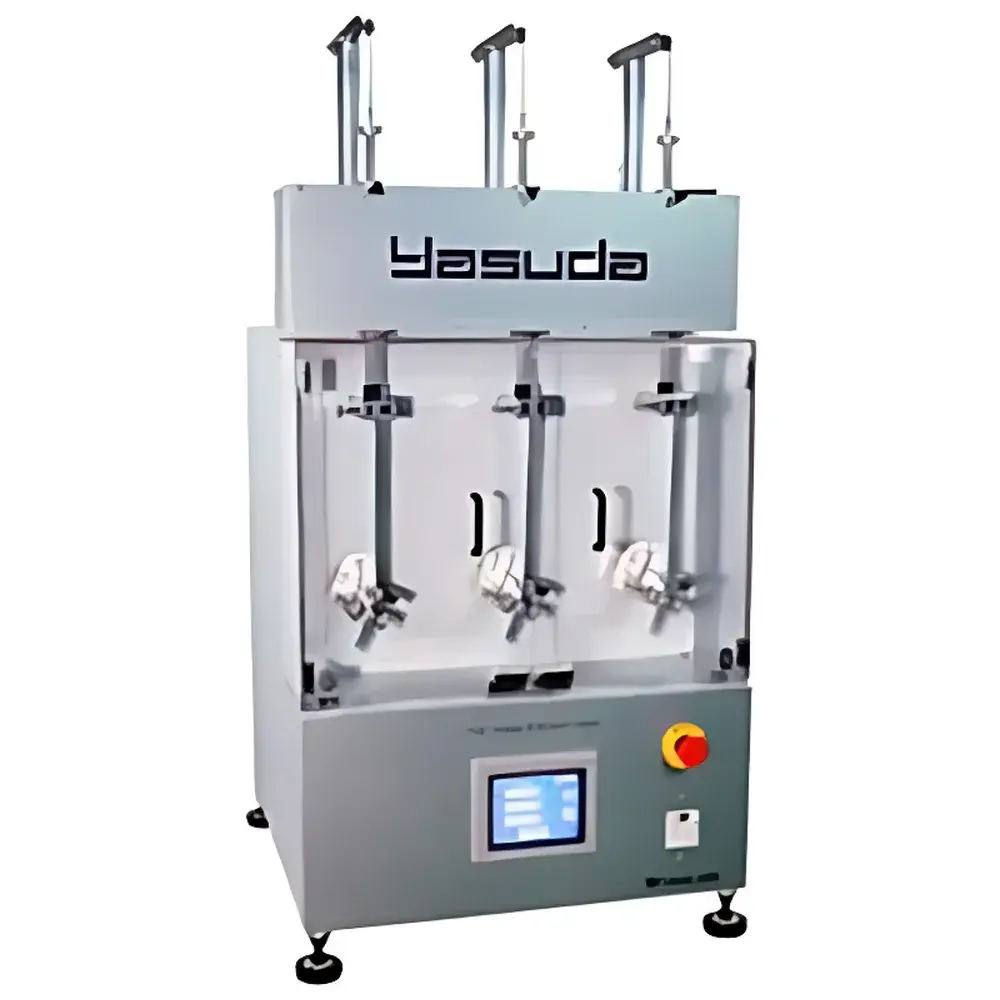
Yasuda No.603 Film Bending Fatigue Tester
| Brand | Yasuda |
|---|---|
| Origin | Japan |
| Model | No.603 |
| Type | Manual Bend-Repeat Fatigue Testing Instrument for Thin Flexible Films and Flexible Printed Circuits (FPCs) |
| Compliance | Designed per JIS K 7187 (Plastics — Determination of Flexural Fatigue Resistance) and ISO 13954 (Flexible Electrical Insulating Materials — Bend Test Methods) |
| Operating Principle | Cylindrical mandrel-driven repeated bending under controlled angular displacement and constant tensile preload |
Overview
The Yasuda No.603 Film Bending Fatigue Tester is a precision-engineered mechanical test instrument designed to evaluate the cyclic flexural durability of thin, flexible polymeric films, conductive polymer laminates, and flexible printed circuit (FPC) substrates. It operates on a well-established mandrel-based bending principle: a standardized cylindrical metal core serves as the bending axis, while the specimen—clamped rigidly at both ends—is repeatedly folded over the mandrel through controlled angular rotation of a manually actuated handle. A calibrated tensile preload is maintained throughout the test cycle to simulate real-world mechanical stress conditions encountered during device folding, such as those in clamshell mobile phones, foldable displays, and wearable electronics interconnects. Unlike high-speed servo-driven fatigue systems, the No.603 delivers deterministic, operator-controlled bend cycles with high repeatability, making it particularly suitable for comparative qualification testing, incoming material screening, and process validation in R&D and QC laboratories.
Key Features
- Fixed-end clamping mechanism with micrometer-adjustable jaw alignment ensures consistent specimen positioning and eliminates slippage during repeated bending.
- Interchangeable cylindrical mandrels (standard diameter: 2.0 mm; optional diameters available upon request) enable evaluation across multiple bend radii per ASTM D2136 and JIS K 7187 protocols.
- Manual angular displacement control via ergonomic handle allows precise definition of bend angle (typically ±90° or ±180°), with tactile feedback for cycle counting.
- Integrated tensioning system applies and maintains a defined static tensile load (adjustable range: 0.5–5.0 N) during bending, replicating service-level mechanical pre-stress.
- Compact benchtop footprint (W300 × D200 × H250 mm) and tool-free mandrel exchange support rapid setup and multi-specimen throughput.
- Corrosion-resistant stainless-steel frame and anodized aluminum components ensure long-term dimensional stability and resistance to environmental degradation in cleanroom or humidity-controlled lab environments.
Sample Compatibility & Compliance
The No.603 accommodates specimens up to 100 mm in length and 25 mm in width, with thicknesses ranging from 25 µm to 300 µm—including PET, PI, PEN, and acrylic-based films; silver nanoparticle-printed FPCs; and copper-clad polyimide laminates. Specimen mounting follows standardized edge-clamp geometry defined in ISO 13954 Annex A. The instrument supports compliance verification for automotive electronics (e.g., ISO 16750-4:2010, Mechanical Loads), consumer electronics reliability standards (IEC 60068-2-14, Change of Temperature with Bending), and internal OEM flex-life specifications (e.g., ≥100,000 cycles at ±135°). While not a fully automated GLP-compliant system, its mechanical traceability, fixed geometry, and documented manual procedure support audit-ready test records when paired with laboratory SOPs.
Software & Data Management
The Yasuda No.603 is a standalone mechanical tester with no embedded microprocessor or digital interface. All test parameters—including bend angle, mandrel diameter, applied tension, and cycle count—are recorded manually by the operator using standardized test sheets compliant with ISO/IEC 17025 documentation requirements. For laboratories requiring electronic data capture, integration with external cycle counters (e.g., Omron K3HB or Keyence VT2 series) via mechanical contact switch output is supported. Raw test logs may be imported into LIMS or ELN platforms using CSV templates aligned with ASTM E1482–22 (Standard Guide for Data Exchange in Materials Testing). Audit trails, user authentication, and electronic signatures are implemented at the laboratory information system level—not within the instrument itself—ensuring adherence to FDA 21 CFR Part 11 where applicable.
Applications
- Qualification of hinge-region film interconnects in dual-screen foldables and flip-style smartphones.
- Comparative fatigue life assessment of alternative substrate materials (e.g., polyimide vs. liquid crystal polymer) under identical bending kinematics.
- In-process monitoring of coating adhesion integrity on flexible substrates after lamination or curing.
- Failure mode analysis of conductor delamination, crack initiation, or resistivity drift under cyclic strain.
- Supporting accelerated aging studies per IPC-TR-579 guidelines for flexible hybrid electronics (FHE).
- Teaching laboratories demonstrating fundamental mechanics of thin-film flexural endurance and strain localization phenomena.
FAQ
What is the maximum recommended specimen thickness for reliable test results?
For optimal repeatability and mandrel contact fidelity, specimens exceeding 300 µm thickness are not recommended; thicker laminates may induce non-uniform strain distribution and premature edge fracture.
Can the No.603 be used for dynamic (oscillatory) bending tests?
No—the instrument is strictly designed for discrete, stepwise angular displacement. It does not support continuous sinusoidal or frequency-dependent loading profiles.
Is calibration certification included with shipment?
Yasuda provides a factory-verified dimensional certificate for mandrel diameter and clamp parallelism; annual recalibration of mandrel geometry and tension spring constants is advised per ISO/IEC 17025 Clause 6.6.
Does the tester comply with UL 746E or IEC 60601-1 mechanical safety requirements?
The No.603 is classified as a Class I laboratory mechanical test apparatus and carries CE marking per Machinery Directive 2006/42/EC; specific medical or fire safety certifications apply only to end-use assemblies—not the tester itself.



