
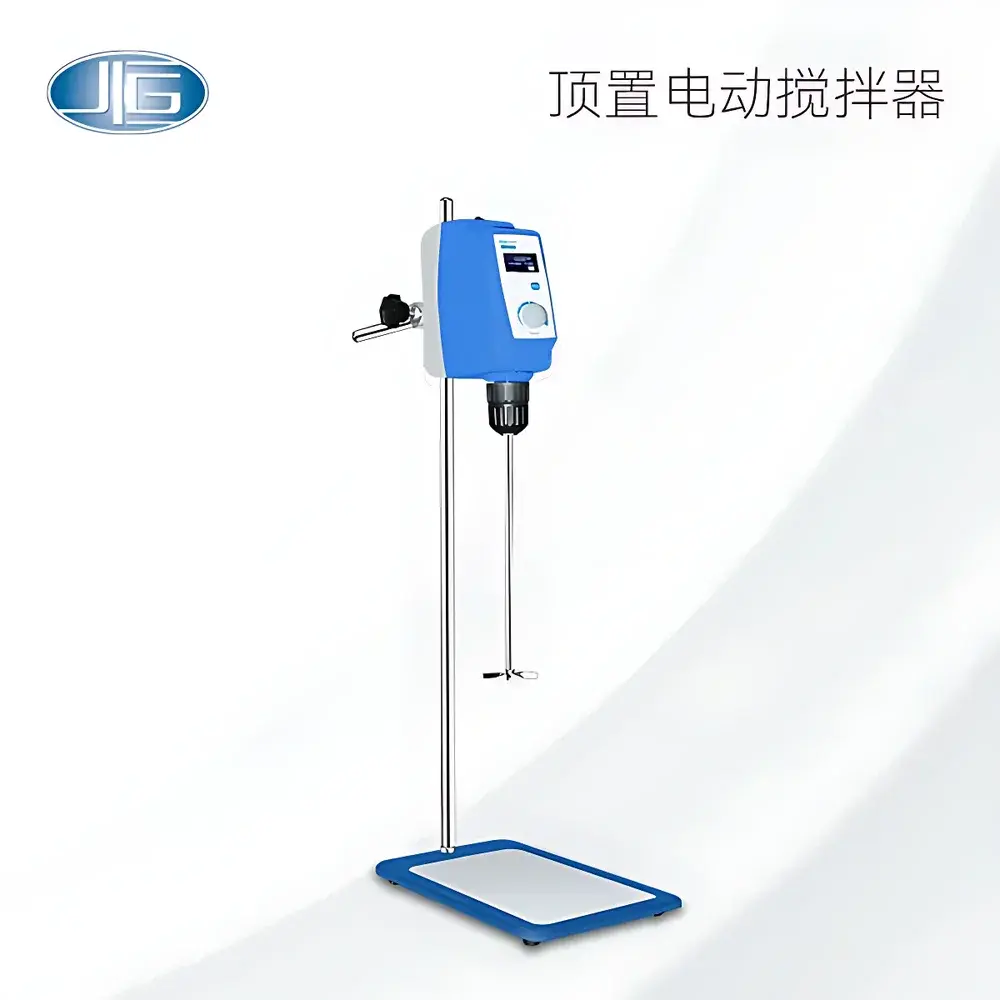
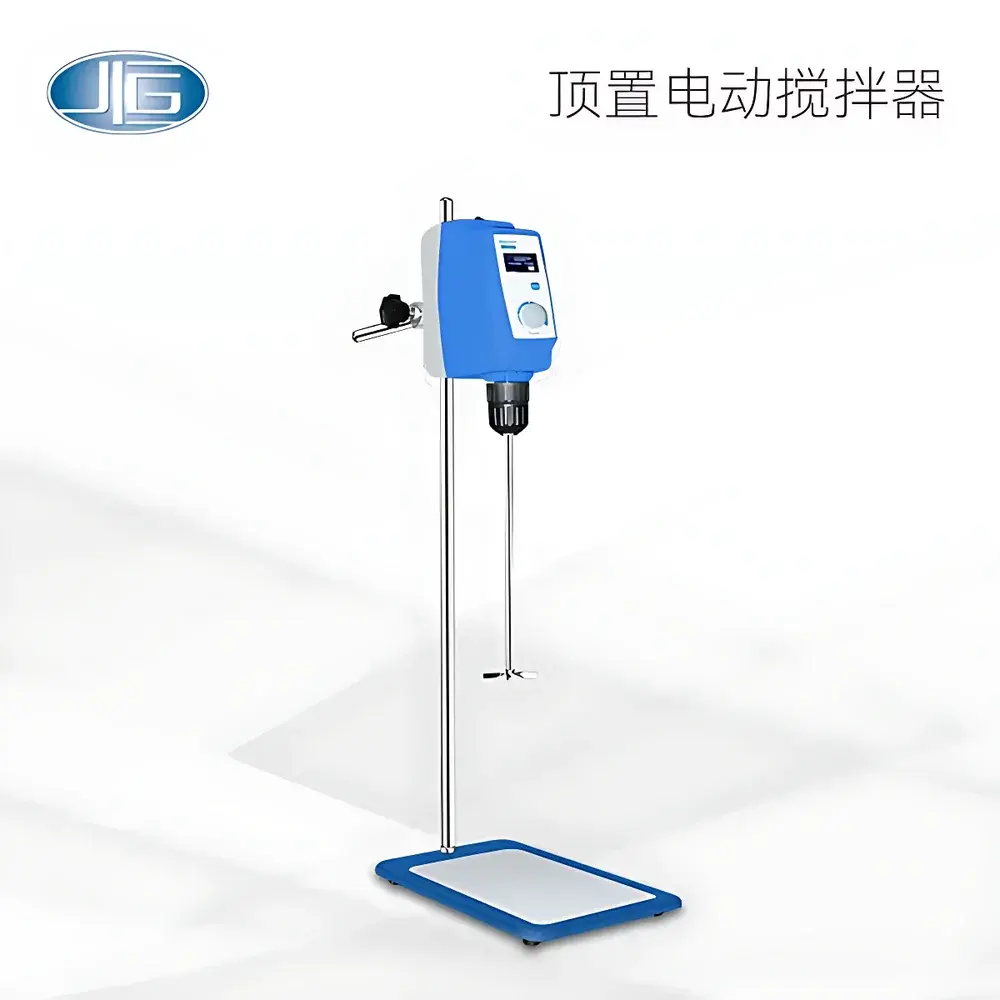
YIHENG BD Series Top-Mount Electric Stirrer
| Brand | YIHENG |
|---|---|
| Origin | Jiangsu, China |
| Manufacturer Type | Direct Manufacturer |
| Product Category | Domestic |
| Model | BD Series |
| Price Range | USD 560 – 730 (FOB) |
| Instrument Type | Electric Stirrer |
| Max. Mixing Volume | 20 L / 40 L / 60 L |
| Speed Range | 30–2200 rpm |
Overview
The YIHENG BD Series Top-Mount Electric Stirrer is an engineered solution for precise, reproducible, and scalable mixing in academic research laboratories, quality control environments, and pilot-scale process development. Designed around a closed-loop digital speed control architecture, it employs a brushless DC motor to deliver consistent torque output across the full operational range—critical for maintaining laminar or transitional flow regimes during viscosity-sensitive protocols such as polymer dissolution, suspension homogenization, or buffer preparation. Its top-mount configuration enables direct coupling with standard laboratory glassware (e.g., beakers, flasks, and jacketed reactors), eliminating alignment drift and minimizing mechanical vibration transmission. Unlike gear-driven or induction-motor-based stirrers, the BD Series maintains ±1% speed accuracy under variable load conditions—verified per ISO 8503-2 methodology for rotational equipment calibration—ensuring experimental repeatability across shifts and operators.
Key Features
- Brushless DC motor with integrated thermal monitoring: Delivers continuous operation at rated load without carbon brush wear or commutation noise; typical acoustic emission <52 dB(A) at 1 m distance.
- Digital feedback speed control system: Compensates for real-time viscosity fluctuations by dynamically adjusting PWM drive current—maintaining setpoint stability within ±0.5% of nominal speed even during sudden medium thickening events.
- Top-access shaft port with self-centering collet: Accepts standard Ø6–Ø10 mm stirring rods; features imported self-locking chuck with axial runout <0.05 mm (measured per ISO 1940-1).
- IP20-rated enclosed housing: Prevents electrolyte ingress from splashes or condensation, supporting safe operation in humid or solvent-rich fume hood environments.
- Soft-start ramp profile (0–3 s adjustable): Limits initial torque surge to avoid vortex collapse or sample ejection during startup—particularly critical for low-surface-tension liquids or high-density suspensions.
- Comprehensive electronic protection suite: Auto-shutdown triggered by overcurrent (>120% rated), overtemperature (>85°C internal ambient), or stall detection—with fault code display on LCD interface.
Sample Compatibility & Compliance
The BD Series accommodates a broad spectrum of sample types—including aqueous buffers, organic solvents (e.g., ethanol, acetone, THF), non-aqueous slurries, and thermally sensitive biopolymer solutions—within its specified volume envelopes (20 L, 40 L, and 60 L configurations). All electrical components comply with IEC 61010-1:2010 safety standards for laboratory equipment. The device supports GLP-compliant workflows through optional RS232 data logging, enabling timestamped export of speed, runtime, and fault-event records for audit trail generation. While not certified for Class I Div 1 hazardous locations, its sealed motor housing and spark-free operation render it suitable for general-purpose use in non-explosive laboratory zones per NFPA 45 guidelines.
Software & Data Management
An optional RS232 serial interface allows bidirectional communication with host PCs running custom or third-party SCADA platforms. The native ASCII protocol supports real-time polling of operational parameters (speed, elapsed time, error status) and remote command execution (start/stop, speed setpoint change, timer preset). Logged data exports as CSV files compatible with Excel, MATLAB, or LIMS integration via middleware. Firmware supports firmware update via serial bootloader, ensuring long-term adaptability to evolving lab informatics requirements. Audit-trail functionality—including user-initiated parameter changes and system reset events—is available when used with compliant terminal emulation software meeting FDA 21 CFR Part 11 electronic record criteria.
Applications
- Preparation of homogeneous cell culture media and phosphate-buffered saline (PBS) solutions in life science labs.
- Accelerated aging studies requiring controlled agitation of coating formulations or adhesive precursors.
- Standardized dispersion of nanomaterials (e.g., graphene oxide, TiO₂ nanoparticles) in ASTM D7824-13 compliant protocols.
- Batch-wise mixing of reagent-grade chemicals prior to HPLC or titration analysis—ensuring compositional uniformity per ISO/IEC 17025 clause 7.2.2.
- Process validation support for pharmaceutical wet granulation trials where shear history directly impacts granule size distribution (per USP <1059>).
FAQ
What is the maximum allowable viscosity for stable operation at 2200 rpm?
Stable operation at full speed is validated up to 5,000 mPa·s (measured with 50% glycerol/water at 25°C using ASTM D2196). For viscosities >10,000 mPa·s, derating to ≤1200 rpm is recommended.
Can the stirrer be mounted on a ring stand or lab frame?
Yes—the base includes M6 threaded inserts compatible with standard clamping hardware; vertical positioning is adjustable via dual-axis micrometer feed (±15 mm range).
Is the RS232 interface optically isolated?
No—galvanic isolation is not implemented; use only with grounded PC systems in electrically quiet lab environments.
Does the device support programmable multi-step protocols?
Not natively; protocol sequencing requires external controller integration via RS232 command scripting.
What is the warranty coverage and service support structure?
Standard 24-month parts-and-labor warranty; technical documentation includes English-language service manual and schematic diagrams for authorized field service technicians.



