
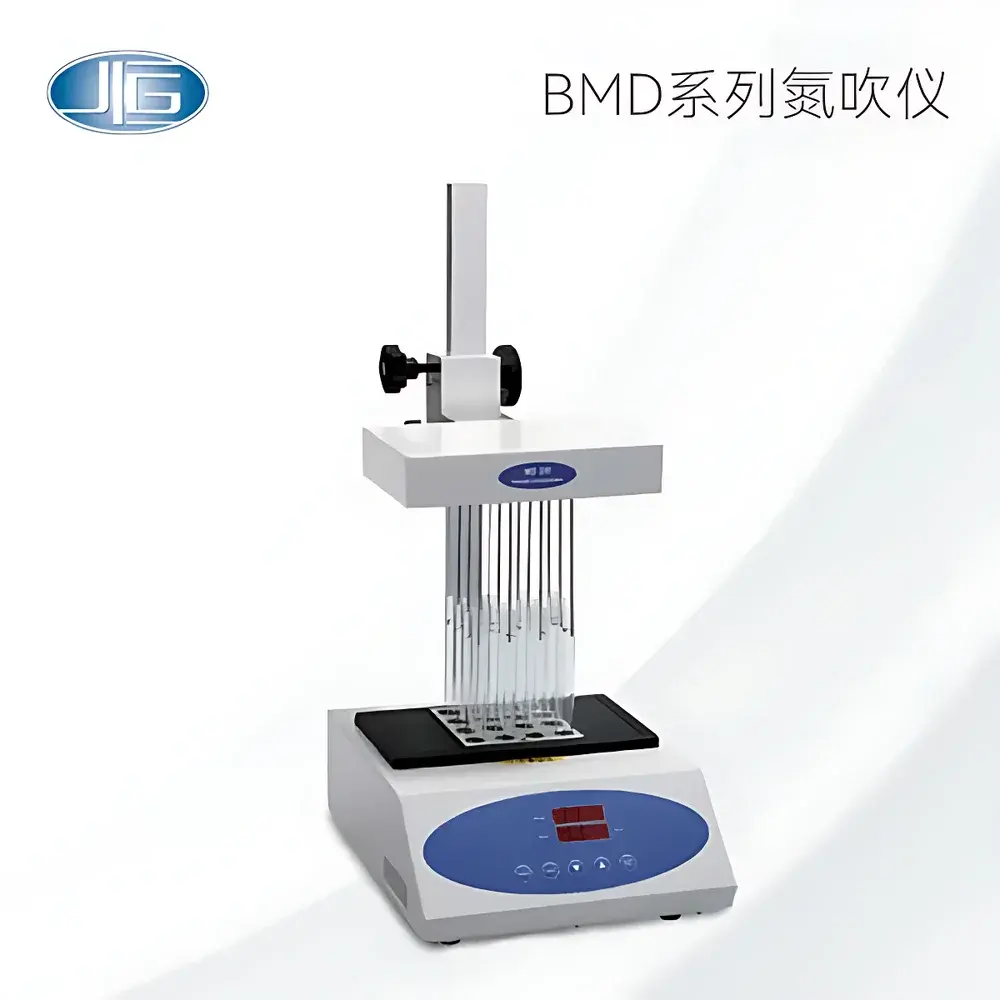
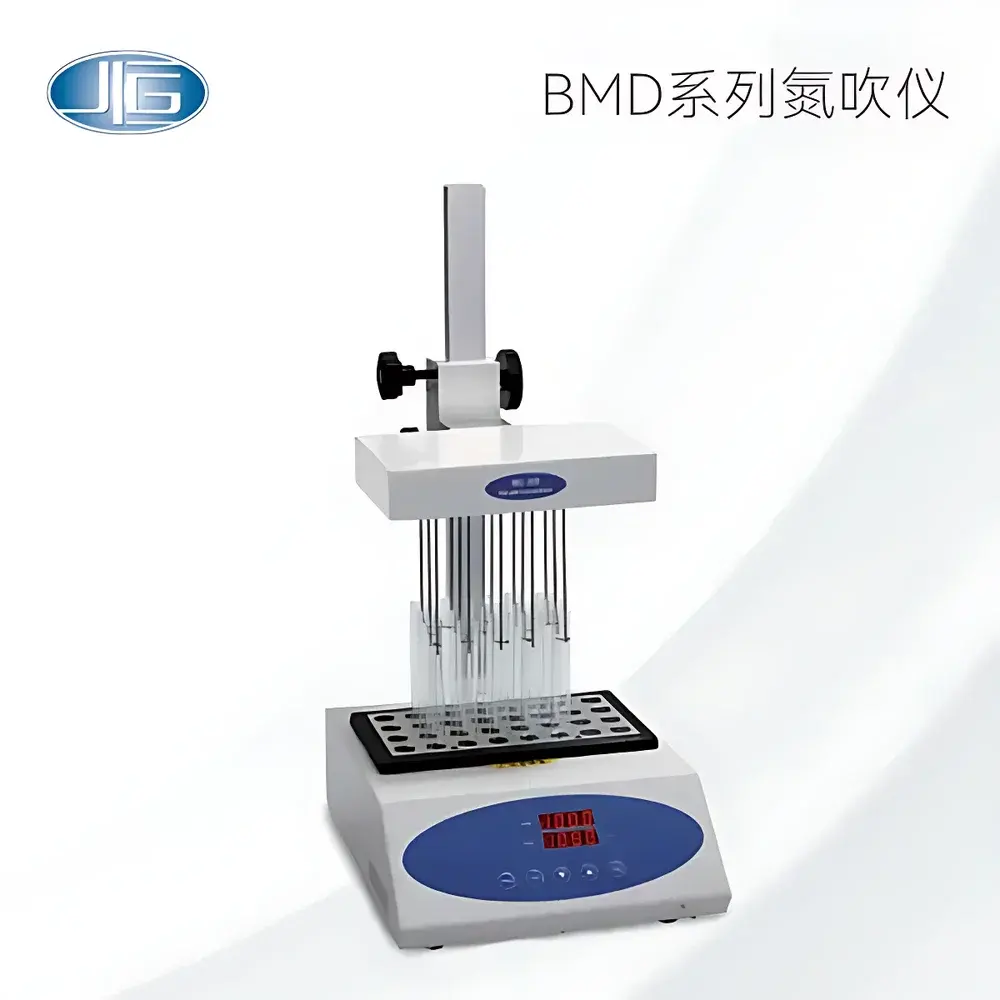
YiHeng BMD200-1 and BMD200-2 Dry-Block Nitrogen Evaporators
| Brand | YiHeng |
|---|---|
| Origin | Shanghai, China |
| Manufacturer Type | Direct Manufacturer |
| Country of Origin | China |
| Model | BMD200-1, BMD200-2 |
| Price Range | USD 1,100 – 1,550 (FOB Shanghai) |
| Heating Method | Dry-Block Heating |
| Temperature Range | Ambient +5°C to 150°C |
Overview
The YiHeng BMD200-1 and BMD200-2 are precision-engineered dry-block nitrogen evaporators designed for reliable, reproducible solvent removal in analytical sample preparation workflows. These instruments operate on the principle of gentle, inert gas-assisted evaporation—introducing controlled streams of nitrogen across the surface of liquid samples held in standard test tubes or vials, thereby accelerating solvent volatilization while minimizing thermal degradation and analyte loss. Unlike water-bath systems, the dry-block architecture eliminates cross-contamination risk, ensures rapid thermal equilibration, and supports operation at elevated temperatures up to 150°C with high spatial uniformity across the heating block. The BMD series is widely deployed in environmental testing labs, pharmaceutical QC/QA departments, food safety laboratories, and academic research facilities where consistent parallel processing of 12–24 samples is required prior to GC, HPLC, or LC-MS analysis.
Key Features
- Independent needle-level gas flow control: Each of the 12 (BMD200-1) or 24 (BMD200-2) stainless-steel nitrogen needles is fitted with a dedicated fine-adjustment valve, enabling precise, non-interfering regulation of gas flow per sample—critical for maintaining method robustness when processing heterogeneous matrices.
- Vertically adjustable needle assembly: The entire needle manifold slides smoothly along dual stainless-steel guide rods, allowing height optimization to match varying tube/vial dimensions (e.g., 10–150 mm tall), ensuring optimal gas impingement angle and minimal splashing or foaming.
- Dry-block heating system: A high-stability aluminum heating block with embedded PT100 sensor delivers ±0.5°C temperature accuracy from ambient +5°C to 150°C, with typical ramp rates of 8–10°C/min and <±0.3°C inter-well uniformity at 80°C (measured per ASTM E220).
- Intuitive dual-display interface: Simultaneous real-time readout of setpoint temperature and actual block temperature, paired with a programmable countdown timer (0–999 min) featuring audible end-of-cycle alert and auto-shutdown capability.
- Robust mechanical construction: Powder-coated steel chassis, corrosion-resistant anodized aluminum block, and modular gas distribution manifold facilitate cleaning, long-term calibration stability, and compliance with ISO/IEC 17025 laboratory infrastructure requirements.
Sample Compatibility & Compliance
The BMD200 series accommodates common sample containers including 10–16 mm OD glass test tubes, 12 × 32 mm GC vials, 15 mL and 50 mL conical centrifuge tubes, and custom-fit microtiter formats (with optional adapter plates). All wetted components comply with USP Class VI biocompatibility standards. The instrument meets CE marking requirements under the EU Machinery Directive 2006/42/EC and Low Voltage Directive 2014/35/EU. While not inherently 21 CFR Part 11 compliant, its operational parameters—including temperature setpoint logs, timer activation timestamps, and manual user entries—can be documented externally to support GLP/GMP audit trails when integrated into validated SOPs.
Software & Data Management
The BMD200-1 and BMD200-2 operate via embedded firmware without proprietary software dependency; all settings are configured directly on the front panel. For laboratories requiring electronic record retention, optional RS-232 or USB-to-serial interfaces (available upon request) enable connection to LIMS or ELN platforms for automated capture of start time, duration, final temperature, and operator ID (when paired with external authentication). Calibration certificates traceable to NIM (National Institute of Metrology, China) are supplied with each unit, and annual recalibration intervals are recommended per ISO/IEC 17025 Clause 6.5.2.
Applications
- Residue analysis: Concentration of pesticide extracts (e.g., QuEChERS) prior to GC-ECD or LC-MS/MS quantification.
- Pharmaceutical impurity profiling: Solvent exchange and volume reduction of API-related substances in forced degradation studies.
- Environmental monitoring: Pre-concentration of PAHs, PCBs, and organochlorine pesticides from water and soil extracts.
- Clinical toxicology: Parallel evaporation of urine or plasma extracts containing benzodiazepines, opioids, or stimulants before derivatization and GC-MS analysis.
- Food authenticity testing: Cleanup and concentration steps in melamine, mycotoxin, or veterinary drug residue workflows aligned with AOAC Official Methods® and EU Commission Regulation (EU) No 2021/808.
FAQ
What is the maximum recommended nitrogen inlet pressure?
The system is rated for input pressures between 0.1–0.4 MPa (1–4 bar); exceeding 0.4 MPa may compromise needle seal integrity and flow regulation accuracy.
Can the BMD200 series be used with gases other than nitrogen?
Yes—argon and compressed air are compatible; however, oxygen or reactive gases are strictly prohibited due to oxidation risks and potential safety hazards.
Is the heating block interchangeable between BMD200-1 and BMD200-2 models?
No—the blocks differ in well count (12 vs. 24), spacing, and thermal mass; cross-model use voids calibration validity and violates manufacturer service protocols.
Does the instrument include a nitrogen generator?
No—BMD200 units require an external nitrogen source (e.g., cylinder or lab-grade generator delivering ≥99.5% purity, oil-free, dew point ≤−40°C).
How often should the O-rings and needle seals be replaced?
Under standard usage (≤4 hrs/day, 5 days/week), inspect seals every 6 months; replace if cracking, compression set, or flow leakage is observed during routine verification.



