
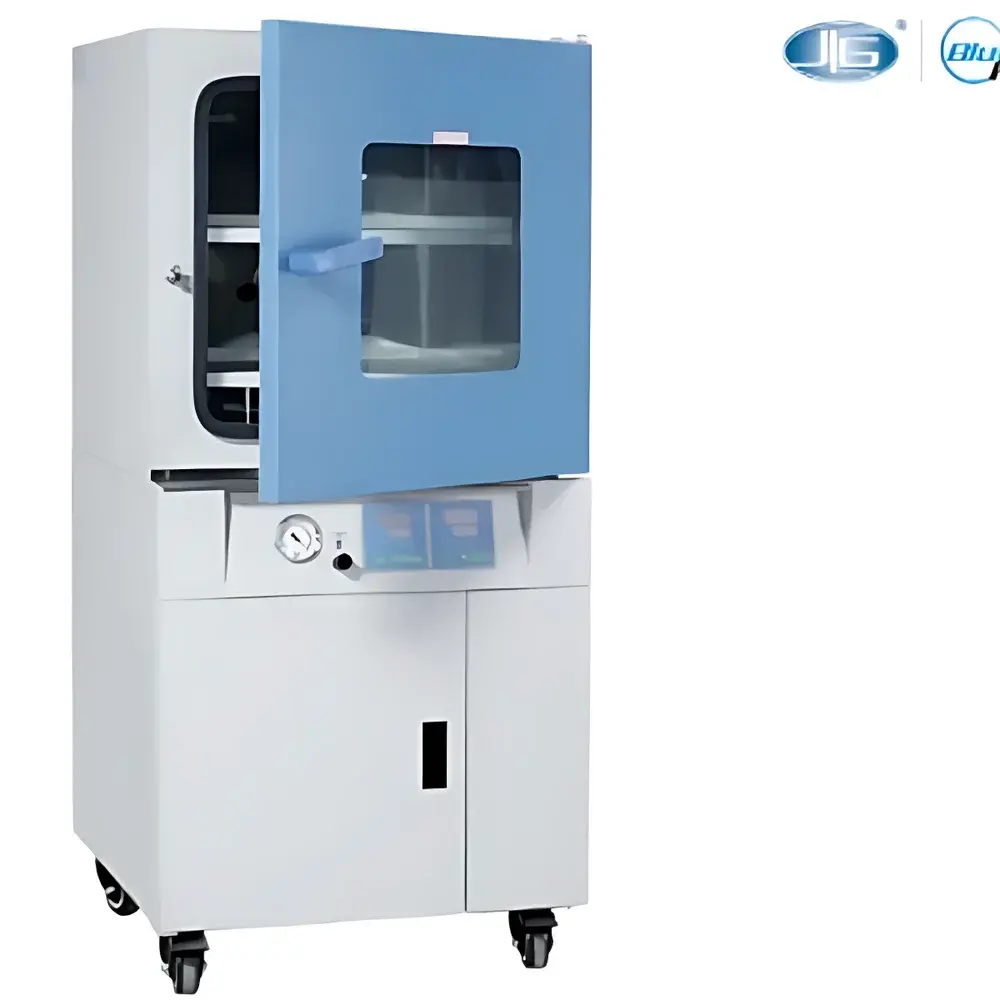
Yiheng BPZ-62003B Vacuum Drying Oven for Electronics & Semiconductor Manufacturing
| Brand | Yiheng |
|---|---|
| Origin | Jiangsu, China |
| Model | BPZ-62003B |
| Instrument Type | Vacuum Oven |
| Temperature Range | RT+10°C to 200°C |
| Vacuum Level | ≤133 Pa |
| Chamber Material | Stainless Steel 304 (1Cr18Ni9Ti) |
| Interior Dimensions (W×D×H) | 900×1500×1500 mm |
| Power Supply | AC 380 V, 50 Hz |
| Input Power | 12.8 kW |
| Temperature Resolution/Uniformity | 0.1°C / ±1°C |
| Observation Window | Dual-layer tempered glass |
| Door Seal | Molded silicone rubber gasket |
| Safety | Over-temperature protection circuit |
| Optional | Programmable controller, inert gas inlet valve, oil mist filter, water trap, nitrogen purge interface |
Overview
The Yiheng BPZ-62003B Vacuum Drying Oven is an industrial-grade thermal processing system engineered for precision vacuum drying and heat treatment in electronics and semiconductor manufacturing environments. It operates on the principle of reduced-pressure thermal desorption—lowering the boiling point of volatile contaminants (e.g., solvents, moisture, residual process gases) to enable gentle, uniform drying without thermal degradation. Designed specifically for high-reliability applications—including lithium-ion battery electrode drying, LED packaging, quartz crystal resonator stabilization, and photonic component post-cleaning treatment—the BPZ-62003B maintains stable vacuum integrity and precise temperature control across large-volume chambers. Its robust construction meets the mechanical and cleanliness requirements of Class 10,000 cleanroom-adjacent production lines, supporting repeatable batch processing under controlled atmospheric conditions.
Key Features
- Spacious stainless steel 304 (1Cr18Ni9Ti) chamber (900 × 1500 × 1500 mm) with electropolished interior surfaces for corrosion resistance and particle minimization.
- Dual-layer tempered glass observation window with argon-filled interlayer for enhanced thermal insulation and real-time visual monitoring without vacuum interruption.
- Adjustable door clamping mechanism and integrally molded silicone rubber gasket ensure long-term vacuum integrity down to ≤133 Pa (equivalent to ~1 Torr).
- Dedicated high-capacity vacuum system: factory-integrated branded vacuum pump (oil-lubricated, low-noise, continuous-duty), rated for stable operation at ≤10⁻¹ mbar base pressure.
- Independent temperature control for up to six removable stainless steel shelves—enabling zonal thermal profiling for multi-layer substrate stacks or mixed-component loads.
- Over-temperature safety cutoff with redundant thermocouple input and fail-safe relay—compliant with IEC 61000-6-2 EMC immunity standards for industrial laboratories.
- Optional programmable logic controller (PLC) with 30-segment ramp-soak profiles, supporting synchronized vacuum hold, heating ramp, and inert gas (N₂ or Ar) purge sequences.
Sample Compatibility & Compliance
The BPZ-62003B accommodates large-format wafers, PCB assemblies, pouch cells, ceramic substrates, and optoelectronic modules—without requiring custom fixtures. Its chamber geometry supports vertical stacking of carrier trays and compatibility with standard JEDEC trays (up to 300 mm × 300 mm footprint). The system complies with ISO 14644-1 (cleanroom particulate classification), ASTM E29-23 (significant figures in test data reporting), and GB/T 29251–2012 (Chinese national standard for vacuum ovens). When equipped with optional inert gas inlet and exhaust filtration, it supports GMP-aligned processes per FDA 21 CFR Part 11 Annex 11 requirements for audit-trail-capable parameter logging.
Software & Data Management
The optional programmable controller provides Ethernet-enabled RS485/Modbus RTU communication for integration into centralized MES or SCADA platforms. All temperature setpoints, vacuum levels, dwell times, and alarm events are timestamped and stored locally with ≥10,000-cycle non-volatile memory. Data export is supported via USB flash drive in CSV format, enabling traceability for quality documentation (e.g., IQ/OQ/PQ protocols). Audit trails include operator ID, parameter changes, and system status transitions—meeting GLP/GMP data integrity criteria as defined in ALCOA+ principles.
Applications
- Lithium-ion battery cathode/anode drying: removal of NMP solvent residues and adsorbed moisture prior to cell assembly.
- LED phosphor coating stabilization: thermal curing under vacuum to suppress bubble formation and interfacial delamination.
- Quartz crystal blank aging: accelerated stress relief and frequency drift reduction during post-metallization bake cycles.
- MEMS package outgassing: pre-seal degassing of cavity structures to minimize internal pressure shift over operational lifetime.
- PCB conformal coating post-bake: solvent evaporation under sub-atmospheric conditions to prevent blistering and pinholes.
- Optical lens assembly drying: moisture elimination from anti-reflective multilayer coatings without thermal distortion.
FAQ
What vacuum level can the BPZ-62003B achieve, and how is it verified?
The system achieves ≤133 Pa (1 Torr) under standard operating conditions; verification is performed using a calibrated Pirani gauge traceable to NIST standards during factory acceptance testing.
Is the chamber suitable for oxygen-sensitive materials?
Yes—when configured with the optional inert gas inlet valve and nitrogen purge protocol, the chamber can be evacuated and backfilled to <10 ppm O₂ residual concentration.
Can temperature uniformity be validated per ASTM E2203?
Yes—nine-point mapping per ASTM E2203-22 is supported using calibrated PT100 sensors; Yiheng provides a certified uniformity report (±1°C at 150°C, empty chamber) with each unit.
What maintenance intervals are recommended for the vacuum pump?
Oil changes every 500 operating hours; oil mist filter replacement every 6 months; annual calibration of vacuum gauge and temperature sensors.
Does the system support remote monitoring via Ethernet or Modbus?
Yes—the optional PLC controller includes embedded TCP/IP stack and Modbus TCP server functionality for integration with LabVIEW, Ignition, or Siemens S7 environments.



