
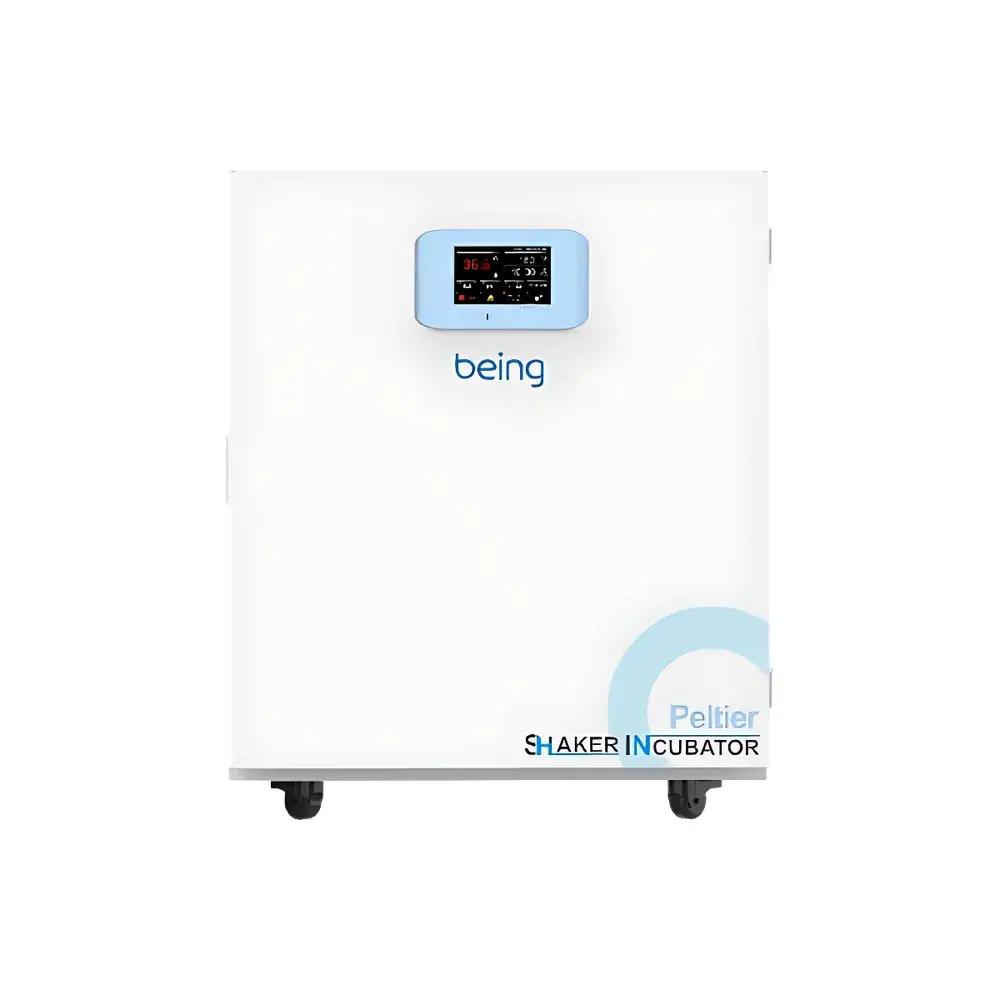
YiHeng BSI-30E Peltier-Cooled Orbital Incubator Shaker
| Brand | YiHeng |
|---|---|
| Origin | Jiangsu, China |
| Manufacturer Type | Direct Manufacturer |
| Country of Origin | China |
| Model | BSI-30E |
| Cooling Method | Thermoelectric (Peltier) |
| Temperature Range | 10–65 °C |
| Temperature Accuracy | ±0.2 °C |
| Temperature Uniformity | ≤±0.5 °C (@37 °C) |
| Chamber Dimensions (W×D×H) | 520×610×620 mm |
| External Dimensions (W×D×H) | 820×800×852 mm |
Overview
The YiHeng BSI-30E Peltier-Cooled Orbital Incubator Shaker integrates precise temperature control with uniform orbital agitation in a single compact platform. Engineered for life science laboratories requiring simultaneous thermal regulation and mechanical stimulation, it employs solid-state thermoelectric (Peltier) technology for bidirectional temperature control—enabling both heating and active cooling without compressors or refrigerants. This architecture eliminates oil-lubricated moving parts, reduces acoustic noise, and delivers rapid thermal response with low power consumption—typical energy savings exceeding 85% compared to conventional compressor-based systems. The unit operates across a broad physiological and experimental range (10–65 °C), maintaining high stability (±0.2 °C accuracy) and spatial uniformity (≤±0.5 °C at 37 °C), making it suitable for sensitive applications including mammalian cell culture, microbial fermentation, hybridization assays, enzyme kinetics, and tissue dissociation protocols.
Key Features
- Touchscreen HMI with bilingual (English/Chinese) interface and password-protected operation modes to prevent unauthorized parameter changes;
- Triple-eccentric-axis balanced drive mechanism ensuring consistent orbital motion across the entire shaker platform—even at maximum load and speed;
- Brushless DC motor with high starting torque, wide speed range (e.g., 20–300 rpm typical), and maintenance-free continuous operation capability;
- Microprocessor-based PID control for independent regulation of temperature and shaking frequency, with programmable ramping and hold segments;
- Multi-stage programming support: up to 99 segments for synchronized temperature, speed, and time profiles; real-time display of setpoint vs. actual values;
- Internal UV-C germicidal lamp (254 nm) for periodic decontamination of chamber air and surfaces, reducing airborne microbial load during sterile workflows;
- Dual independent overtemperature protection: primary PID-controlled limit + secondary hardware-based cutoff with audible/visual alarm;
- Robust construction: 304 stainless steel interior with radius-corner design for easy cleaning; high-density polyurethane foam insulation for minimal thermal leakage;
- 25 mm diameter access port on left side wall for sensor cabling, gas lines, or external monitoring devices;
- Power-failure recovery: all user-defined parameters retained in non-volatile memory and automatically resumed upon power restoration.
Sample Compatibility & Compliance
The BSI-30E accommodates standard laboratory vessels—including flasks (up to 5 L), culture bottles, multi-well plates, and test tubes—via interchangeable platforms and universal clamping systems. Its chamber volume (~195 L net) supports high-throughput configurations while maintaining airflow integrity. The system complies with IEC 61010-1 for electrical safety and meets essential requirements for GLP-compliant environments. Optional RS485 communication enables integration into centralized lab management systems supporting audit trails per FDA 21 CFR Part 11 when paired with validated software. All materials in contact with samples conform to USP Class VI biocompatibility standards. UV sterilization cycles are configurable and documented via internal event log.
Software & Data Management
Data logging is performed internally with timestamped records of temperature, speed, and runtime. Standard USB port allows direct export of CSV-formatted logs to USB flash drives for offline analysis. Optional RS485 interface supports Modbus RTU protocol for remote monitoring and data acquisition using third-party SCADA or LIMS platforms. An optional mobile application provides push notifications for fault conditions (e.g., temperature deviation, door open, UV cycle completion), real-time status viewing, and remote parameter adjustment—subject to network configuration and role-based authentication. Audit trail functionality includes operator ID, timestamp, action type, and pre-/post-change values where enabled.
Applications
This incubator shaker is routinely deployed in academic research labs, biopharmaceutical QC/QA departments, and contract development organizations for applications such as: suspension cell expansion under controlled O2/CO2-compatible conditions (when used with external gas mixing modules); recombinant protein expression in E. coli or yeast; bacterial growth curve analysis; biochemical assay development requiring kinetic mixing; primary neuron culture maintenance; and microbiological enrichment protocols. Its stable thermal environment and reproducible agitation profile support ISO/IEC 17025 method validation requirements when operated within defined SOPs.
FAQ
Does the BSI-30E support CO2 or humidity control?
No—this model is designed for temperature and agitation only. Humidity and CO2 control require auxiliary modules not integrated into the base unit.
What is the maximum flask size supported on the standard platform?
The standard dual-platform configuration accommodates two 5 L Erlenmeyer flasks or up to eight 1 L flasks simultaneously.
Is the Peltier cooling system suitable for sub-ambient operation?
Yes—the thermoelectric module enables active cooling down to 10 °C ambient, though performance depends on room temperature and heat dissipation capacity.
Can the UV lamp be scheduled independently of incubation cycles?
Yes—UV sterilization duration and timing can be programmed separately from temperature/shaking routines via the touchscreen interface.
What safety certifications does the unit carry?
It conforms to IEC 61010-1:2010 for laboratory equipment safety and carries CE marking for EMC and Low Voltage Directive compliance.
Is firmware upgrade supported in the field?
Yes—firmware updates are delivered via USB and applied through the system maintenance menu, preserving all user settings and calibration data.




