
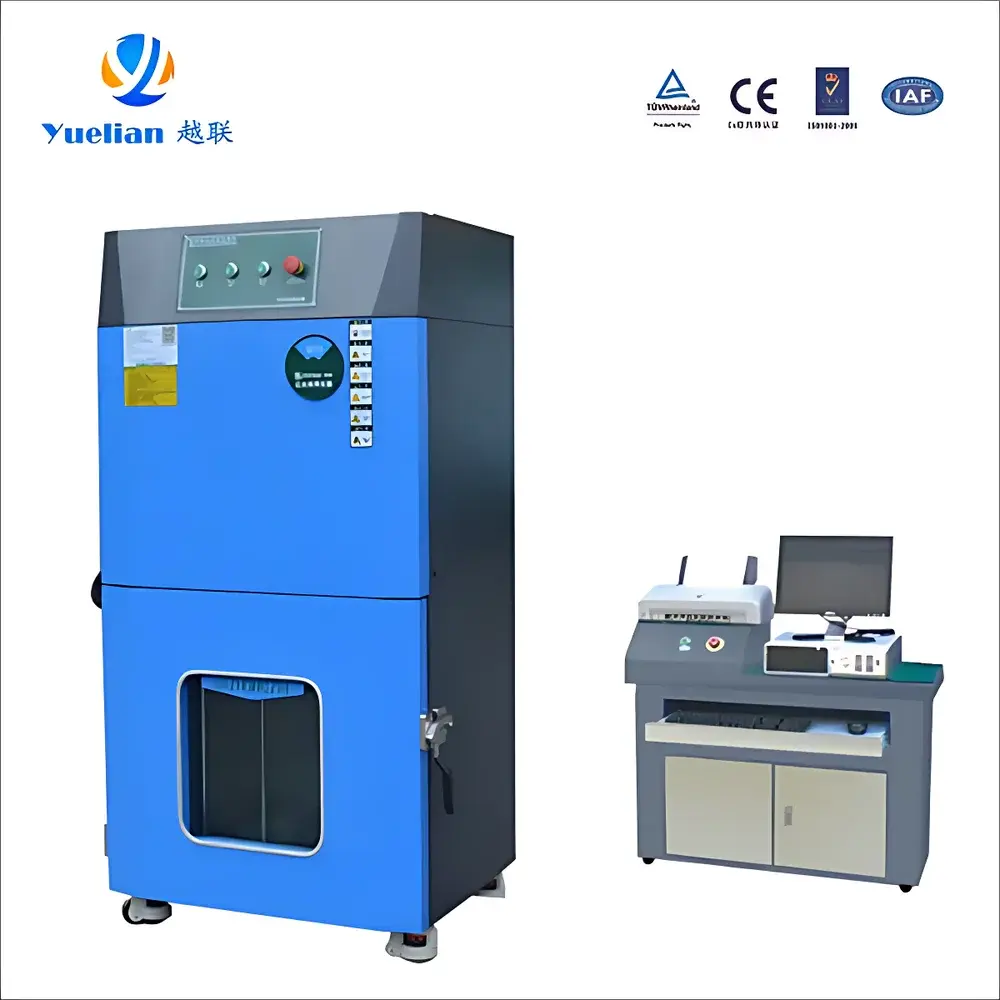
YL-JY-2T Battery Crush Tester by Yuelian
| Key | Brand: Yuelian |
|---|---|
| Model | YL-JY-2T |
| Max Crushing Force | 20 kN (2 metric tons) |
| Max Sample Dimensions | 300 × 300 mm (W × D) |
| Stroke Range | 0–300 mm (adjustable) |
| Speed Range | 1–500 mm/min (programmable) |
| Force Accuracy | ±0.5% of reading |
| Force Resolution | 1/500,000 full scale |
| Displacement Accuracy | ±0.5% of reading |
| Displacement Resolution | 0.01 mm |
| Voltage Measurement | 0–36 V (±0.1% FS) |
| Temperature Measurement | 0–300 °C (±1 °C) |
| Data Acquisition Rate | ≥30 Hz |
| Compliance | Meets UN 38.3, IEC 62133, GB/T 31241, UL 1642, and ISO 12405 test requirements for mechanical abuse evaluation |
Overview
The YL-JY-2T Battery Crush Tester is an engineered mechanical abuse testing system designed to evaluate the structural integrity and safety response of lithium-ion and other rechargeable battery cells under controlled uniaxial compressive loading. Operating on the principle of quasi-static force application via a servo-controlled hydraulic or electromechanical actuator, the system applies calibrated compressive loads perpendicular to electrode planes—per ASTM F3048 Annex A1, UN Manual of Tests and Criteria Part III, subsection 38.3.5, and IEC 62133-2:2017 Clause 7.2.1—while simultaneously monitoring real-time voltage, surface temperature, displacement, and applied force. Its architecture supports standardized crush protocols for cylindrical (aligned with longitudinal axis parallel to platens), prismatic, pouch, and coin-cell formats, ensuring reproducible boundary conditions critical for hazard identification during thermal runaway initiation studies.
Key Features
- High-fidelity dual-channel synchronized data acquisition: captures voltage (0–36 V, ±0.1% FS), surface temperature (0–300 °C, ±1 °C), force (up to 20 kN), displacement (0–300 mm), and time at ≥30 samples per second—enabling precise correlation of electrochemical and mechanical failure onset.
- Programmable motion control: stroke range 0–300 mm with 0.01 mm resolution; speed adjustable from 1 to 500 mm/min, supporting both constant-rate and load-hold profiles per ISO 12405-2 and GB/T 31241-2014 Annex E.
- Robust safety-integrated enclosure: 12-mm thick cold-rolled steel outer chassis (gray + blue epoxy finish), 304 stainless steel inner chamber, dual-layer tempered explosion-proof observation window (350 × 400 mm), integrated LED lighting, forced-air exhaust, and automatic pressure-relief venting compliant with laboratory ventilation standards.
- Modular platen configuration: includes interchangeable, precision-ground stainless steel crushing plates with alignment guides; accommodates standard cell geometries without retooling—cylindrical (diameter ≤ 80 mm), prismatic (≤ 300 × 300 mm face), pouch (flat orientation), and coin cells (face-down compression).
- Compliance-ready software suite: features audit-trail-enabled test sequencing, GLP/GMP-aligned user access levels, electronic signature support, and automated report generation conforming to FDA 21 CFR Part 11 requirements where configured.
Sample Compatibility & Compliance
The YL-JY-2T is validated for use across primary and secondary battery chemistries including LiCoO₂, NMC, LFP, LiMn₂O₄, and emerging solid-state prototypes. It satisfies mandatory mechanical abuse test criteria defined in UN 38.3 Section 38.3.5 (crush test), IEC 62133-2:2017 Clause 7.2.1, UL 1642 Section 9, GB/T 31241-2014 Annex E, and ISO 12405-2:2012 Annex C. Test specimen orientation follows standardized conventions: cylindrical cells are placed with their longitudinal axis parallel to the direction of compression; prismatic and pouch cells are compressed across the largest planar surface; coin cells undergo axial compression between flat platens. Each test uses a single-use sample protocol per regulatory guidance to prevent cross-contamination and ensure statistical independence.
Software & Data Management
The proprietary Windows-based control platform provides real-time visualization of five-parameter curves (force, displacement, voltage, temperature, time) with overlay capability for comparative analysis. All raw data—including timestamps, operator ID, environmental metadata, and calibration logs—are stored in encrypted SQLite databases with SHA-256 hashing. Export functions support CSV, Excel (.xlsx), and PDF formats; cloud upload modules (optional) integrate with LIMS environments via HTTPS RESTful API. Software validation documentation—including IQ/OQ protocols, traceability matrices, and cybersecurity risk assessments—is available upon request for regulated QA/QC laboratories operating under ISO/IEC 17025 or GMP frameworks.
Applications
- Evaluation of cell-level mechanical robustness prior to module/pack integration
- Root-cause analysis of internal short-circuit initiation under compressive stress
- Validation of separator integrity and electrode stack stability under deformation
- Supporting DOE-driven parameter optimization for battery housing design
- Regulatory submission testing for transport safety (UN 38.3), consumer electronics (IEC 62133), and EV battery systems (GB/T 31485)
- Research into thermal runaway propagation thresholds in multi-cell arrays
FAQ
What safety certifications does the YL-JY-2T comply with?
The system meets mechanical design and operational safety requirements per IEC 61000-6-2 (EMC immunity), IEC 61000-6-4 (EMC emissions), and EN 60204-1 (electrical equipment of machines). Its enclosure conforms to IP2X-rated personnel protection standards.
Can the system be integrated with external thermal imaging or high-speed cameras?
Yes—standardized digital I/O ports and TTL-triggered synchronization interfaces enable hardware-level coordination with third-party thermal cameras (e.g., FLIR Axxx series) and high-speed vision systems (≥1,000 fps) for multimodal failure characterization.
Is calibration traceable to national metrology institutes?
Force and displacement transducers are supplied with NIST-traceable calibration certificates (valid for 12 months); optional annual recalibration services include uncertainty budgets per ISO/IEC 17025.
Does the software support multi-user role-based access control?
Yes—administrator, technician, and reviewer roles enforce separation of duties; all actions are logged with timestamp, user ID, and parameter change history for audit readiness.
What maintenance intervals are recommended?
Preventive maintenance is scheduled every 6 months or after 500 test cycles—covering actuator lubrication, sensor zero-check, emergency stop verification, and exhaust duct inspection per manufacturer’s service manual.



