
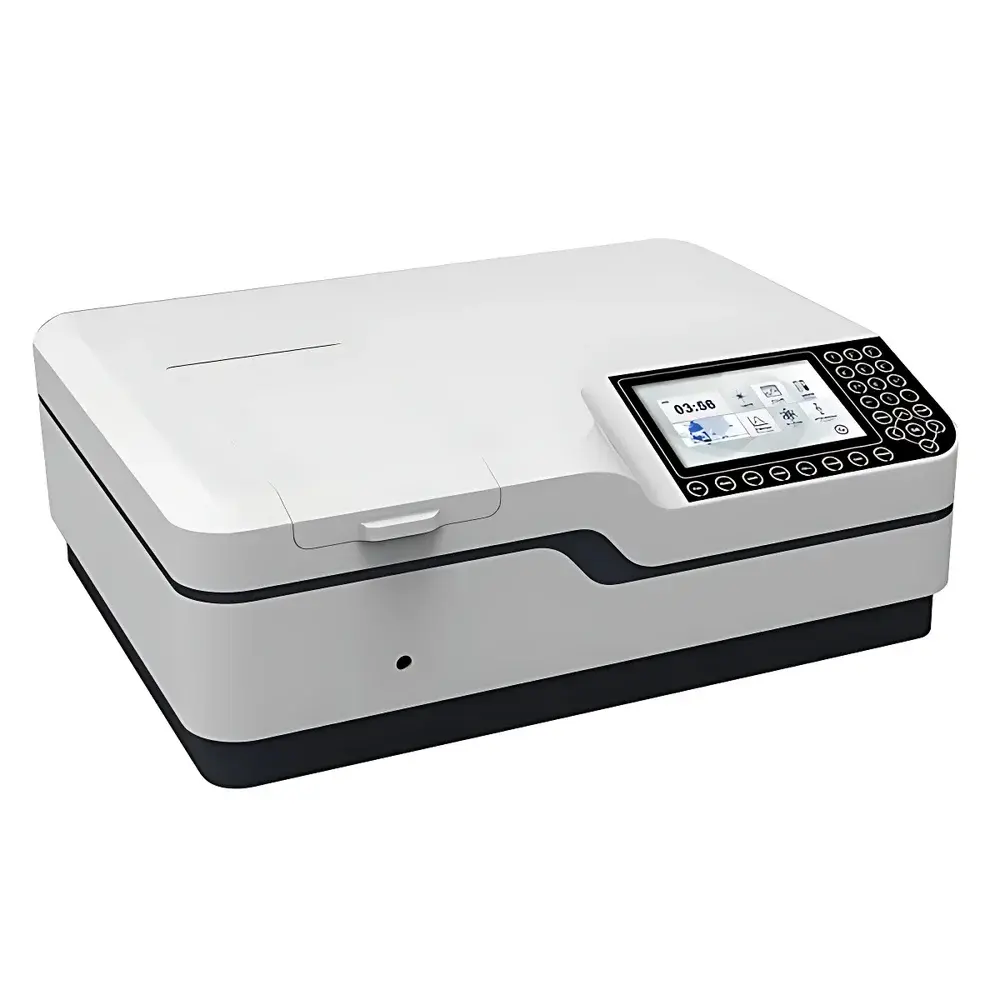
Yoke T2602 Dual-Beam UV-Vis Spectrophotometer
| Brand | Yoke |
|---|---|
| Origin | Shanghai, China |
| Manufacturer Type | Direct Manufacturer |
| Model | T2602 |
| Optical System | Dual-Beam |
| Detector | Photodiode Array (PDA) |
| Wavelength Range | 190–1100 nm |
| Wavelength Accuracy | ±0.3 nm (full range), ±0.1 nm at 656.1 nm |
| Spectral Bandwidth | 2 nm (fixed) |
| Stray Light | ≤0.05% at 220 nm |
| Transmittance Accuracy | ±0.3% T |
| Wavelength Repeatability | ±0.1 nm |
| Display | 7-inch TFT LCD (1024 × 600) |
| Data Storage | Internal 16 GB + USB Host support |
| Interfaces | RS-232C, USB Drive, USB HOST |
| Light Sources | Imported deuterium lamp & tungsten-halogen lamp |
| Optical Design | Czerny-Turner monochromator with suspended optical bench |
Overview
The Yoke T2602 Dual-Beam UV-Vis Spectrophotometer is a precision optical instrument engineered for quantitative and qualitative analysis across the ultraviolet, visible, and near-infrared spectral regions (190–1100 nm). It operates on the fundamental principle of Beer-Lambert law-based absorbance measurement, utilizing a dual-beam optical architecture to continuously balance reference and sample beam intensities in real time. This design eliminates baseline drift caused by source intensity fluctuation or detector sensitivity drift—critical for long-duration kinetic assays or temperature-dependent measurements. The instrument employs a Czerny-Turner monochromator with a fixed 2 nm spectral bandwidth and high-stability imported deuterium and tungsten-halogen lamps, ensuring consistent photometric performance over extended operational cycles. Its suspended optical bench and reinforced aluminum baseplate mitigate mechanical vibration and thermal deformation effects, contributing to high wavelength reproducibility (±0.1 nm) and photometric stability (±0.001 A/h at 500 nm after warm-up).
Key Features
- 7-inch high-resolution TFT color display (1024 × 600) with intuitive graphical interface—enables full spectral scanning, kinetic profiling, multi-wavelength quantitation, and standard curve generation without external PC dependency.
- Dual-beam optical path with real-time reference compensation ensures robust baseline stability during extended measurements, including time-resolved kinetics and temperature ramping experiments.
- Photodiode array (PDA) detector provides rapid spectral acquisition (≤1 s per full scan) and eliminates mechanical slit movement errors associated with single-point detectors.
- ARM11-based embedded computing platform supports local storage of up to 2,000 absorbance readings or 500 calibration curves; internal 16 GB flash memory enables persistent data retention independent of external media.
- Patented optoelectronic signal detection module (Chinese Patent ZL 2010 2 0562320.3) enhances signal-to-noise ratio and improves photometric linearity across the full dynamic range (0–3.5 A).
- Modular hardware architecture facilitates field-upgradable components—including optional 8-position rotating cuvette changer (patented centering mechanism) and integrated flow cell adapter for automated liquid handling integration.
Sample Compatibility & Compliance
The T2602 accommodates standard 10 mm square quartz, glass, or plastic cuvettes (pathlengths from 1 mm to 50 mm via optional holders), as well as micro-volume adapters (down to 2 µL) and fiber-optic probes for non-contact or in-situ applications. It meets core international performance benchmarks defined in ISO/IEC 17025 for laboratory equipment validation and aligns with ASTM E275, USP , and EP 2.2.25 for spectrophotometric system suitability testing. While not pre-certified for FDA 21 CFR Part 11, its audit-trail-capable firmware (with timestamped user log entries and immutable data export logs) supports implementation in GLP/GMP environments when deployed with documented SOPs and periodic verification protocols.
Software & Data Management
All spectral and quantitative data are natively exportable in vendor-neutral formats: CSV (for Excel-compatible tabular analysis), QUA (instrument-native binary format), TXT (ASCII-readable), and BMP (publication-ready spectral plots). No proprietary software installation is required—data files open directly in common spreadsheet or image viewers. USB HOST port allows direct connection of standard FAT32-formatted USB drives; RS-232C interface supports legacy printer output or integration into centralized lab networks via serial-to-Ethernet gateways. Firmware updates are delivered via USB drive with cryptographic signature verification to ensure integrity and traceability.
Applications
The T2602 serves as a foundational analytical tool in regulated and research-intensive settings: pharmaceutical QC (active ingredient assay, dissolution testing, excipient compatibility), environmental monitoring (nitrate, phosphate, COD determination per APHA methods), food safety (colorant quantification, antioxidant capacity via DPPH assay), clinical biochemistry (enzyme kinetics, protein quantitation via Bradford/Lowry), and academic spectroscopy education (bandgap estimation of semiconductors, ligand-field transition analysis). Its dual-beam stability and low stray light (<0.05% at 220 nm) make it suitable for high-sensitivity nucleic acid and protein work in the far-UV region.
FAQ
Is the T2602 compliant with FDA 21 CFR Part 11?
The instrument does not include built-in electronic signature or role-based access control modules required for out-of-the-box Part 11 compliance. However, its immutable data export logs, user activity timestamps, and firmware update traceability enable qualification under a site-specific Part 11 implementation plan.
Can the T2602 perform kinetic measurements over extended durations?
Yes—the dual-beam architecture and thermally stabilized optical bench support kinetic runs exceeding 60 minutes with ≤±0.002 A drift at 280 nm, provided ambient temperature variation remains within ±2 °C.
What cuvette types are supported without modification?
Standard 10 mm pathlength quartz, borosilicate glass, and UV-transparent polystyrene cuvettes are fully compatible. Custom pathlengths require optional holder accessories; micro-volume cells require separate adapter kits.
Does the instrument support wavelength scanning in absorbance mode only?
No—it simultaneously acquires and displays transmittance (%T), absorbance (A), concentration (via stored calibration curves), and energy (mW/cm²) modes, all with real-time unit conversion and auto-scaling.
How is photometric accuracy verified during routine operation?
Users may perform daily verification using NIST-traceable holmium oxide (241, 279, 287, 333, 360, 418, 460, 485, 536 nm) and potassium dichromate (235, 257, 313, 350 nm) reference standards per USP .





