
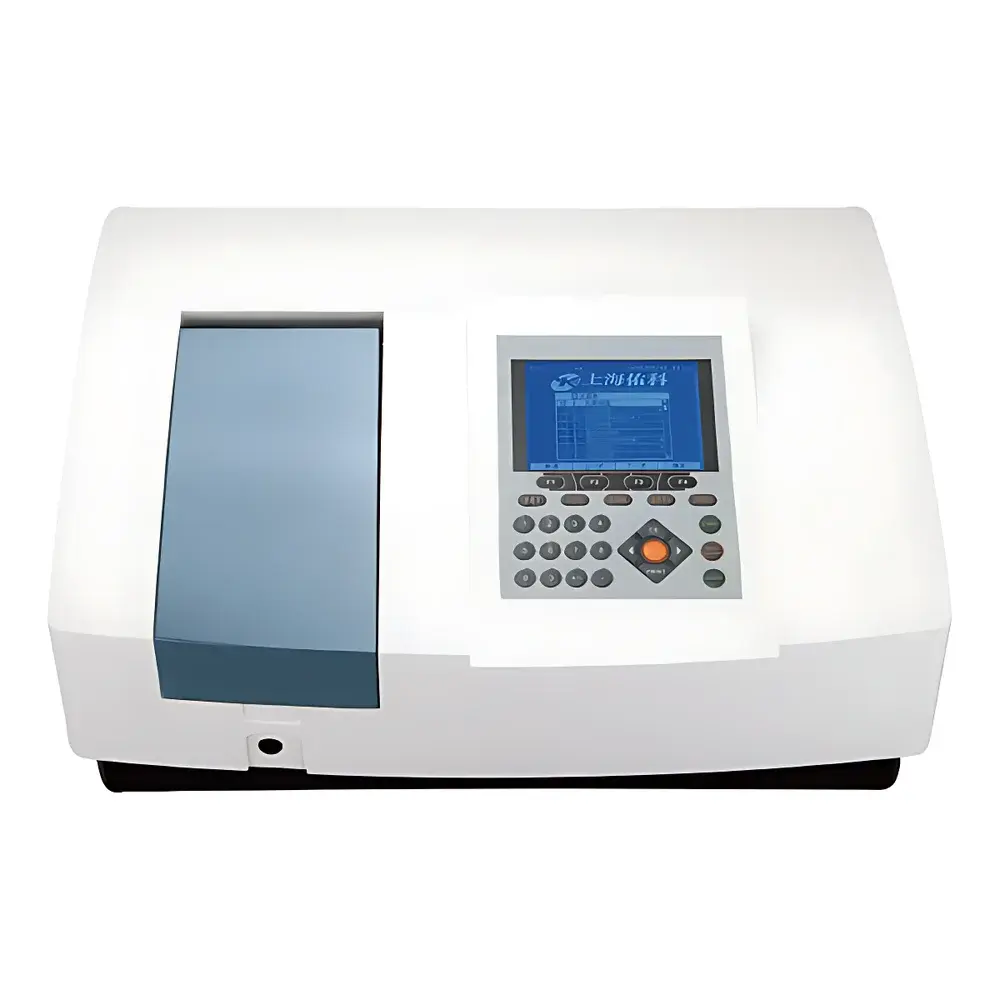
Yoke UV1810 UV-Vis Spectrophotometer
| Brand | Yoke |
|---|---|
| Origin | Shanghai, China |
| Manufacturer Type | Direct Manufacturer |
| Model | UV1810 |
| Instrument Architecture | Pseudo-Double-Beam |
| Detector | Photodiode Array (PDA) |
| Wavelength Range | 190–1100 nm |
| Automation Level | Automatic Wavelength Scanning |
| Spectral Bandwidth | 1 nm |
| Wavelength Accuracy | ±0.1 nm at D₂ line (656.1 nm), ±0.3 nm across full range |
| Stray Light | ≤0.03% T |
Overview
The Yoke UV1810 UV-Vis Spectrophotometer is a high-performance, pseudo-double-beam scanning instrument engineered for precision absorbance, transmittance, and concentration measurements across the ultraviolet, visible, and near-infrared spectral regions (190–1100 nm). Based on a robust optical architecture featuring a high-efficiency 1200 lines/mm holographic grating and imported silicon photodiode array detection, the UV1810 delivers exceptional wavelength fidelity, low stray light, and long-term photometric stability—critical attributes for routine QC/QA, academic research, and method development in pharmaceutical, environmental, biochemical, and materials laboratories. Its ARM-based embedded platform supports dual-language (English/Chinese) operation without external PC dependency, enabling standalone execution of spectral scanning, kinetic assays, multi-wavelength analysis, DNA/protein quantification (using standard 260/280 nm protocols), and fixed-wavelength photometry.
Key Features
- Pseudo-double-beam optical design with real-time reference beam compensation, minimizing drift from source intensity fluctuations and temperature-induced baseline shifts.
- High-resolution 320 × 240 pixel, 6-inch backlit LCD display—enables direct visualization of full-spectrum scans, peak identification, and real-time data overlay without software tethering.
- Plug-and-play deuterium and tungsten-halogen lamps with pre-aligned sockets; lamp replacement requires no optical recalibration or mechanical adjustment.
- 24-bit high-speed analog-to-digital conversion ensures superior signal-to-noise ratio, photometric resolution down to 0.0001 A, and rapid spectral acquisition (typical scan speed: 12,000 nm/min).
- Suspended optical bench and extended optical path length enhance mechanical rigidity and reduce vibration sensitivity—contributing to baseline flatness of ±0.0015 A and thermal drift of ≤±0.0005 A/h at 500 nm.
- Universal sample compartment accommodating cuvettes from 5 mm to 100 mm pathlength; compatible with standard 10 mm quartz, glass, or plastic cells.
- Optional patented rotating octagonal auto-sampler (Patent No. ZL 2010 2 0562307.8) ensures consistent beam positioning, eliminates lateral misalignment common in dual-row racks, and improves inter-sample repeatability.
Sample Compatibility & Compliance
The UV1810 supports liquid, suspension, and solution-phase samples in standard spectrophotometric cuvettes. Its 1 nm spectral bandwidth and ≤0.03% T stray light meet performance criteria outlined in ISO 9001-compliant analytical workflows and are suitable for applications referenced in USP , EP 2.2.25, and ASTM E275 for spectrophotometer verification. While not inherently 21 CFR Part 11 compliant out-of-the-box, the instrument’s USB data export capability enables integration into validated LIMS or ELN environments where audit trails, electronic signatures, and user access controls are externally managed. The system adheres to IEC 61010-1 safety standards for laboratory electrical equipment.
Software & Data Management
Internal firmware handles all core measurement modes—including photometric (T/A/C/E), quantitative (single/multi-point calibration), kinetic (time-resolved absorbance tracking), spectral scanning (full-range or user-defined windows), and nucleic acid/protein analysis (with built-in ε values and dilution calculators). Raw spectral data and measurement logs are stored in CSV format via USB flash drive, facilitating downstream processing in MATLAB, Origin, or Excel. Optional PC-based software (sold separately) provides advanced curve fitting, derivative spectroscopy, and GLP-compliant report generation with timestamped metadata, operator ID fields, and instrument configuration snapshots—supporting traceability in GMP-regulated environments.
Applications
- Quantitative analysis of active pharmaceutical ingredients (APIs) per pharmacopeial monographs.
- Determination of nucleic acid concentration and purity (A₂₆₀/A₂₈₀, A₂₆₀/A₂₃₀ ratios) in molecular biology workflows.
- Enzyme kinetics monitoring (e.g., NADH/NADPH oxidation at 340 nm) under controlled temperature conditions.
- Colorimetric assay validation (e.g., Bradford, Lowry, BCA) with multi-point calibration and error propagation reporting.
- Thin-film and nanoparticle characterization via absorption edge analysis and Tauc plot derivation.
- Water quality testing (nitrate, phosphate, COD estimation) using EPA-approved colorimetric methods.
FAQ
Does the UV1810 support GLP-compliant data integrity requirements?
The standalone unit does not include electronic signature, role-based access control, or audit trail functionality. However, its USB-exported CSV files retain full metadata (wavelength, absorbance, date/time stamp, operator notes), enabling integration into validated third-party data management systems that enforce 21 CFR Part 11 or EU Annex 11 compliance.
Can the instrument be calibrated using NIST-traceable standards?
Yes—absorbance accuracy verification may be performed using NIST SRM 930e (neutral density filters) and SRM 2034 (peak wavelength standards); wavelength calibration is verified using holmium oxide and didymium filters per ISO/IEC 17025 guidelines.
What is the typical warm-up time before achieving photometric stability?
Optimal stability is reached within 20 minutes after lamp ignition; the instrument’s thermal management system maintains detector and optics at steady-state temperature to minimize baseline drift during extended scans.
Is the optional auto-sampler compatible with microvolume or capillary cuvettes?
No—the patented octagonal rack is designed exclusively for standard rectangular cuvettes (12.5 × 12.5 mm footprint) with pathlengths from 5 mm to 100 mm. Microvolume adapters require manual placement.
How frequently should wavelength and photometric accuracy be verified?
Per ISO/IEC 17025 and internal QA protocols, wavelength accuracy should be checked daily before use; photometric accuracy and stray light verification are recommended weekly or after lamp replacement.






