
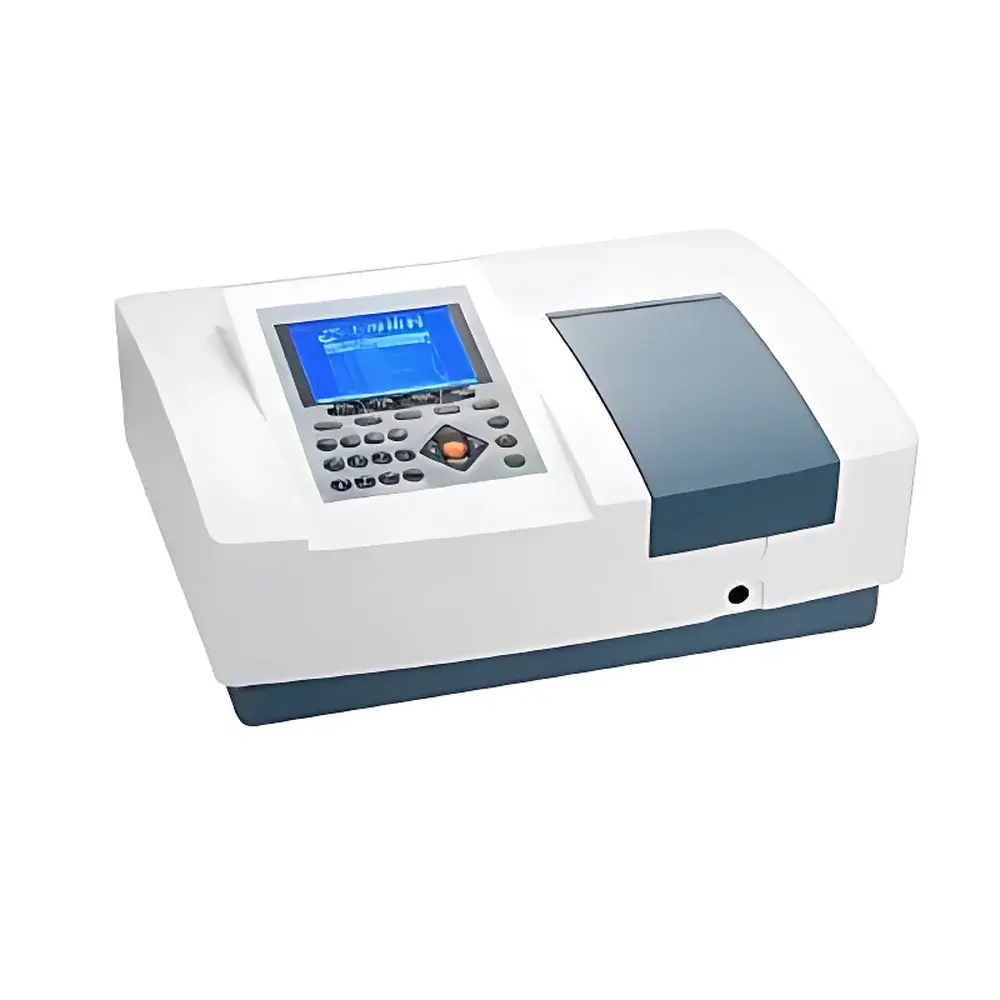
Yoke UV1810S Adjustable Spectral Bandwidth UV-Vis Spectrophotometer
| Brand | Yoke |
|---|---|
| Origin | Shanghai, China |
| Manufacturer Type | Original Equipment Manufacturer (OEM) |
| Instrument Architecture | Pseudo-double-beam |
| Detector | Photodiode Array (PDA) |
| Wavelength Range | 190–1100 nm |
| Wavelength Accuracy | ±0.1 nm (at D₂ line, 656.1 nm) |
| Spectral Bandwidth | Adjustable at 0.5 / 1.0 / 2.0 / 4.0 / 5.0 / 6.0 nm |
| Stray Light | ≤0.03% T |
| Photometric Accuracy | ±0.002 A (0–0.5 A), ±0.004 A (0.5–1.0 A), ±0.2% T (0–100% T) |
| Photometric Repeatability | ±0.001 A (0–0.5 A), ±0.002 A (0.5–1.0 A), ±0.15% T (0–100% T) |
| Baseline Flatness | ±0.0015 A |
| Drift | ±0.0005 A/h (at 500 nm) |
| Sample Compartment | Accommodates cuvettes from 5 mm to 100 mm pathlength |
| Data Interface | USB 2.0 |
| Display | 6-inch high-brightness LCD, 320 × 240 pixels |
| Light Sources | Imported long-life tungsten halogen lamp and deuterium lamp |
| Weight | 18 kg |
Overview
The Yoke UV1810S is a high-performance, pseudo-double-beam UV-Vis spectrophotometer engineered for precision absorbance, transmittance, and concentration measurements across the ultraviolet, visible, and near-infrared spectral regions (190–1100 nm). Its optical architecture integrates a high-efficiency 1200 lines/mm holographic grating with a thermally stabilized photodiode array detector, enabling robust signal acquisition and high wavelength fidelity. The instrument operates on an embedded ARM-based platform supporting dual-language (English/Chinese) firmware, ensuring intuitive operation in international laboratory environments without reliance on external PCs. Designed for compliance with fundamental spectroscopic metrology requirements, the UV1810S delivers traceable wavelength accuracy (±0.1 nm at the deuterium 656.1 nm reference line) and low stray light (<0.03% T), critical for quantitative analysis of low-absorbance biological samples and high-concentration industrial formulations.
Key Features
- Pseudo-double-beam optical design with real-time reference beam correction, minimizing drift from source instability or environmental fluctuations.
- Adjustable spectral bandwidth (0.5, 1.0, 2.0, 4.0, 5.0, or 6.0 nm) — selectable via front-panel interface — to optimize resolution vs. signal-to-noise trade-offs per application (e.g., narrow bandwidth for sharp protein peaks; wider for rapid screening).
- Plug-and-play deuterium and tungsten-halogen lamps with socket-mounted alignment — lamp replacement requires no optical recalibration.
- High-stability mechanical architecture featuring suspended optical bench and extended optical path length, enhancing baseline reproducibility (±0.0015 A) and thermal robustness.
- 24-bit high-speed analog-to-digital conversion ensures precise digitization of photometric signals with minimal quantization error.
- Large sample compartment accommodating standard cuvettes (5–100 mm pathlength), compatible with optional patented rotating 8-position autosampler (Patent No.: ZL 2010 2 0562307.8) for unattended multi-sample workflows.
- Integrated 6-inch high-brightness LCD display (320 × 240 pixels) provides real-time spectral visualization, kinetic plots, and quantitative results without external monitoring hardware.
Sample Compatibility & Compliance
The UV1810S supports routine and regulated analytical workflows across pharmaceutical QC, academic research, food safety, and environmental testing laboratories. Its photometric accuracy (±0.2% T, ±0.004 A) and repeatability meet foundational performance criteria outlined in ASTM E275, ISO 6059, and USP . While not pre-certified for 21 CFR Part 11 compliance, the instrument’s USB data export capability enables integration into validated LIMS or ELN systems where audit trails, electronic signatures, and secure data archiving are implemented at the enterprise level. The wide cuvette compatibility (5–100 mm) accommodates both microvolume assays and standard 1-cm quartz cells, supporting applications ranging from nucleic acid quantification (A₂₆₀/A₂₈₀ ratio analysis) to heavy-metal complexometry.
Software & Data Management
Standalone operation is fully supported via the onboard ARM system: users perform photometric mode (T/A/C/E), quantitative calibration (single/multi-point), kinetic time-course studies, full-spectrum scanning (190–1100 nm), multi-wavelength analysis, and DNA/protein concentration calculations without PC dependency. Spectral and tabular data are saved directly to USB mass storage devices in CSV or proprietary binary format. Print output is enabled via parallel port connection to standard laboratory printers. For advanced data processing (e.g., derivative spectra, peak integration, method validation), exported CSV files are compatible with third-party software including OriginLab, MATLAB, and Excel-based QA/QC templates aligned with GLP documentation practices.
Applications
- Quantitative determination of pharmaceutical actives using Beer-Lambert law-based calibration curves.
- Enzyme kinetics monitoring via time-resolved absorbance at characteristic wavelengths (e.g., NADH at 340 nm).
- DNA, RNA, and protein purity assessment through dual-wavelength absorbance ratios (A₂₆₀/A₂₈₀, A₂₆₀/A₂₃₀).
- Colorimetric assay validation (e.g., BCA, Bradford, Lowry) under controlled bandwidth selection.
- Quality control of dyes, pigments, and optical filters requiring high-resolution spectral profiling.
- Environmental water analysis (e.g., nitrate, phosphate, COD) using standardized APHA/EPA-compliant methods.
FAQ
Is the UV1810S compliant with FDA 21 CFR Part 11?
The instrument itself does not include built-in electronic signature, audit trail, or role-based access control features required for direct Part 11 compliance. However, its USB data export functionality allows seamless integration into validated enterprise systems that provide those controls.
What is the minimum detectable absorbance change?
Based on photometric repeatability specifications (±0.001 A in 0–0.5 A range), the practical resolution limit for absorbance change detection is approximately 0.001–0.002 A under stable conditions.
Can the instrument be used with fiber-optic probes or flow cells?
Yes — the large sample compartment and fixed optical geometry support custom accessories, including fiber-optic couplers and flow-through cells, provided optical alignment and pathlength calibration are performed externally.
Does the adjustable slit width affect wavelength calibration?
No — spectral bandwidth selection alters only the entrance/exit slit configuration; wavelength calibration remains invariant and is maintained via internal deuterium and holmium oxide reference checks.
Is technical support available in English for international customers?
Yes — Yoke provides English-language user manuals, firmware updates, and remote troubleshooting assistance through authorized regional distributors. Hardware service contracts may be arranged locally upon purchase.





