
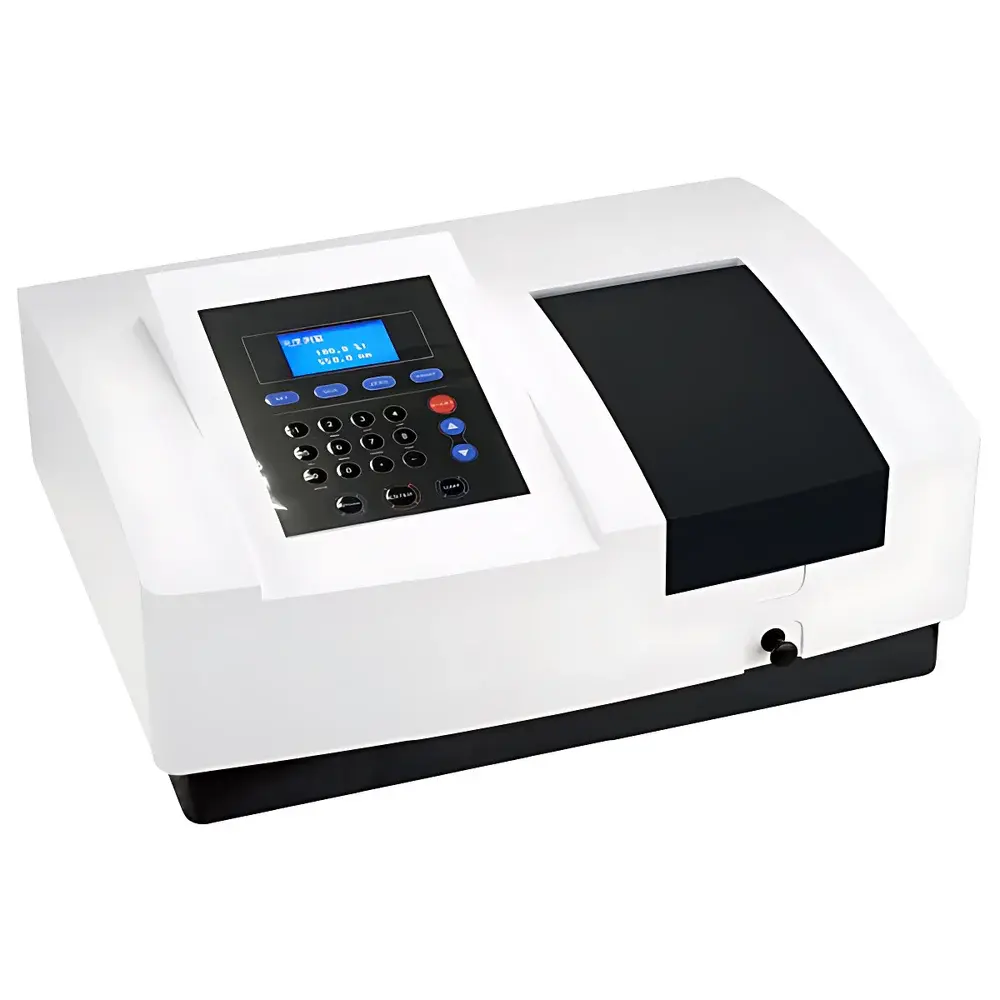
Yoke UV759 Scanning Ultraviolet-Visible Spectrophotometer
| Brand | Yoke |
|---|---|
| Origin | Shanghai, China |
| Manufacturer Type | Direct Manufacturer |
| Product Category | Domestic (China-made) |
| Model | UV759 |
| Price Range | USD 2,800–4,300 (FOB Shanghai) |
| Optical Design | Pseudo-Double-Beam |
| Detector | Photodiode Array (PDA) |
| Wavelength Range | 190–1100 nm |
| Wavelength Accuracy | ±0.3 nm |
| Wavelength Repeatability | 0.1 nm |
| Spectral Bandwidth | 1.8 nm |
| Stray Light | ≤0.05% T at 220 nm and 360 nm |
| Photometric Accuracy | ±0.3% T |
| Photometric Repeatability | 0.1% T |
| Absorbance Range | –0.30 to 3.00 A |
| Transmittance Range | 0.0–200.0% T |
| Concentration Range | 0–1999 units |
| Baseline Flatness | ±0.001 A |
| Drift | ±0.001 A/h at 500 nm |
| Interface | USB (RS-232 compatible) |
| Display | 128 × 64 dot-matrix LCD |
| Data Storage | Onboard memory for spectra and quantitative results |
| Optional Accessories | Thermal printer, PC software (UVWinPro), cuvette holders (1–10 cm), quartz/cuvette kits |
Overview
The Yoke UV759 Scanning Ultraviolet-Visible Spectrophotometer is a precision optical instrument engineered for routine and research-grade quantitative and qualitative analysis across the ultraviolet, visible, and near-infrared spectral regions (190–1100 nm). Based on pseudo-double-beam optical architecture, the UV759 compensates for source intensity drift and detector response variation in real time—enhancing measurement stability without requiring mechanical beam choppers or reference cell repositioning. Its core optical path integrates a high-efficiency 1200 lines/mm holographic grating, optimized collimation optics, and a thermally stabilized photodiode array (PDA) detector. This configuration enables rapid full-spectrum acquisition (scanning speed up to 3,000 nm/min), high wavelength fidelity (±0.3 nm accuracy), and low stray light performance (≤0.05% T at critical validation wavelengths of 220 nm and 360 nm), meeting essential requirements for pharmaceutical assay, environmental monitoring, biochemical quantification, and academic spectroscopy.
Key Features
- Pseudo-double-beam optical design with real-time reference correction, minimizing baseline drift during extended measurements.
- High-resolution 1200 lines/mm holographic grating paired with precision stepper-motor-driven wavelength drive for accurate and reproducible monochromator positioning (wavelength repeatability: 0.1 nm).
- Photodiode array (PDA) detector enabling simultaneous multi-wavelength detection—eliminating mechanical scanning delays and improving signal-to-noise ratio.
- Narrow, fixed spectral bandwidth of 1.8 nm—optimized for resolution-sensitive applications such as overlapping peak deconvolution and narrow absorption band characterization.
- Thermally stabilized tungsten-halogen and deuterium lamp sources with intelligent auto-switching logic at ~340 nm, ensuring seamless UV–Vis transition and extended lamp lifetime (>2,000 h typical).
- Embedded microprocessor-based control system with 128 × 64 graphical LCD display—supporting direct visualization of absorbance spectra, calibration curves, and numeric results without external hardware.
- Onboard data storage for up to 200 spectra and 500 quantitative results; expandable via USB interface for firmware updates and data export.
Sample Compatibility & Compliance
The UV759 accommodates standard 10 mm square quartz or glass cuvettes (pathlengths from 1–10 cm available via optional holders), supporting liquid, solution-phase, and suspended particulate samples. It complies with fundamental metrological standards referenced in ISO 6425:2020 (spectrophotometer performance verification) and aligns with key regulatory expectations for analytical instrumentation used in GLP and GMP environments—including traceable wavelength and photometric calibration, audit-ready baseline stability (±0.001 A/h at 500 nm), and documented stray light verification per ASTM E275-22. While not pre-certified for FDA 21 CFR Part 11, the optional UVWinPro software package supports electronic signatures, user access levels, and audit trail logging—facilitating compliance readiness for regulated laboratories.
Software & Data Management
The UV759 operates stand-alone but is fully compatible with UVWinPro, a Windows-based analytical software suite supporting method development, instrument control, and data evaluation. UVWinPro implements six primary operational modes: photometric measurement (A/T/C at fixed λ), quantitative analysis (linear/nonlinear calibration using single-point, multi-point, or dual-wavelength methods), full-spectrum scanning (with smoothing, peak detection, and overlay), kinetic studies (time-resolved absorbance tracking), multi-wavelength analysis (up to 10 user-defined λ points), and biomolecular analysis (DNA/Protein A260/A280 ratio calculation with built-in extinction coefficients). All raw spectral data are stored in ASCII-compatible .csv format; calibration files include metadata (date, operator ID, lamp hours) for traceability.
Applications
- Pharmaceutical quality control: Assay of active pharmaceutical ingredients (APIs) per USP and EP 2.2.25, dissolution testing, and excipient interference screening.
- Environmental analysis: Nitrate/nitrite quantification (EPA Method 353.2), COD determination, and heavy metal complexation studies using colorimetric reagents.
- Biochemistry & molecular biology: Nucleic acid purity assessment (A260/A280, A260/A230), protein concentration (Bradford/Lowry/Biuret), and enzyme kinetics (e.g., NADH oxidation at 340 nm).
- Academic teaching labs: Beer–Lambert law validation, spectral identification of organic chromophores, and comparative analysis of conjugated systems.
- Industrial R&D: Dye formulation optimization, polymer degradation monitoring via carbonyl index (1710 cm⁻¹ equivalent in UV-Vis), and thin-film transmittance profiling.
FAQ
Does the UV759 support GLP-compliant data integrity?
Yes—when used with UVWinPro software, it supports user authentication, electronic signatures, and time-stamped audit trails for all method changes and result exports.
What is the maximum scan speed and resolution?
Full 190–1100 nm scans complete in under 60 seconds at 1.0 nm data interval; resolution is governed by the fixed 1.8 nm spectral bandwidth and grating dispersion.
Can the instrument perform kinetic measurements over extended periods?
Yes—programmable time intervals (0.1 s to 9999 s), up to 9999 data points per run, and real-time plotting enable robust enzyme or reaction rate studies.
Is calibration traceable to NIST standards?
Wavelength calibration uses holmium oxide and didymium filters (certified per NIST SRM 2034/2035); photometric calibration employs neutral density filters traceable to national metrology institutes.
What maintenance is required for long-term stability?
Annual verification of wavelength accuracy, photometric linearity, and stray light performance is recommended; lamp replacement every 2,000 operating hours ensures optimal UV output and signal stability.
Related Products





