
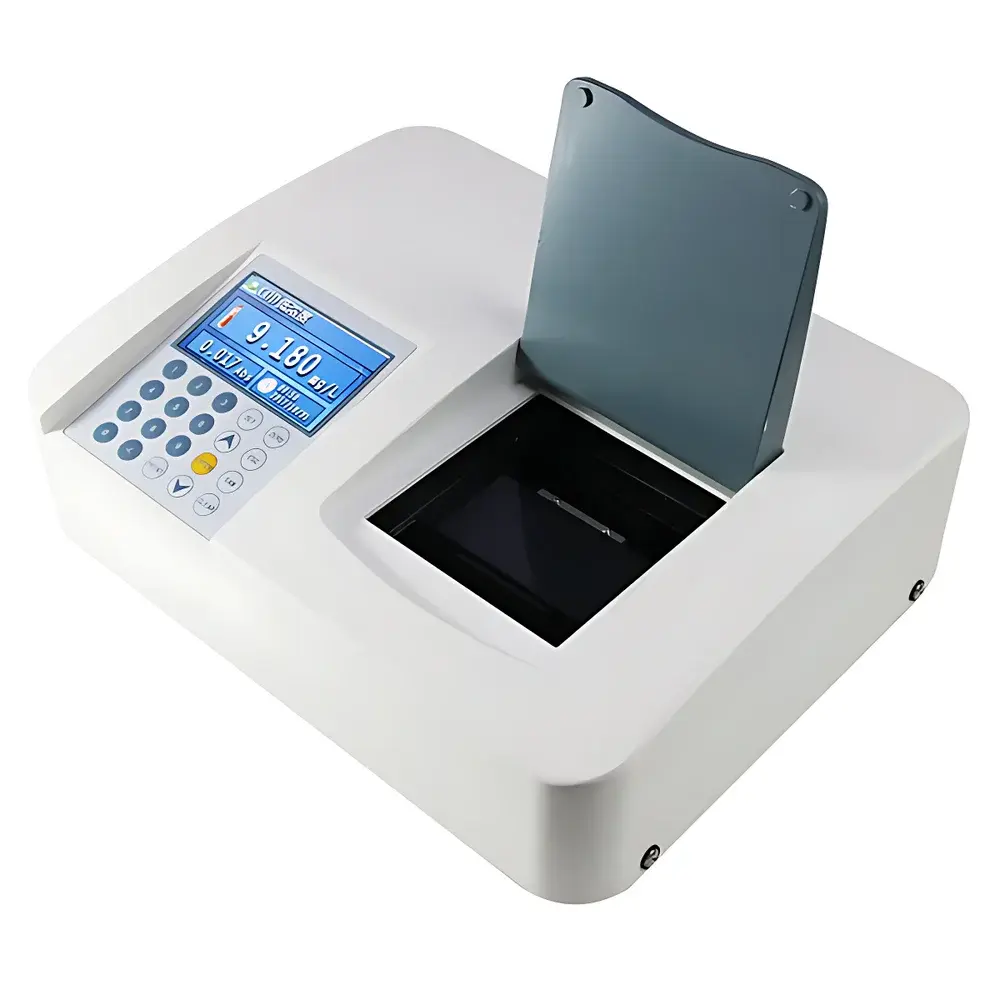
Yoke YKM-C Intelligent COD Rapid Analyzer
| Brand | Yoke |
|---|---|
| Origin | Shanghai, China |
| Manufacturer Type | Manufacturer |
| Product Category | Domestic |
| Model | YKM-C |
| Instrument Type | Laboratory Benchtop Analyzer |
| Measurement Principle | Rapid Digestion Spectrophotometric Method (ISO 15705-compliant digestion protocol) |
| Measurement Range | 5–160 mg/L (Low Range) or 15–8000 mg/L (High Range) |
| Accuracy | ≤ ±5% |
| Repeatability | ≤ ±5% |
| Detection Limit | 5 mg/L |
| Analysis Time | 20 min per batch |
| Batch Capacity | 20 samples |
| Chloride Interference Tolerance | [Cl⁻] < 1000 mg/L (standard) |
| Optical Stability | ≤ 0.001 A/10 min |
| Light Source | Cold LED with narrow-band interference filters (lifetime ≥ 100,000 h) |
| Data Storage | ≥ 5000 measurement records + 200 calibration curves (5 factory-default + 195 user-expandable) |
| Display | 4.3″ TFT color touchscreen (dual-language UI: English/Chinese) |
| Connectivity | USB Device (PC transfer), USB Host (U-disk import/export), RS-232C (printer interface), Bluetooth 5.0 (optional) |
| Internal Memory | 512 MB NAND flash (ARM9 core processor) |
Overview
The Yoke YKM-C Intelligent COD Rapid Analyzer is a laboratory-grade spectrophotometric instrument engineered for precise, reproducible, and compliant chemical oxygen demand (COD) determination in wastewater, surface water, industrial effluent, and municipal treatment streams. It implements the rapid digestion-spectrophotometric method—aligned with the technical foundation of ISO 15705 and EPA Method 410.4—wherein sample digestion occurs under controlled thermal conditions (165 °C, 15 min) using pre-formulated dichromate-based reagents, followed by photometric quantification at 620 nm (low range) or 420 nm (high range). Unlike open-reflux or titrimetric approaches, this closed-system digestion minimizes operator exposure, reduces acid consumption, and ensures inter-laboratory comparability. The analyzer’s optical architecture integrates thermally stabilized cold LED sources and high-transmittance narrow-band interference filters (FWHM < 10 nm), delivering long-term photometric stability (< 0.001 A/10 min) essential for GLP/GMP-aligned routine analysis.
Key Features
- 4.3″ high-resolution TFT color touchscreen with intuitive dual-language (English/Chinese) GUI, enabling rapid method selection, parameter entry, and real-time result visualization
- Dual-range COD quantification: low-range mode (5–160 mg/L) optimized for clean water or tertiary effluent; high-range mode (15–8000 mg/L) suitable for raw sewage and industrial discharges
- Integrated 20-position digestion block with uniform temperature control (±0.5 °C), ensuring consistent oxidation kinetics across all samples within a single 20-minute cycle
- Advanced curve management system supporting 200 stored calibration profiles—including 5 factory-verified reference curves and 195 user-defined or segmented curves—with automatic K-factor adjustment per concentration segment to minimize nonlinearity error
- Robust embedded architecture powered by ARM9 processor and 512 MB onboard memory, enabling seamless execution of multi-step protocols, data logging, and firmware updates
- Comprehensive connectivity suite: USB Device (direct PC upload), USB Host (U-disk data export/import), RS-232C (thermal printer support), and optional Bluetooth 5.0 for wireless audit trail synchronization
Sample Compatibility & Compliance
The YKM-C accommodates standard 10-mm pathlength cuvettes (glass or quartz), conforming to ISO 7027 optical geometry requirements. It supports chloride interference mitigation up to 1000 mg/L Cl⁻ without correction; an optional high-chloride digestion module extends tolerance to 8000 mg/L Cl⁻ via mercury-free silver sulfate catalysis—fully compatible with ISO 6060 and ASTM D1252-12 Annex A1. All measurement workflows adhere to quality assurance frameworks required under ISO/IEC 17025:2017, including documented calibration traceability, operator authentication logs, and audit-ready data export (CSV/TXT). Raw data files retain full metadata: timestamp, operator ID, digestion temperature/time, curve ID, absorbance values, and QC flags.
Software & Data Management
Data integrity is enforced through hierarchical storage: ≥5000 measurement records are retained with full contextual metadata (date/time, sample ID, range mode, curve used, raw absorbance, calculated COD). Curve libraries support version-controlled import/export via U-disk, facilitating cross-instrument method harmonization. USB and Bluetooth interfaces enable secure, timestamped transfer to LIMS or ELN platforms. Optional software modules provide FDA 21 CFR Part 11-compliant electronic signatures, audit trails, and role-based access control—critical for regulated environmental laboratories operating under EPA, EU Water Framework Directive, or national discharge permit programs.
Applications
The YKM-C serves as a primary COD verification tool in municipal wastewater treatment plants (influent/effluent monitoring), electroplating and textile dyeing facilities (process control and compliance reporting), environmental testing labs (ISO 17025-accredited analyses), and academic research on biodegradability kinetics. Its 20-sample throughput and 20-minute total assay time support high-volume daily screening—e.g., daily influent characterization or weekly sludge digestibility assessment—while maintaining metrological rigor demanded by regulatory submissions (e.g., US EPA NPDES permits, China’s GB 18918-2002).
FAQ
Does the YKM-C comply with international COD testing standards?
Yes—it implements rapid digestion principles aligned with ISO 15705 and EPA Method 410.4; optical design conforms to ISO 7027; chloride compensation options meet ISO 6060 requirements.
Can calibration curves be validated and re-certified internally?
Yes—users may perform multi-point verification using NIST-traceable COD standards (e.g., potassium hydrogen phthalate), with automatic residual error reporting and curve revision logging.
Is remote firmware update supported?
Yes—updates are delivered via encrypted USB drive or authenticated cloud sync (optional enterprise license), preserving configuration integrity and audit history.
What documentation is provided for regulatory audits?
Factory calibration certificate, ISO/IEC 17025 traceability statement, user manual with SOP templates, and electronic audit log export capability (CSV with SHA-256 hash verification).
How is data security ensured during Bluetooth transmission?
Bluetooth 5.0 pairing requires explicit device authorization; all transmitted records include digital signatures and are encrypted using AES-128 prior to transmission.
Related Products







