
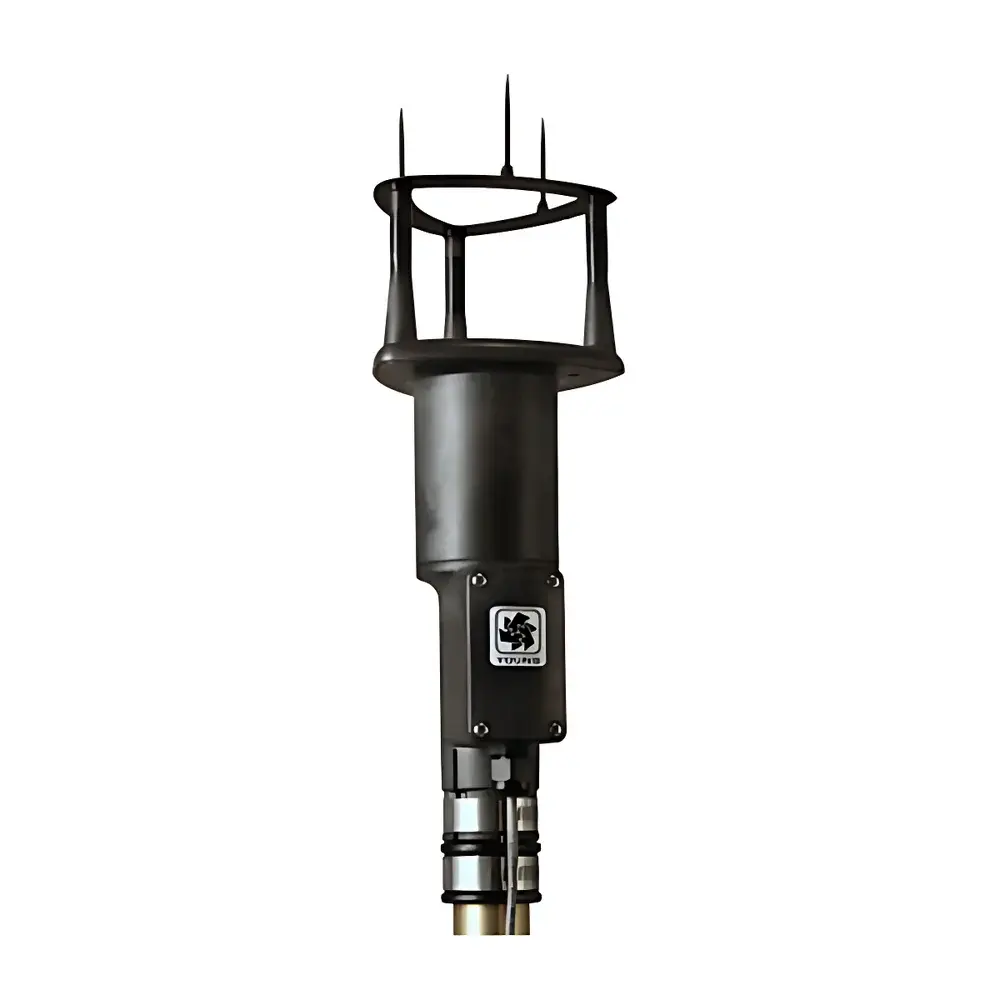
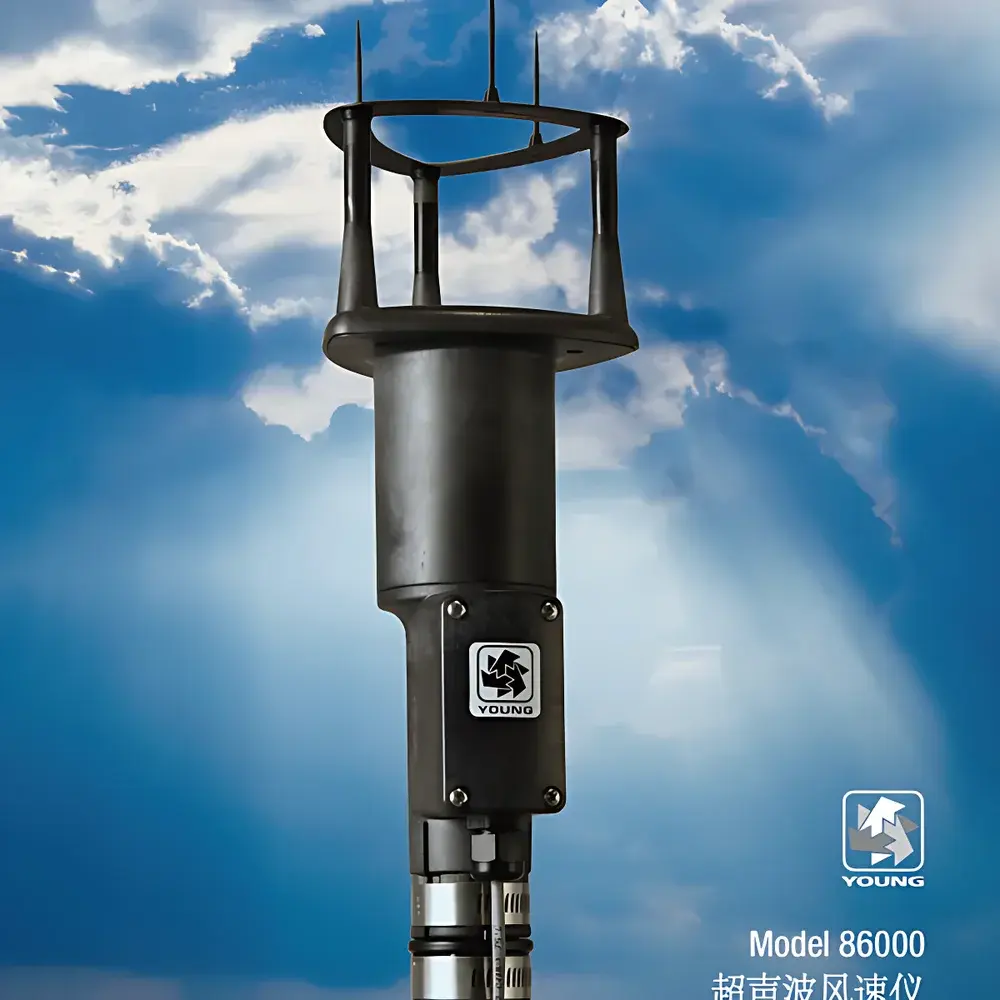
R.M. Young 86106 Marine-Grade Ultrasonic Anemometer
| Brand | R.M. Young |
|---|---|
| Origin | USA |
| Model | 86106 |
| Instrument Type | Ultrasonic Anemometer |
| Wind Speed Range | 0–75 m/s |
| Resolution | 0.01 m/s |
| Accuracy | ±2% (0–30 m/s), ±3% (30–70 m/s) |
| Wind Direction Range | 0–360° |
| Wind Direction Resolution | 0.1° |
| Wind Direction Accuracy | ±2° |
| Startup Threshold | 0.01 m/s |
| Response Time | <0.25 s |
| Operating Temperature | −40 to +60 °C |
| Relative Humidity | 0–100% RH |
| Output Options | NMEA 0183, RS-232/RS-485, Analog (0–5 V / 4–20 mA) |
| Enclosure Rating | IP65 |
| Dimensions | 29 cm H × 11 cm W |
| Weight | 0.4 kg |
| Power Supply | 10–30 VDC (heater: 24 VDC, 2.5 A for heated variants) |
Overview
The R.M. Young 86106 is a marine-optimized, two-dimensional ultrasonic anemometer engineered for high-fidelity wind vector measurement in demanding coastal, offshore, and maritime environments. Unlike mechanical cup-and-vane sensors, the 86106 employs time-of-flight (TOF) ultrasonic transit-time principle: paired transducers transmit and receive acoustic pulses across orthogonal paths; wind-induced asymmetries in upstream/downstream propagation times are precisely calculated to derive true horizontal wind speed and direction with no moving parts. This solid-state architecture eliminates mechanical wear, inertia lag, and icing-related failure modes—critical advantages for long-term unattended deployment on buoys, lighthouses, research vessels, and offshore platforms. The sensor conforms to IEC 61000-6-2 (immunity) and IEC 61000-6-4 (emissions) standards and is designed to meet the environmental robustness requirements of NOAA, WMO, and IMO observational guidelines.
Key Features
- Marine-specific firmware and NMEA 0183 output protocol (sentence types: $WIMWV, $WIMWD, $WIVWR) for seamless integration with shipboard navigation systems, AIS transceivers, and oceanographic data loggers.
- Corrosion-resistant, UV-stabilized polycarbonate housing with stainless-steel mounting hardware and sealed transducer faces rated IP65—tested per MIL-STD-810G for salt fog (Method 509.6) and thermal cycling.
- Dual-output capability: simultaneous analog (0–5 V or 4–20 mA) and digital (RS-232/RS-485) interfaces, supporting baud rates up to 38,400 bps and configurable data formats including ASCII (polling/continuous), RMYT (for YOUNG display units), and SDI-12 (on compatible variants).
- Sub-second dynamic response (<0.25 s) enables capture of turbulent gust structures and microscale boundary layer phenomena relevant to air-sea interaction studies and port operations safety monitoring.
- Low-power design: typical operating current <20 mA at 12 VDC—compatible with solar-charged battery systems common in remote marine telemetry stations.
- Mounting flexibility: standard 1-inch IPS pipe thread interface allows direct attachment to mast brackets, buoy frames, or radar pedestals without custom adapters.
Sample Compatibility & Compliance
The 86106 is validated for continuous operation across full marine environmental envelopes: ambient temperature from −40 °C to +60 °C and relative humidity 0–100% RH, including condensing and salt-laden conditions. Its transducer geometry and signal processing algorithms are optimized for low-wind sensitivity (startup threshold: 0.01 m/s) and minimal flow distortion—verified via NIST-traceable wind tunnel calibration per ISO 17025-accredited procedures. The instrument complies with FCC Part 15 Class B and CE RED Directive 2014/53/EU for electromagnetic compatibility. While not intrinsically safe, it meets UL 61010-1 for electrical safety in non-hazardous locations. Data integrity aligns with WMO Guide to Instruments and Methods of Observation (CIMO Guide, Chapter 6) requirements for surface wind observation networks.
Software & Data Management
The 86106 operates autonomously without host software but supports configuration and diagnostics via terminal emulation (e.g., PuTTY, Tera Term) over serial link. All output sentences include embedded status flags (e.g., data validity, sensor health, temperature compensation active) compliant with NMEA 0183 v4.10 conventions. For networked deployments, the RS-485 option enables multidrop configurations (up to 32 nodes) using Modbus RTU mapping (custom register map available upon request). Raw wind vector (U/V components) and scalar (speed/direction) outputs are timestamped with millisecond resolution when synchronized to external PPS or NTP sources. Data logging systems implementing IEC 62443-3-3 security profiles may integrate the 86106 as a trusted field device within SCADA architectures for port authority environmental monitoring dashboards.
Applications
- Oceanographic research vessels requiring real-time wind input for flux calculations (CO₂, heat, momentum) and turbulence kinetic energy (TKE) profiling.
- Coastal meteorological stations participating in the Global Climate Observing System (GCOS) Surface Network (GSN) or national mesonets.
- Offshore wind farm site assessment campaigns where spatially dense, low-maintenance sensor arrays are deployed on met masts or floating LiDAR support platforms.
- Maritime safety systems—including automated harbor pilotage aids, vessel traffic service (VTS) centers, and tsunami early-warning buoy networks.
- Long-term ecological monitoring on island observatories or Antarctic coastal stations where field service intervals exceed 12 months.
FAQ
Is the 86106 certified for use in SOLAS-compliant navigation systems?
Yes—the NMEA 0183 output meets IEC 61162-1:2016 conformance requirements for interfacing with ECDIS, radar, and ARPA systems. Type approval documentation is available under NDA.
Can the 86106 be used in freshwater lake environments without salt corrosion concerns?
Absolutely—the marine-grade construction provides over-engineered protection for inland applications; many users deploy it on Great Lakes buoys and reservoir monitoring networks.
Does the sensor require periodic recalibration?
No scheduled recalibration is mandated; however, R.M. Young recommends verification against a reference anemometer every 24 months for metrological traceability in regulatory reporting contexts (e.g., EPA Method 2F, ISO 16614-2).
What is the maximum cable length supported for RS-485 output?
Up to 1,200 meters using shielded twisted-pair cable (AWG 22, 120 Ω characteristic impedance) at 9,600 bps; shorter runs required at higher baud rates.
Is firmware update capability available in the field?
Yes—field-upgradable firmware is delivered via ASCII command sequence over serial interface; version history and release notes are published in the Technical Support Portal.
Related Products







