
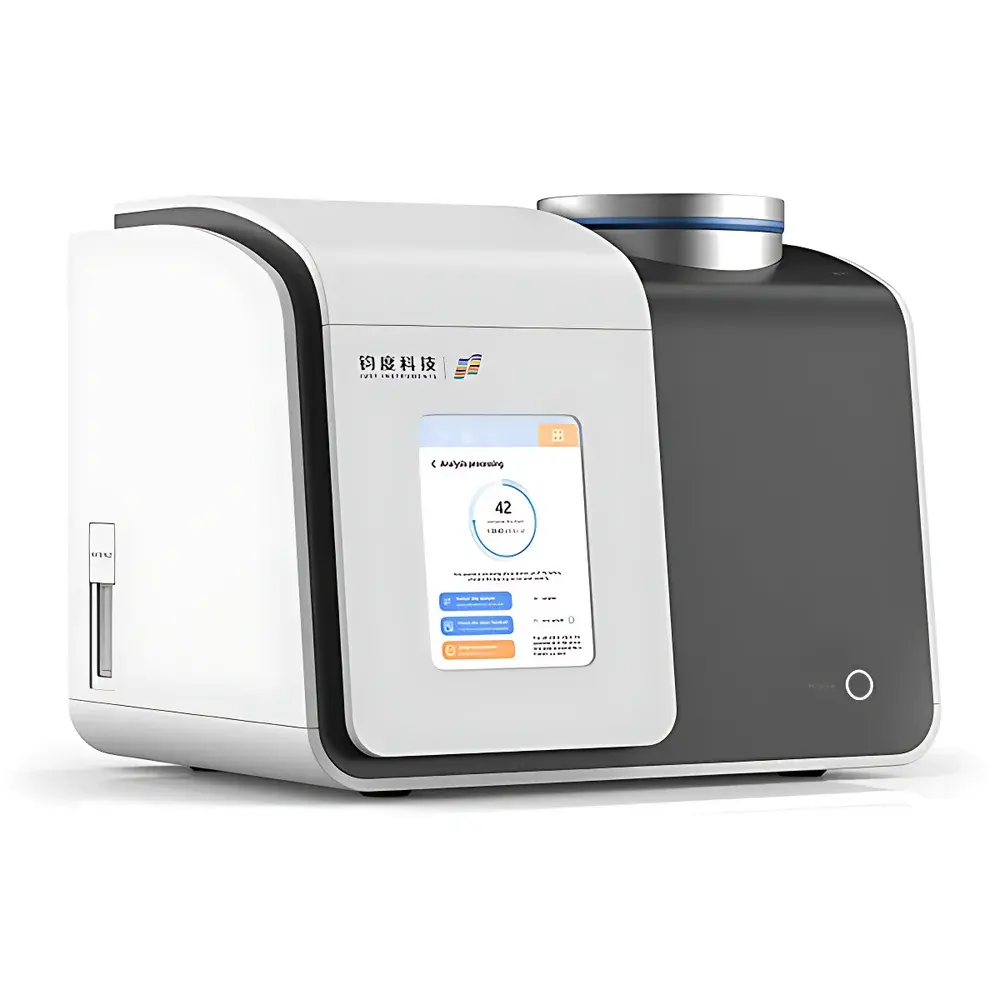
Young Instruments ATC 300A Automatic Bomb Calorimeter
| Brand | Young Instruments |
|---|---|
| Origin | Zhejiang, China |
| Manufacturer Type | Manufacturer |
| Country of Origin | China |
| Model | ATC 300A |
| Instrument Type | Bomb Calorimeter |
| Ignition Method | Cotton Thread & Ignition Wire |
| Temperature Resolution | 0.0001 °C |
| Test Mode | Isothermal |
| Test Duration | ≤15 min (Standard Method), ≤10 min (Rapid Method) |
| Calorific Value Range | ≤34,000 J |
| Heat Capacity Precision | ≤0.10% |
| Heat Capacity Drift | ≤0.20% |
| Oxygen Bomb Max Pressure | 240 bar |
| Bomb Material | Stainless Steel & Hastelloy (Corrosion-Resistant) |
| Data Storage Capacity | ≥10,000 Tests |
Overview
The Young Instruments ATC 300A Automatic Bomb Calorimeter is a precision-engineered isothermal combustion calorimeter designed for accurate and reproducible determination of gross calorific value (GCV), net calorific value (NCV), and bomb calorific value of solid, liquid, and slurry fuels—including coal, coke, biomass, waste-derived fuels, petroleum products, and municipal solid waste. Based on the principle of adiabatic or isothermal jacketed calorimetry with oxygen-enhanced combustion in a high-pressure sealed bomb, the ATC 300A complies with internationally recognized thermodynamic measurement protocols defined in ASTM D240, ASTM D5865, ASTM D4809, ISO 1928, GB/T 213, and GB/T 384. Its robust architecture integrates a dual-temperature-controlled water jacket system with semiconductor-based active thermal regulation, enabling rapid thermal equilibrium (<10 min stabilization post-combustion) and minimizing environmental drift effects. The instrument operates under rigorously controlled oxygen pressure (up to 3.5 MPa), ensuring complete oxidation of carbon, hydrogen, sulfur, and nitrogen-bearing compounds—critical for trace-level correction of nitric acid and sulfuric acid formation heat.
Key Features
- Fully automated bomb handling: motorized lift mechanism, RFID-based bomb identification, and programmable O2 charging (pressure monitoring ±0.1 bar) and venting sequence
- Self-regulating water circulation system featuring Peltier-based heating/cooling modules and multi-stage particulate filtration (≤5 µm), enabling precise temperature ramping, holding, and decay control within ±0.0001 °C resolution
- Intelligent ignition diagnostics: real-time continuity check of ignition wire, short-circuit protection, and automatic energy compensation for ignition wire combustion enthalpy
- Triple-calorific-value output: simultaneous calculation of gross (higher) heating value (HHV), net (lower) heating value (LHV), and bomb calorific value—with built-in corrections for nitric acid formation, sulfuric acid formation, and latent heat of vaporization of water
- Dual-control interface: integrated 7-inch capacitive touchscreen with real-time thermogram visualization + optional PC-based software with remote monitoring, audit trail logging, and user role management
- Auto-fill and auto-drain functionality for inner and outer water jackets—eliminating manual intervention and reducing operator-induced variability
- Serial communication architecture supporting up to 8 units on a single host controller with independent experiment scheduling and data isolation
Sample Compatibility & Compliance
The ATC 300A accommodates standard 1 g–1.5 g sample masses in crucibles compatible with both cotton thread and iron/nichrome ignition wires. It supports heterogeneous matrices including pulverized coal, torrefied wood pellets, tire-derived fuel (TDF), sewage sludge, and emulsified biofuels. All operational parameters—including oxygen pressure, stirrer speed, and thermal equilibration time—are configurable to meet method-specific requirements across ASTM, ISO, and Chinese national standards. The system meets GLP and GMP documentation requirements through timestamped, user-verified test logs, electronic signatures, and tamper-evident data encryption. Full compliance with FDA 21 CFR Part 11 is supported via optional software module with audit trail, electronic signature, and data integrity controls.
Software & Data Management
The embedded firmware and optional PC software provide comprehensive data lifecycle management: automatic generation of calibration certificates, raw thermographic curves (ΔT vs. t), corrected heat release profiles, and summary reports compliant with ISO/IEC 17025 reporting guidelines. All datasets are stored in encrypted binary format with SHA-256 checksum validation. Historical records support SQL-based querying by date range, operator ID, sample ID, or calorific value range. Export options include CSV, PDF (with digital signature), and XML formats compatible with LIMS integration. Calibration history, maintenance logs, and instrument verification records are retained separately with version-controlled metadata.
Applications
- Quality control and specification verification in coal-fired power plants and cement kiln operations
- Renewable fuel certification per EN 14918 and ASTM D5865 for biomass and bioliquids
- R&D laboratories evaluating combustion efficiency of novel synthetic fuels and hydrogen carriers
- Environmental testing labs quantifying energy content of waste streams under EPA Method 9040C
- Academic research in thermochemistry, fuel formulation, and reaction enthalpy modeling
- Third-party certification bodies performing accredited calorific value testing for ISO/IEC 17025 scope accreditation
FAQ
What standards does the ATC 300A fully comply with for regulatory reporting?
The instrument meets all hardware, procedural, and data integrity requirements of ASTM D240, ASTM D5865, GB/T 213, and ISO 1928; optional 21 CFR Part 11 compliance enables use in FDA-regulated environments.
How is thermal drift minimized during long-duration calibration runs?
Through active semiconductor-based temperature control of both inner and outer water jackets, coupled with real-time ambient temperature compensation algorithms and continuous thermal gradient monitoring.
Can the system correct for sulfur and nitrogen contributions in high-ash fuels?
Yes—the software applies standardized correction factors for sulfuric acid and nitric acid formation enthalpies, as specified in ASTM D5865 Annex A2 and GB/T 213 Clause 8.3.
Is remote diagnostics and firmware update capability available?
Firmware updates are performed via secure USB or Ethernet connection; remote diagnostic access requires optional VPN-enabled maintenance license with encrypted session logging.
What is the maximum allowable moisture content for solid samples?
Samples with moisture content up to 15% w/w may be tested directly; higher moisture levels require pre-drying per ASTM D3173 or GB/T 212 protocols to ensure complete combustion and accurate water vapor enthalpy correction.



