
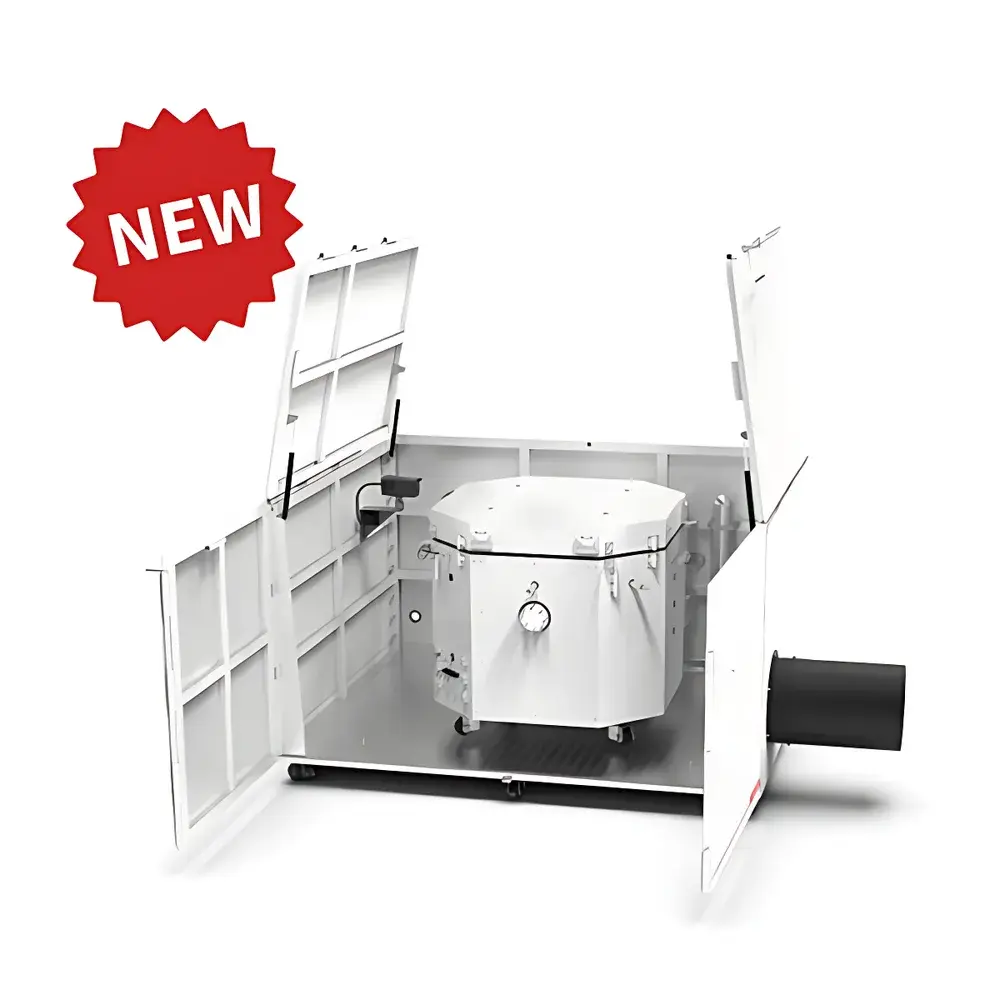
Young Instruments BAC-800A Large-Scale Battery Adiabatic Calorimeter for Lithium-Ion Thermal Runaway Testing
| Brand | Young Instruments |
|---|---|
| Origin | Zhejiang, China |
| Manufacturer Type | Direct Manufacturer |
| Instrument Type | Accelerating Rate Calorimeter (ARC) |
| Measurement Mode | Adiabatic Calorimetry |
| Model | BAC-800A |
| Compliance | GB/T 36276–2023, UL 9540A, SAE J2464-R2009, ASTM E1981–98(2012), UL 1973, SN/T 3078.1–2012, SAND99-0497, FreedomCAR SAND 2005-3123 |
| Adiabatic Chamber Dimensions | Ø800 mm × 520 mm depth |
| Self-Heating Detection Sensitivity | <0.02 °C/min |
| Wall–Sample Temperature Differential | ≤1 °C |
| Temperature Control Range | RT to 300 °C (with optional low-temperature module down to –25 °C) |
| Temperature Tracking Rate | 0.02–15 °C/min |
| Sealed Test Vessel Pressure Range | 0–2 MPa |
| Puncture Stroke | Software-Configurable |
| Current Capacity of Charging/Discharging Electrode Posts | ±500 A |
Overview
The Young Instruments BAC-800A is a large-scale, high-fidelity adiabatic calorimeter engineered specifically for the thermal safety characterization of prismatic and pouch lithium-ion battery cells and small modules—spanning physical dimensions from 100 mm to 900 mm in length. Operating on the principle of heat-wait-search (HWS) and dynamic adiabatic tracking, the BAC-800A maintains near-zero heat exchange between the sample and its environment by actively controlling the temperature of the surrounding adiabatic jacket to precisely match the sample’s surface temperature in real time. This enables true adiabatic conditions essential for quantifying intrinsic thermal runaway kinetics—including onset temperature (Tonset), maximum self-heating rate (dT/dt)max, adiabatic temperature rise (ΔTad), time-to-thermal-runaway (TTR), and specific heat capacity (Cp) under controlled electrochemical or mechanical abuse conditions. Its design directly addresses the growing need for standardized, reproducible thermal hazard assessment in accordance with GB/T 36276–2023 and international frameworks such as UL 9540A and SAE J2464.
Key Features
- High-sensitivity adiabatic control: Real-time jacket temperature synchronization ensures wall–sample differential ≤1 °C and self-heating detection limit <0.02 °C/min—exceeding the sensitivity threshold required by GB/T 36276–2023 and ASTM E1981.
- Large-volume adiabatic chamber: Internal cavity dimensions of Ø800 mm × 520 mm depth accommodate full-size commercial battery cells (e.g., LFP or NMC prismatic units) and 2–4-cell modules without geometric constraint.
- Integrated electrochemical testing capability: Dual ±500 A electrode posts support simultaneous charge/discharge cycling during calorimetric measurement, enabling precise quantification of Joule heating, reversible entropy effects, and total enthalpy evolution at sub-ambient temperatures (down to –25 °C with optional cryo module).
- Multi-hazard synchronized acquisition: Simultaneous monitoring of temperature, pressure, voltage, current, and gas evolution (via integrated pressure transducer and optional mass flow sensor interface) supports coupled thermal–electrochemical–gas kinetic analysis.
- Engineered safety architecture: Includes rupture disc, pressure-relief valve, reinforced anti-explosion chamber rated for ≥2 MPa internal overpressure, and redundant hardware-level alarm triggers linked to emergency cooling, power cutoff, and ventilation activation.
- Innovative thermal–gas correlation mode: Unique firmware-driven protocol synchronizes adiabatic runaway progression with real-time volumetric gas release data, facilitating empirical modeling of gas generation stoichiometry and decomposition pathway validation.
Sample Compatibility & Compliance
The BAC-800A is validated for use with lithium-ion battery formats including large-format prismatic, pouch, and cylindrical cells (diameter up to 80 mm), as well as 2–6s modular assemblies with integrated busbars. It meets functional requirements of multiple regulatory and industry standards: GB/T 36276–2023 (Clause 7.3.2 “Adiabatic Temperature Rise Test”), UL 9540A (Section 7.2 “Cell-Level Thermal Runaway Propagation Test”), SAE J2464-R2009 (4.4.2 “Thermal Stability Test”), ASTM E1981–98(2012) (“Standard Guide for Evaluating Thermal Stability of Chemicals by ARC”), and SN/T 3078.1–2012. All test protocols are structured to support GLP-compliant documentation, with audit-trail-enabled parameter logging aligned with FDA 21 CFR Part 11 principles for electronic records and signatures.
Software & Data Management
The instrument operates via Young Instruments’ proprietary CaloSuite™ v4.2 software platform—a Windows-based application supporting ISO/IEC 17025-aligned calibration management, method template libraries, and automated report generation compliant with internal QA workflows and third-party certification submissions. Raw thermal, electrical, and pressure time-series data are stored in HDF5 format with embedded metadata (user ID, timestamp, environmental conditions, calibration coefficients). Export options include CSV, MATLAB .mat, and PDF reports with traceable digital signatures. Remote monitoring and multi-user role-based access control (RBAC) are supported through optional TLS-secured Ethernet connectivity, enabling integration into centralized lab information management systems (LIMS).
Applications
- Thermal runaway initiation and propagation analysis under electrical (overcharge, external short), thermal (oven exposure, hot plate), and mechanical (nail penetration, crush) abuse conditions.
- Determination of low-temperature electrochemical heat generation profiles to inform battery thermal management system (BTMS) design for EV and grid-scale storage applications.
- Quantitative evaluation of electrolyte and cathode material thermal stability, including exothermic onset, reaction enthalpy, and gas evolution composition (when paired with FTIR or GC-MS).
- Validation of cell-level safety models (e.g., Newman-type electrochemical-thermal coupling simulations) using experimentally derived kinetic parameters.
- Support for UN 38.3 T.4 (thermal test) and IEC 62619 safety certification documentation packages.
FAQ
What battery sizes can the BAC-800A accommodate?
The adiabatic chamber accepts single cells up to 900 mm in length and modules containing up to four standard-format prismatic or pouch cells. Maximum cross-sectional envelope is constrained by the Ø800 mm internal diameter.
Does the system support low-temperature calorimetry?
Yes—optional cryogenic cooling module extends the temperature control range to –25 °C, enabling accurate measurement of entropic heating effects and low-T thermal stability thresholds.
Can gas evolution be quantified during thermal runaway?
The BAC-800A includes a sealed pressure vessel rated to 2 MPa and integrated pressure transducer; when interfaced with external gas analyzers (e.g., FTIR or quadrupole mass spectrometer), it supports time-resolved gas composition and volumetric release rate analysis.
Is the software compliant with regulatory data integrity requirements?
CaloSuite™ implements ALCOA+ principles: attributable, legible, contemporaneous, original, accurate, complete, consistent, enduring, and available. Audit trails, electronic signatures, and locked datasets satisfy FDA 21 CFR Part 11 and EU Annex 11 expectations.
How is thermal runaway onset defined in BAC-800A measurements?
Onset is determined algorithmically using the ASTM E1981-recommended “inflection point + 0.02 °C/min self-heating threshold” method, applied to smoothed dT/dt curves derived from high-resolution thermocouple arrays embedded in the sample fixture.



