
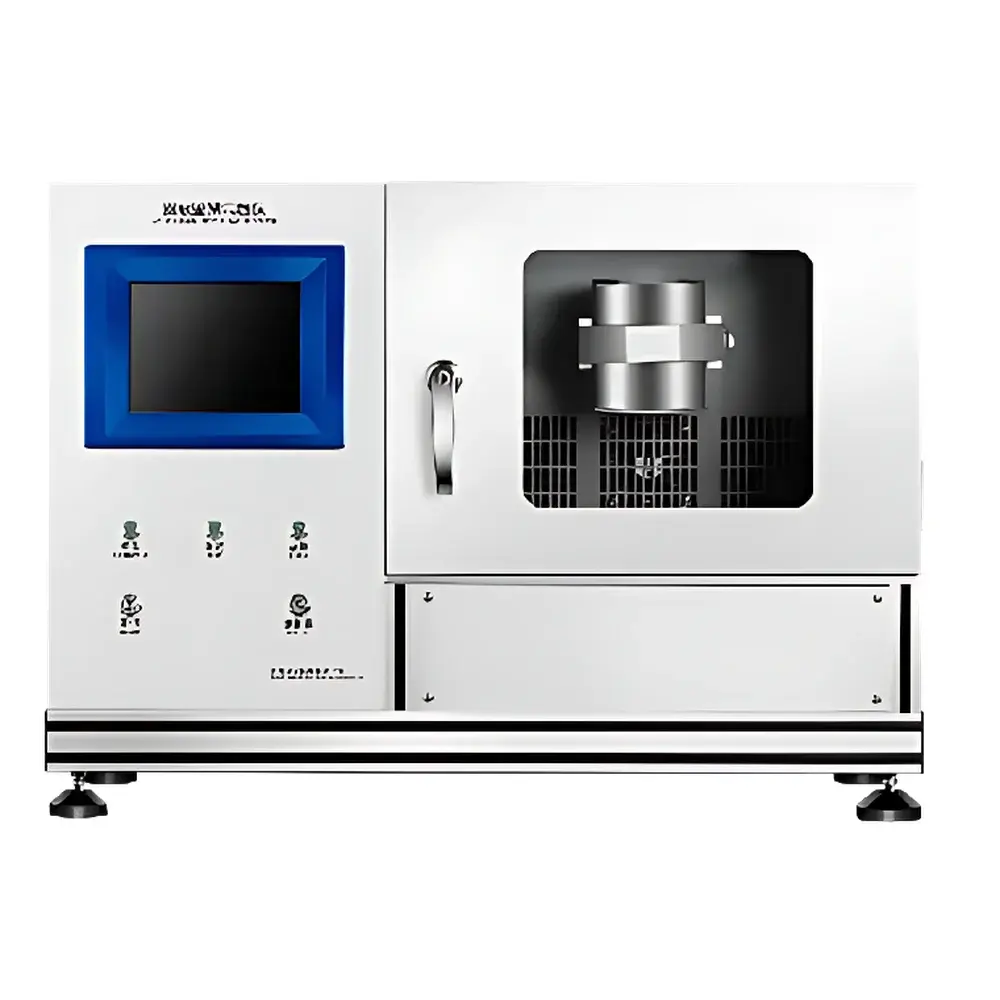
Young Instruments HWP31-10S Solid-Liquid Discrimination Tester
| Brand | Young Instruments |
|---|---|
| Origin | Zhejiang, China |
| Manufacturer Type | Manufacturer |
| Country of Origin | China |
| Model | HWP31-10S |
| Key Features | Embedded Windows CE processor |
| Compliance | GB/T 40244–2021, ISO 2137:2020(E), ASTM D-series (petroleum products, fuels, low-strength plastics, paints & coatings) |
Overview
The Young Instruments HWP31-10S Solid-Liquid Discrimination Tester is an automated, standards-compliant instrument engineered for objective physical classification of viscous or semi-solid substances under controlled thermal and mechanical conditions. It implements the principle of gravity-driven flow initiation and quantification—measuring both the horizontal displacement of material following standardized tipping and the mass of material that separates from the sample container within a defined time window. This dual-parameter approach aligns with internationally recognized decision criteria in regulatory frameworks governing chemical hazard classification, particularly for substances where conventional melting point or viscosity thresholds are ambiguous or inapplicable. Designed for laboratories performing UN GHS and CLP classification, transport safety assessments (e.g., ADR/RID/IMDG), and regulatory submissions to agencies including ECHA, EPA, and CCPS, the HWP31-10S delivers repeatable, auditable results without operator-dependent interpretation.
Key Features
- Embedded Windows CE operating system with real-time process control and deterministic I/O response for metrological integrity
- 8-inch high-brightness capacitive touchscreen with intuitive GUI supporting multi-language localization and user-level access control
- Motorized sample holder with programmable 100 mm release stroke and precise angular positioning for reproducible tipping dynamics
- Class II laser displacement sensor (0–100 mm range, 0.01 mm resolution) mounted orthogonally to flow path for non-contact, drift-compensated distance measurement
- High-stability analytical balance module (0–500 g, ±0.1 g linearity) integrated into drip collection tray assembly with automatic zero-tracking and tare recalibration upon tray exchange
- Thermostatically regulated test chamber maintaining 38 ± 3 °C—aligned with ISO 2137 and GB/T 40244 ambient conditioning requirements for petroleum and coating samples
- LED illumination system with uniform spectral output (5000 K CCT) enabling direct visual verification of flow onset, bridging, and cessation without UV exposure or thermal load
- Integrated fault-detection logic triggering simultaneous audible (85 dB) and visual (flashing amber LED) alerts for out-of-spec motion, temperature deviation, sensor timeout, or weight saturation
- Full automation sequence: tip initiation → start timing → continuous flow distance sampling at 10 Hz → mass accumulation logging → auto-stop on timeout or threshold breach → data timestamping and checksum validation
Sample Compatibility & Compliance
The HWP31-10S accommodates samples in standardized 1 L carbon steel cans (108 mm × 120 mm, customizable materials available upon request), suitable for viscous liquids, pastes, greases, bituminous materials, polymer melts, and semi-solid formulations. Its operational envelope supports classification of ASTM D-class substances—including fuel oils, lubricants, asphalt binders, solvent-based paints, and low-modulus thermoplastics—where traditional solid/liquid delineation fails due to thixotropy, yield stress, or temperature-sensitive rheology. The instrument satisfies mandatory testing requirements under GB/T 40244–2021 (Chinese national standard for solid–liquid discrimination via flow distance), ISO 2137:2020(E) (penetration testing of lubricating greases and petrolatum), and relevant clauses of ASTM D1386, D217, and D937. Data outputs are structured for traceability per GLP and ISO/IEC 17025:2017 Annex A.2, with optional audit trail extension compliant with FDA 21 CFR Part 11 when paired with validated software modules.
Software & Data Management
Instrument firmware includes embedded data logging with local storage (16 GB industrial-grade eMMC) and USB export capability. All measurements—flow distance vs. time curves, cumulative drip mass, chamber temperature logs, and event timestamps—are stored with embedded metadata (operator ID, test ID, calibration certificate hash, environmental conditions). CSV-formatted reports include raw sensor values, derived parameters (e.g., flow rate at 10 s, total displacement at 30 min), pass/fail flags per selected standard, and digital signatures for integrity verification. Optional PC-based software provides advanced analytics: comparative trend analysis across batches, statistical process control (SPC) charting, and automated report generation conforming to ISO 10423 or UN ST/SG/AC.10/11/Rev.5 documentation templates.
Applications
- Regulatory classification of chemicals under UN GHS Category 2 (liquids) vs. Category 1 (solids) based on flow behavior at 38 °C
- Quality control of petroleum-derived products (e.g., residual fuel oil, marine diesel, bitumen emulsions) prior to transport or storage
- Formulation development for water-based coatings and adhesives where sag resistance and leveling performance correlate with flow onset characteristics
- Stability assessment of phase-separated emulsions and suspensions during accelerated aging studies
- Supporting hazard communication documentation (SDS Section 9) and transport classification (UN Manual of Tests and Criteria, Part III, Section 32)
- Academic research in soft matter physics, particularly yield-stress fluid characterization where conventional rheometry is impractical for field-deployable screening
FAQ
What standards does the HWP31-10S directly support?
It is fully aligned with GB/T 40244–2021, ISO 2137:2020(E), and ASTM D-series methods applicable to petroleum products, lubricants, paints, and low-strength plastics.
Can the instrument operate outside the 38 °C test condition?
The thermostatic chamber is fixed at 38 ± 3 °C per standard requirements; ambient operation below or above this range is not supported for compliance-critical testing.
Is calibration traceable to national metrology institutes?
Laser displacement and mass modules are factory-calibrated against NIM-traceable artifacts; full calibration certificates (including uncertainty budgets) are provided with each unit.
How is data integrity ensured during long-duration tests (up to 50 hours)?
Firmware employs cyclic redundancy checking (CRC-32) on all logged records, automatic power-fail recovery, and write-protected flash memory partitions to prevent corruption.
Are custom sample container geometries supported?
Yes—custom can dimensions, materials (e.g., stainless steel, PTFE-lined), and mounting interfaces are available under OEM engineering services, subject to mechanical compatibility review.




