
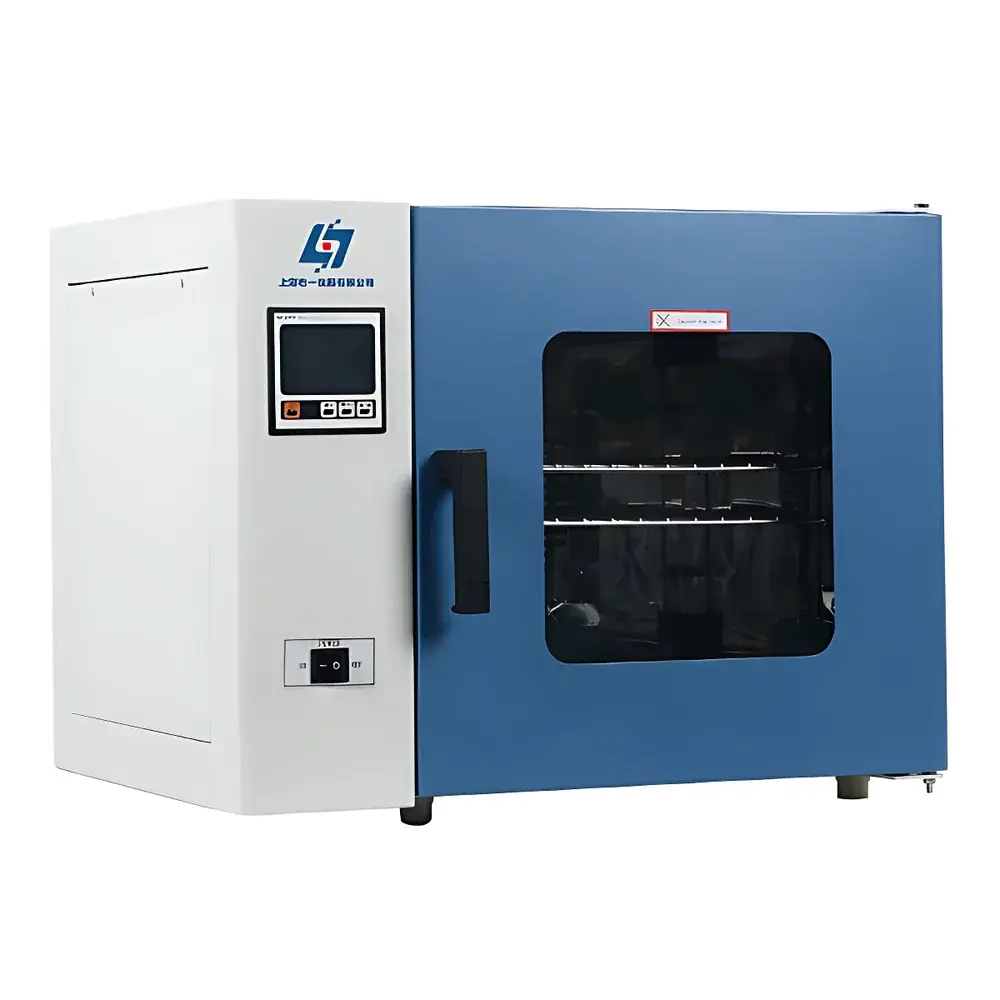
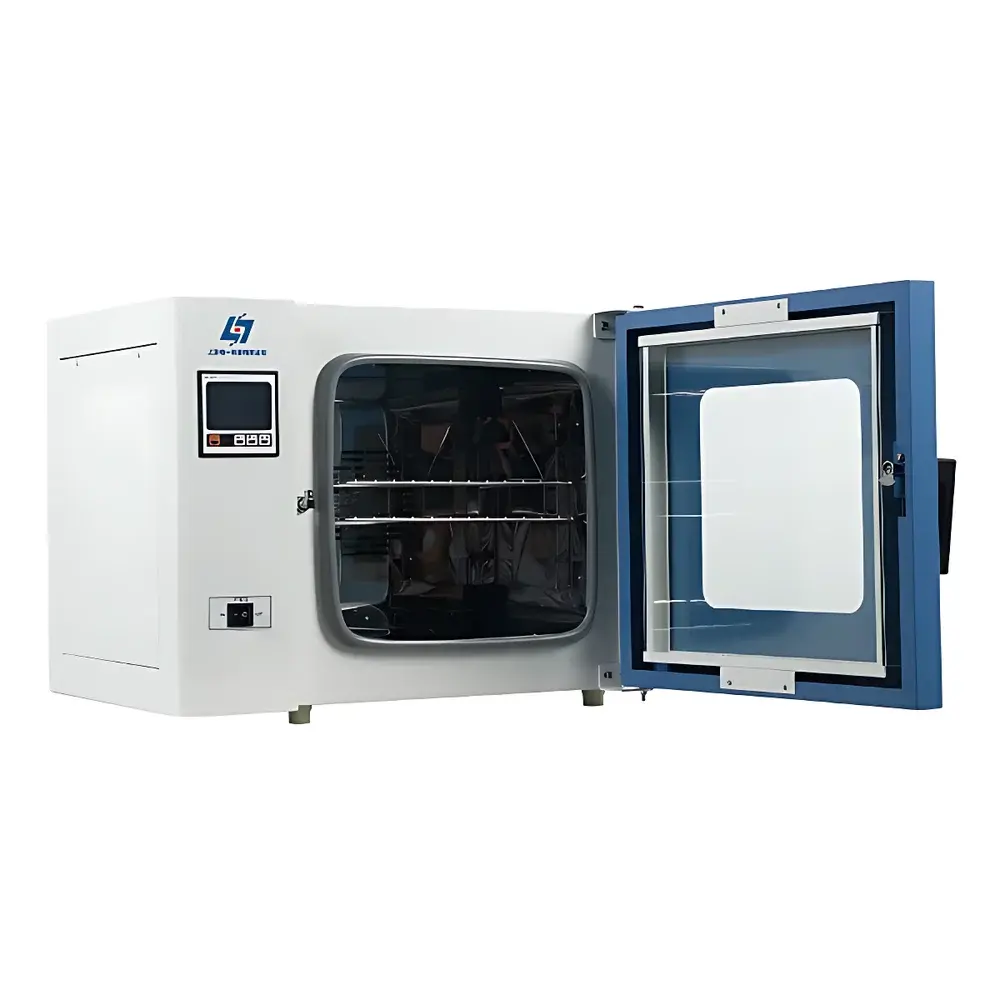
Yoyi DHG-9035A Precision Forced-Air Constant-Temperature Drying Oven
| Brand | Yoyi |
|---|---|
| Origin | Shanghai, China |
| Manufacturer Type | Direct Manufacturer |
| Product Category | Domestic |
| Model | DHG-9035A |
| Instrument Type | General-Purpose Forced-Air Oven |
| Temperature Range | RT+10°C to 300°C |
| Temperature Uniformity | ±2.5% (at 100°C) |
| Temperature Fluctuation | ±1.0°C |
| Temperature Resolution | 0.1°C |
| External Dimensions (W×D×H) | 625×540×500 mm |
| Internal Chamber Dimensions (W×D×H) | 340×330×320 mm |
| Internal Chamber Volume | 30 L |
| Chamber Material | Mirror-Finish Stainless Steel (SUS304) |
| Heating Method | Electric Resistance Heating |
| Power Supply | AC 220 V, 50 Hz |
| Rated Power | 850 W |
| Working Environment | Ambient Temperature 5–40°C, Relative Humidity ≤80% RH |
| Compliance Standard | GB/T 30435–2013 |
Overview
The Yoyi DHG-9035A is a precision-engineered forced-air constant-temperature drying oven designed for reproducible thermal processing in research laboratories, quality control environments, and industrial R&D settings. It operates on the principle of convection-driven heat transfer, utilizing an optimized rear-mounted centrifugal blower and multi-directional air ducts to ensure uniform airflow distribution across the entire working chamber. This architecture enables consistent thermal exposure—critical for applications such as moisture removal, polymer curing, sterilization validation, residual solvent evaporation, and pre-conditioning of test specimens per ASTM D618, ISO 291, or USP . The oven’s temperature control system employs a microprocessor-based PID algorithm with real-time feedback from a high-stability PT100 sensor mounted within the chamber wall, delivering stable setpoint maintenance under dynamic load conditions.
Key Features
- Microcomputer-controlled PID temperature regulation with 0.1°C resolution and ±1.0°C fluctuation tolerance at steady state
- Forced-air circulation system featuring a rear-mounted adjustable-speed blower and symmetrical air duct design for ±2.5% temperature uniformity (measured at 100°C per GB/T 30435–2013)
- Double-layer tempered glass observation window with silicone-sealed frame, enabling non-intrusive visual monitoring without thermal loss
- Mirror-finish SUS304 stainless steel interior chamber and adjustable chrome-plated steel shelves (2 standard trays included)
- Robust cold-rolled steel outer casing with electrostatic epoxy-polyester powder coating for corrosion resistance and mechanical durability
- High-temperature silicone door gasket ensuring long-term sealing integrity up to 300°C
- Auto-recovery function preserving user-defined parameters after power interruption or system reset
- Dual independent safety systems: primary PID controller + optional over-temperature cut-off (hardware-limited, non-software-dependent)
- Rear-mounted automatic intake/exhaust ports facilitating passive vapor management during extended drying cycles
Sample Compatibility & Compliance
The DHG-9035A accommodates a wide range of sample formats—including Petri dishes, weighing boats, crucibles, glassware, PCB substrates, and polymer film reels—within its 30 L chamber. Its stainless steel construction resists oxidation and chemical attack from common solvents (e.g., acetone, ethanol, hexane), making it suitable for GMP-aligned QC labs performing residual solvent analysis (ICH Q3C) or extractables/leachables sample preparation. The unit complies with GB/T 30435–2013 for electric heating ovens and meets general electrical safety requirements per IEC 61010-1. Optional configurations support GLP/GMP traceability: RS485 serial interface enables integration with LIMS or SCADA systems; embedded printer output provides auditable hard-copy logs compliant with FDA 21 CFR Part 11 when paired with validated software.
Software & Data Management
While the base model features a menu-driven LCD interface for direct parameter entry (setpoint, dwell time, ramp rate), optional digital enhancements extend data governance capabilities. The RS485 communication module supports Modbus RTU protocol for bidirectional data exchange with host PCs running custom or third-party acquisition software. Time-stamped temperature logs can be exported in CSV format for statistical process control (SPC) analysis. When equipped with the optional programmable controller (up to 30 segments), users define complex thermal profiles—including hold steps, linear ramps, and cycle repeats—for applications like thermal aging per ASTM D573 or accelerated stability testing per ICH Q1A(R2). All configuration changes are timestamped and stored in non-volatile memory with audit-trail functionality.
Applications
- Moisture content determination in pharmaceutical excipients, food powders, and soil samples (per AOAC 950.46 or USP )
- Pre-drying of filter papers, gravimetric vessels, and ceramic crucibles prior to ashing or titration
- Thermal conditioning of electronic components and printed circuit boards before solderability testing (IPC-J-STD-001)
- Curing of epoxy adhesives, silicone encapsulants, and conformal coatings in microelectronics packaging
- Stabilization of reference standards and calibration weights in metrology labs
- Baking of chromatography columns and GC injectors prior to system qualification
- Heat treatment of metallographic specimens and ceramic green bodies in materials science workflows
FAQ
What is the maximum operating temperature and certified accuracy range?
The DHG-9035A is rated for continuous operation from ambient +10°C to 300°C. Temperature accuracy is validated per GB/T 30435–2013 at key points (e.g., 100°C, 150°C, 200°C), with typical deviation ≤±1.0°C under no-load conditions.
Is the chamber volume sufficient for ISO-standard test specimens?
Yes—the 340×330×320 mm internal dimensions accommodate standard ISO 527-2 Type 1A tensile bars (170 mm length) laid flat, as well as ASTM D638 Type I specimens stacked vertically with clearance.
Can inert gas purging be integrated for oxygen-sensitive processes?
An optional inert gas inlet port (with calibrated rotameter and quick-connect fitting) allows continuous N₂ or Ar flow to reduce chamber O₂ concentration below 0.5%, supporting applications such as lithium battery electrode drying or catalyst activation.
Does the oven support regulatory-compliant data archiving?
When configured with RS485 + validated software, the system generates ALCOA+ compliant records—including operator ID, timestamp, setpoint, actual temperature, and alarm events—with electronic signatures and change history logging.
What maintenance intervals are recommended for sustained performance?
Blower motor lubrication and door gasket inspection are advised every 12 months; chamber calibration using NIST-traceable thermocouples should occur semiannually or after any physical impact or prolonged >250°C operation.



