
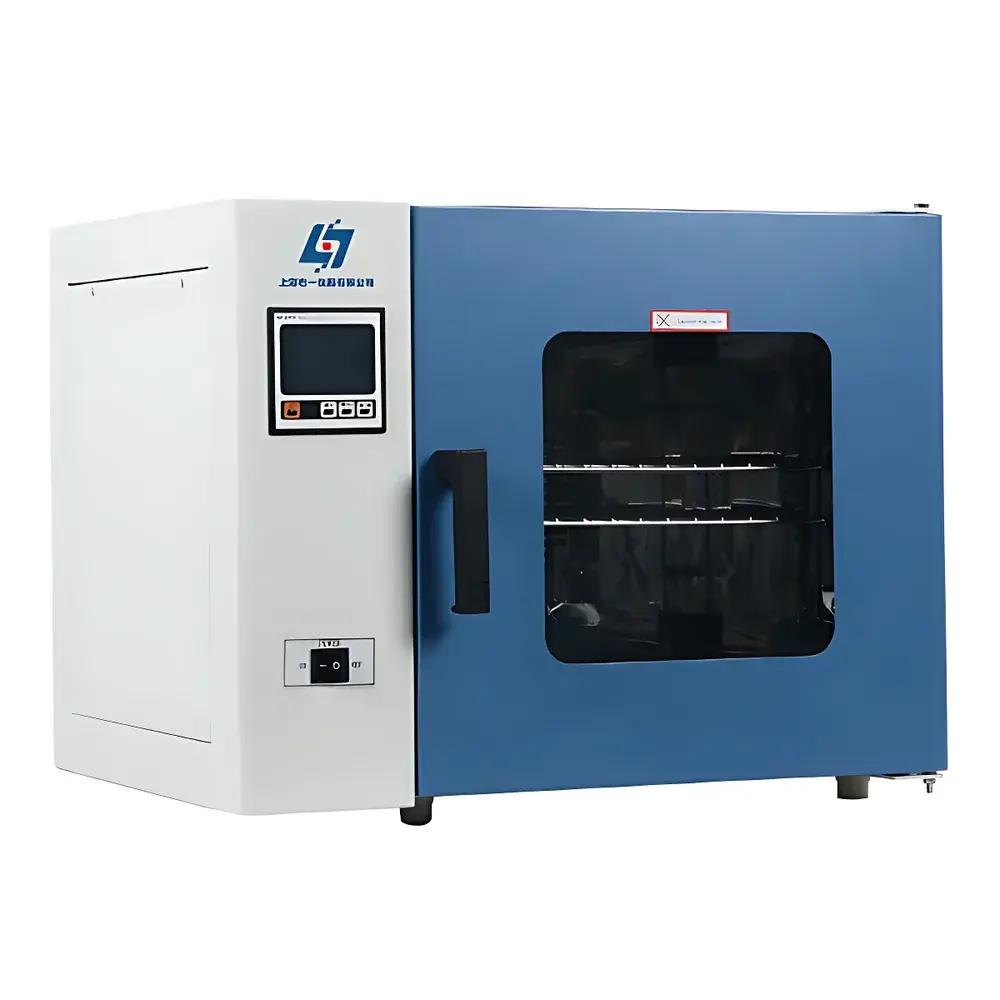
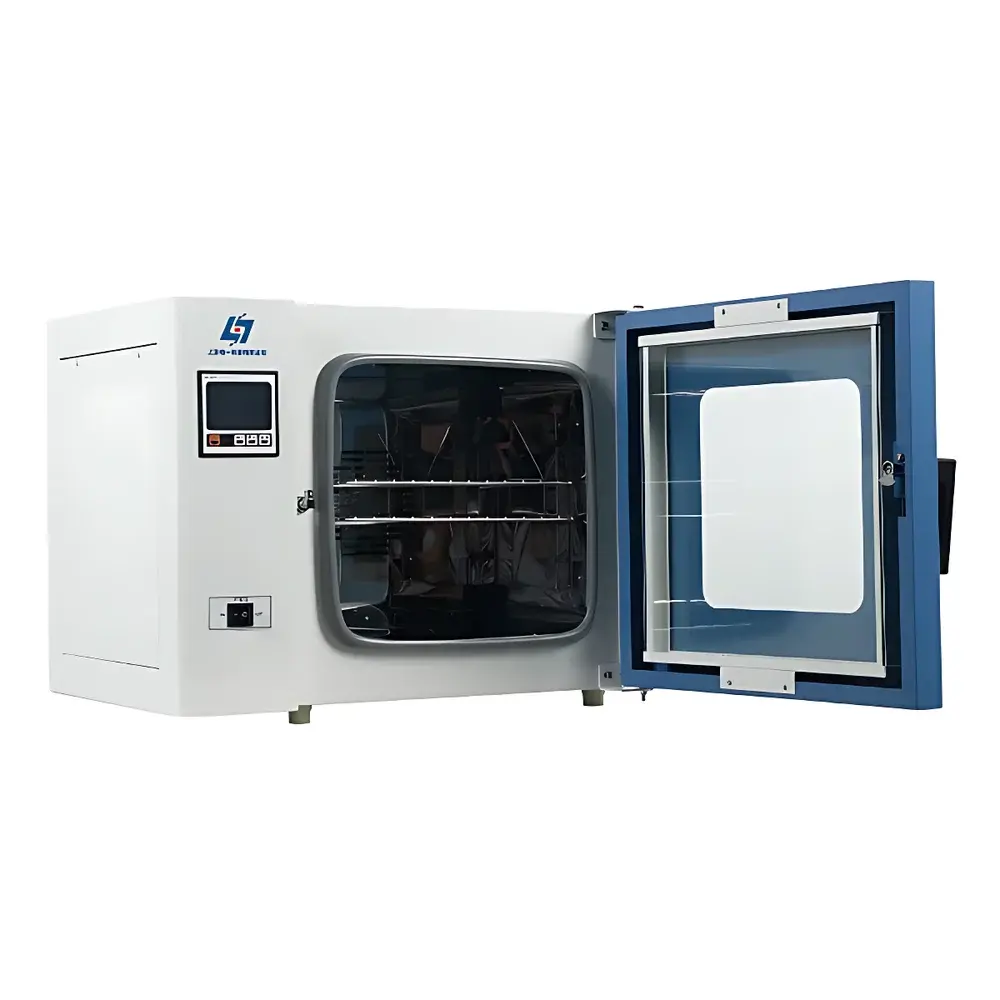
Yoyi DHG-9053A Forced-Air Constant-Temperature Drying Oven
| Brand | Yoyi |
|---|---|
| Origin | Shanghai, China |
| Manufacturer Type | Direct Manufacturer |
| Product Category | Domestic |
| Model | DHG-9053A |
| Instrument Type | General-Purpose Drying Oven |
| Temperature Range | RT+10 °C to 280 °C |
| Temperature Uniformity | ±2.5% (at 100 °C, empty chamber) |
| Temperature Fluctuation | ±1 °C |
| External Dimensions (W×D×H) | 705×610×530 mm |
| Internal Chamber Dimensions (W×D×H) | 420×350×390 mm |
| Chamber Material | Mirror-Finish Stainless Steel (SUS304) |
| Heating Method | Electric Resistive Heating |
| Power Input | 1100 W |
| Control Resolution | 0.1 °C |
| Timer Range | 1–9999 min |
| Working Environment | 5–40 °C ambient, ≤80% RH |
| Compliance | GB/T 30435–2013 |
Overview
The Yoyi DHG-9053A Forced-Air Constant-Temperature Drying Oven is an entry-level yet rigorously engineered benchtop drying system designed for routine thermal processing in academic laboratories, quality control facilities, and industrial R&D environments. It operates on the principle of forced convection—using a centrifugal blower and optimized airflow ducting to circulate heated air uniformly across the chamber—ensuring consistent thermal exposure for samples undergoing drying, baking, sterilization, or moisture removal. Unlike natural-convection ovens, this model maintains high spatial temperature uniformity (±2.5% at 100 °C per GB/T 30435–2013) and rapid thermal recovery after door opening, making it suitable for applications where reproducibility and process stability are critical. Its design adheres to national standard GB/T 30435–2013 for electric heating drying ovens, covering safety, performance verification, and metrological traceability requirements applicable to laboratory-grade thermal equipment.
Key Features
- Microprocessor-based PID temperature controller with intuitive LCD menu interface—displays setpoint, real-time chamber temperature, and remaining timer simultaneously
- Robust chamber construction: mirror-polished SUS304 stainless steel interior; cold-rolled steel exterior with electrostatic epoxy coating for corrosion resistance and cleanability
- High-efficiency horizontal airflow system with rear-mounted intake/exhaust ports and adjustable damper-free circulation—eliminates manual vent tuning and facilitates automatic moisture expulsion
- Dual-layer tempered glass observation window with silicone gasket seal—enables non-intrusive visual monitoring without thermal loss or condensation interference
- Intelligent power-loss recovery: retains user-defined parameters (set temperature, timer, alarm thresholds) during unexpected shutdowns and resumes operation upon power restoration
- Optional independent over-temperature cut-off circuit (not factory-installed)—meets IEC 61000-4-5 surge immunity and provides fail-safe thermal protection per EN 61010-1
- Modular accessory compatibility: RS485 serial interface (with Modbus RTU protocol support), embedded thermal printer port, inert gas inlet with calibrated rotameter (0–10 L/min range), and 25/50 mm diameter test ports
Sample Compatibility & Compliance
The DHG-9053A accommodates a broad spectrum of sample types—including petri dishes, weighing bottles, crucibles, glassware, polymer films, electronic components, and biological specimens—within its 50 L working volume. Its stainless steel chamber resists oxidation up to 280 °C and withstands repeated exposure to mild organic solvents and aqueous residues. The oven is validated under empty-chamber conditions per GB/T 30435–2013, with temperature uniformity verified using calibrated Class A Pt100 probes at nine standardized points. While not certified to ISO/IEC 17025 or FDA 21 CFR Part 11 out-of-the-box, its programmable timer, parameter logging capability (when paired with optional RS485 + software), and audit-ready operational logs support GLP/GMP-aligned documentation practices. Users performing regulated thermal validation (e.g., residual solvent removal per USP , or dry-heat depyrogenation per ISO 15883) may integrate it into IQ/OQ protocols with third-party calibration and mapping services.
Software & Data Management
When equipped with the optional RS485 communication module and accompanying PC software, the DHG-9053A supports remote parameter configuration, real-time temperature trending, and time-stamped data export in CSV format. The software enables multi-segment temperature ramping (via optional programmable controller add-on), configurable alarm notifications (email/SMS via gateway), and generation of PDF-formatted test reports compliant with internal SOP templates. All logged data include timestamps synchronized to host PC system clock, supporting basic ALCOA+ principles (Attributable, Legible, Contemporaneous, Original, Accurate). No cloud connectivity or proprietary firmware updates are provided; all firmware revisions are distributed as signed local binaries requiring manual upload via USB-to-serial adapter.
Applications
- Drying of moisture-sensitive powders, granules, and filter papers in pharmaceutical QC labs
- Baking of coated substrates and curing of low-Tg polymer films in materials science research
- Thermal conditioning of electrical insulators and PCB assemblies prior to environmental stress screening
- Moisture content determination (gravimetric method) per ASTM D2231 and ISO 1183
- Pre-sterilization drying of glassware and stainless steel tools in microbiology suites
- Accelerated aging studies of elastomers and adhesives under controlled thermal load
- Removal of residual solvents from synthesized compounds in synthetic chemistry workflows
FAQ
What is the maximum operating temperature, and is it suitable for depyrogenation?
The DHG-9053A achieves a maximum setpoint of 280 °C. While sufficient for general dry-heat sterilization (e.g., 160 °C for 2 hours), depyrogenation typically requires ≥250 °C for ≥45 minutes—this unit can meet that threshold but must be validated with thermocouple mapping and biological indicators per ISO 15883 Annex C.
Does the oven support NIST-traceable calibration?
Yes—the controller accepts external Pt100 input for field calibration verification. Users may perform in-house calibration using a NIST-traceable reference thermometer (e.g., Fluke 1523) and document deviations against manufacturer specifications.
Can multiple units be networked for centralized monitoring?
Via RS485 daisy-chaining (up to 32 devices on one bus), provided the host SCADA or LabVIEW system implements Modbus RTU polling. No native Ethernet or Wi-Fi interface is available.
Is the stainless steel chamber electropolished?
No—it features mechanically polished mirror-finish SUS304, suitable for routine cleaning with ethanol or diluted nitric acid but not classified as electropolished per ASTM A967.
What maintenance intervals are recommended?
Blower motor lubrication every 12 months; silicone door gasket inspection every 6 months; annual verification of temperature uniformity and fluctuation using accredited third-party service providers.



