
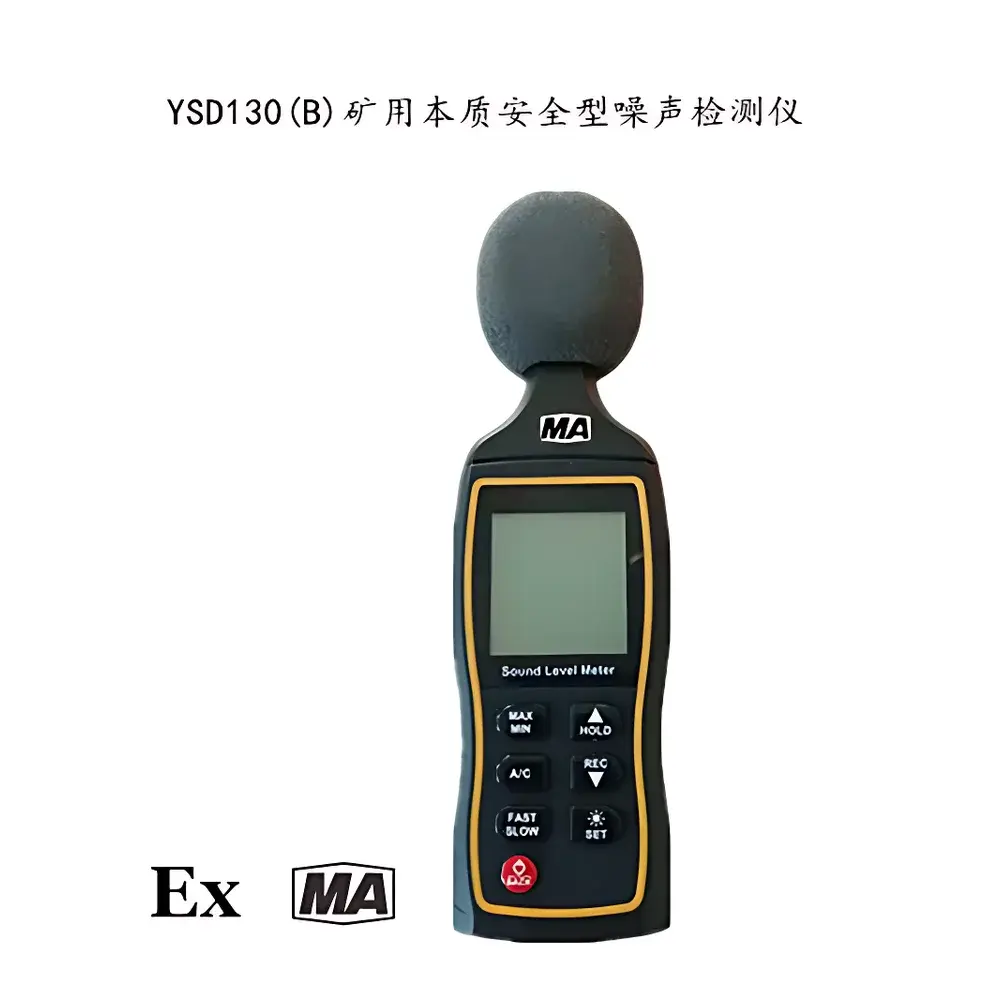
YSD130(B) Mine-Use Intrinsically Safe Sound Level Meter
| Origin | Beijing |
|---|---|
| Manufacturer Type | Distributor |
| Origin Category | Domestic |
| Model | YSD130 |
| Price Range | USD 280–700 |
| Frequency Range | 31.5 Hz–8.5 kHz |
| Measurement Range | 30 dB–130 dB |
| Accuracy | ±1.4 dB |
Overview
The YSD130(B) Mine-Use Intrinsically Safe Sound Level Meter is a certified Class I, Division 1 (Exib I Mb) acoustic measurement instrument engineered for continuous, reliable operation in hazardous underground coal mine environments. It operates on the principle of electret condenser microphone transduction—utilizing a 1/2-inch polarized capacitor microphone with linear frequency response—to convert sound pressure fluctuations into proportional electrical signals. Signal conditioning, A- and C-frequency weighting, and Fast/Slow time-weighting (per IEC 61672-1:2013) are implemented in real time within an embedded low-power microcontroller architecture. Designed specifically for intrinsically safe deployment, the device complies with GB 3836.1–2010 (Explosion-Proof Electrical Equipment) and MT 209–1990 (Mine Safety Standards), ensuring no ignition risk under fault conditions in methane-air atmospheres. Its operational envelope spans 30 dB to 130 dB (re 20 µPa), covering occupational noise exposure assessment from ambient ventilation noise to high-intensity mechanical equipment emissions.
Key Features
- Intrinsically safe design certified to Exib I Mb per GB 3836.4–2010, enabling direct use in active mining zones including working faces, return airways, and electromechanical chambers
- Four selectable measurement modes: Low-range (30–80 dB), Mid-range (50–100 dB), High-range (80–130 dB), and Auto-ranging (30–130 dB) for adaptive dynamic range optimization
- High-resolution 4-digit backlit LCD display with 0.1 dB resolution and dual update rates: numeric values refresh at 2 Hz; analog bar graph updates at 20 Hz for transient event tracking
- Comprehensive data logging: stores up to 4,700 timestamped measurement records with date/time stamp (built-in calendar clock per ISO 8601), supporting post-hoc exposure duration analysis
- Integrated DC/AC output and Micro-USB interface compliant with USB 2.0 full-speed protocol, enabling real-time streaming, historical data download, and graphical export (CSV/PNG) via PC software
- Robust mechanical construction: IP54-rated enclosure resists dust ingress and water splashing; compact form factor (256 × 70 × 35 mm) and lightweight design (280 g with batteries) facilitate handheld use during mobile surveys
Sample Compatibility & Compliance
The YSD130(B) is validated for use with standard 1/2-inch free-field microphone calibration adapters and compatible acoustic calibrators (e.g., 94 dB/114 dB @ 1 kHz). It meets the metrological requirements of IEC 61672-1:2013 Class 2 for sound level meters and satisfies Chinese national standards GB/T 3785.1–2010 (equivalent to IEC 61672-1) for electroacoustic performance. Safety certification includes MA (Mine Safety Approval) mark, explosion-proof certificate issued by CNEX (China National Explosion Protection Inspection Center), and third-party type test reports per MT/T 1165–2018 (Noise Monitoring Instruments for Coal Mines). The instrument supports GLP-aligned field documentation through traceable timestamps and configurable alarm thresholds (user-definable upper limit with audible/visual alert).
Software & Data Management
Data retrieval and analysis are supported via proprietary Windows-compatible PC software that provides audit-trail functionality—including user login logs, parameter change history, and export timestamps—aligned with basic FDA 21 CFR Part 11 principles for electronic records integrity. Raw measurement files include metadata such as battery voltage, microphone sensitivity offset, temperature-compensated gain status, and measurement mode flags. Export formats include CSV (for Excel or MATLAB import), PDF summary reports with annotated waveform snippets, and PNG plots of Leq, Lmax, and time-history traces. Firmware updates are delivered via signed binary packages with CRC-32 validation to ensure configuration consistency across fleet deployments.
Applications
Primary applications include occupational noise exposure monitoring per China’s Work Safety Law and AQ/T 8009–2013 (Technical Specifications for Occupational Health Surveillance in Coal Mines); compliance verification against mandatory noise limits in underground conveyor systems, drilling rigs, and ventilation fans; baseline environmental noise mapping for mine ventilation planning; and routine QA/QC checks in surface-based coal preparation plants. Secondary use cases extend to industrial hygiene departments in heavy manufacturing, municipal environmental protection agencies conducting community noise impact assessments near mining districts, and academic institutions performing acoustical engineering research on low-frequency noise propagation in confined underground geometries.
FAQ
What intrinsic safety certifications does the YSD130(B) hold?
It carries the Exib I Mb marking per GB 3836.4–2010 and MA approval (Safety Mark No. MAAxxxxx) issued by the National Mine Safety Administration.
Is the device suitable for long-term unattended logging in remote mine areas?
Yes—its 4×AAA alkaline battery configuration supports ≥12 hours of continuous operation at typical sampling intervals; optional external power input (5 V DC via Micro-USB) enables extended deployment.
Can measurement data be integrated into enterprise-level EHS management platforms?
Via CSV export and timestamp-synchronized batch upload, data can be ingested into SQL-based EHS databases or cloud platforms supporting ISO 45001 reporting workflows.
Does the instrument support octave or 1/3-octave band analysis?
No—this model implements only broadband A/C-weighted measurements and time-weighted peak detection per IEC 61672-1; spectral decomposition requires external FFT analyzers.
How is calibration traceability maintained in field operations?
Each unit ships with a factory calibration certificate traceable to NIM (National Institute of Metrology, China); users perform daily acoustic checks using a certified 94 dB calibrator (e.g., CA120), with results logged alongside measurement records.







