
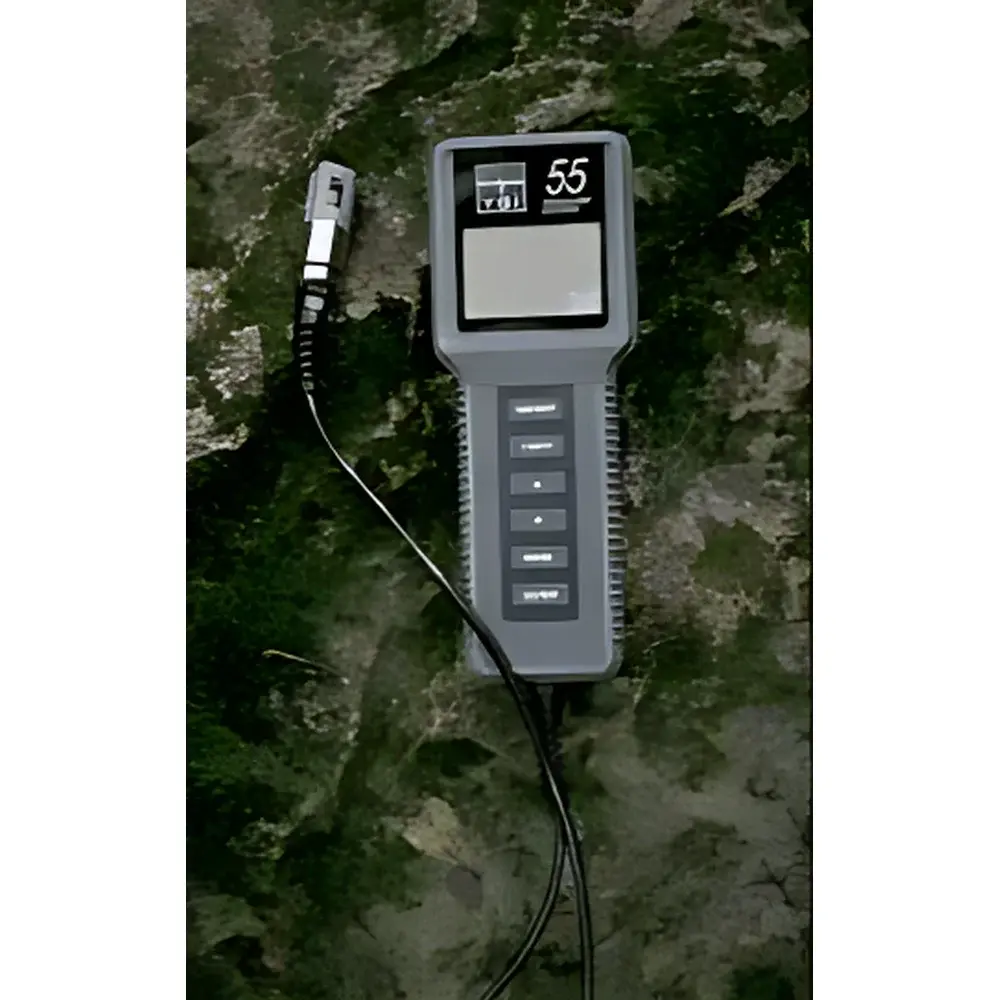
YSI 55 and 55D Dissolved Oxygen and Temperature Meter
| Origin | USA |
|---|---|
| Manufacturer Type | Authorized Distributor |
| Origin Category | Imported |
| Model | YSI 55 / 55D |
| Price | Upon Request |
Overview
The YSI 55 and 55D Dissolved Oxygen and Temperature Meter is a field-deployable, microprocessor-controlled instrument engineered for reliable, real-time measurement of dissolved oxygen (DO) concentration and temperature in freshwater, estuarine, and marine environments. It operates on the polarographic (Clark-type) electrochemical principle: molecular oxygen diffuses through a gas-permeable membrane to a cathode, where it is reduced in the presence of an applied voltage, generating a current proportional to DO concentration. Temperature is measured simultaneously via a precision thermistor embedded in the same probe assembly. This dual-parameter architecture enables automatic temperature compensation and supports both % air saturation and mg/L reporting modes—critical for compliance with environmental monitoring protocols such as EPA Method 360.5, ASTM D888, and ISO 5814. Designed for rugged outdoor use, the system integrates robust mechanical construction, battery-powered operation, and field-calibratable electronics—making it suitable for regulatory field surveys, wastewater effluent monitoring, limnological studies, and aquaculture management.
Key Features
- Handheld, portable design with shoulder strap and belt clip options for extended field deployment
- Stainless-steel probe housing rated for immersion up to 30 m; optimized mass ensures rapid submersion without floatation
- Three standard cable lengths available: 3.7 m (12 ft), 7.5 m (25 ft), and 15 m (50 ft)—compatible with both fixed (55) and modular (55D) configurations
- Full keypad-based calibration and operation; no external software or PC required for routine use
- Dual-display LCD with backlighting for low-light conditions; simultaneous readout of DO (% saturation or mg/L) and temperature (°C)
- Manual salinity compensation (0–40 ppt) and barometric pressure correction via elevation input (0–3000 m ASL)
- Integrated calibration chamber doubles as probe storage compartment—enables quick air-saturation calibration in situ
- Stress-relieved MS-style connector (55D) or molded integral connector (55) for enhanced cable durability and IP67-rated environmental sealing
- Alkaline battery operation (4 × AA); typical service life exceeds 100 hours with low-battery indicator
Sample Compatibility & Compliance
The YSI 55/55D is validated for use across natural waters—including rivers, lakes, wetlands, coastal zones, and wastewater treatment basins—with full compatibility for samples containing suspended solids, organic matter, and moderate biofouling. Its Clark-cell sensor requires periodic membrane replacement and electrolyte replenishment (KCl solution), supported by three membrane options: Standard (5775/5793), High-Sensitivity (5576/5794), and Semi-Sensitive (5685). The instrument meets general requirements for field instrumentation under ISO/IEC 17025-accredited laboratories when operated per manufacturer’s calibration and maintenance procedures. While not inherently 21 CFR Part 11 compliant (as it lacks electronic audit trail functionality), its documented calibration logs, manual entry traceability, and stable analog signal path support GLP-aligned data integrity in non-regulated environmental QA/QC workflows.
Software & Data Management
The YSI 55 and 55D operate autonomously without proprietary software or data logging capability. All measurements are displayed in real time and must be manually recorded in field notebooks or transferred to external databases. However, the modular 55D configuration allows seamless integration with third-party data loggers via analog output (0–2 V DC) when equipped with optional interface modules (not included). For long-term deployments requiring automated recording, users commonly pair the 55D probe with YSI’s EXO multiparameter platforms or industry-standard SDI-12-compatible dataloggers. Calibration records—including date, operator ID, salinity/elevation inputs, and air-saturation verification values—are maintained externally per site-specific SOPs.
Applications
- Regulatory surface water quality monitoring per state NPDES permits and EPA Region-specific sampling plans
- Benthic and pelagic DO profiling in stratified reservoirs and eutrophic lakes
- Effluent discharge compliance testing at municipal and industrial wastewater treatment plants
- Aquaculture pond management—optimizing aeration cycles based on diurnal DO trends
- Wetland restoration assessment, including sediment oxygen demand (SOD) screening
- Field validation of laboratory DO analyzers and continuous online sensor networks
- Academic limnology and hydrology coursework involving hands-on water chemistry field methods
FAQ
What is the difference between the YSI 55 and 55D models?
The YSI 55 integrates a fixed probe and cable into a single unit, while the 55D separates the meter body from the probe via a military-spec (MS) connector—enabling interchangeable cables and probe replacement without instrument recalibration.
Can the YSI 55/55D measure dissolved oxygen in seawater?
Yes, provided salinity is manually entered (0–40 ppt) to correct for oxygen solubility differences; accuracy remains within ±2% saturation or ±0.3 mg/L across the specified range.
How often should the membrane and electrolyte be replaced?
Under typical field conditions, replace membranes every 2–4 weeks and refill KCl electrolyte during each membrane change—or more frequently in high-fouling or low-temperature applications.
Is the instrument suitable for long-term unattended deployment?
No—it lacks internal memory or datalogging; however, the 55D probe may be connected to external dataloggers for extended monitoring when paired with appropriate interface hardware.
Does the YSI 55/55D require annual factory recalibration?
Not mandatory, but recommended every 12 months for critical regulatory applications; field air calibration before each use satisfies most routine QA/QC requirements.
Related Products







