
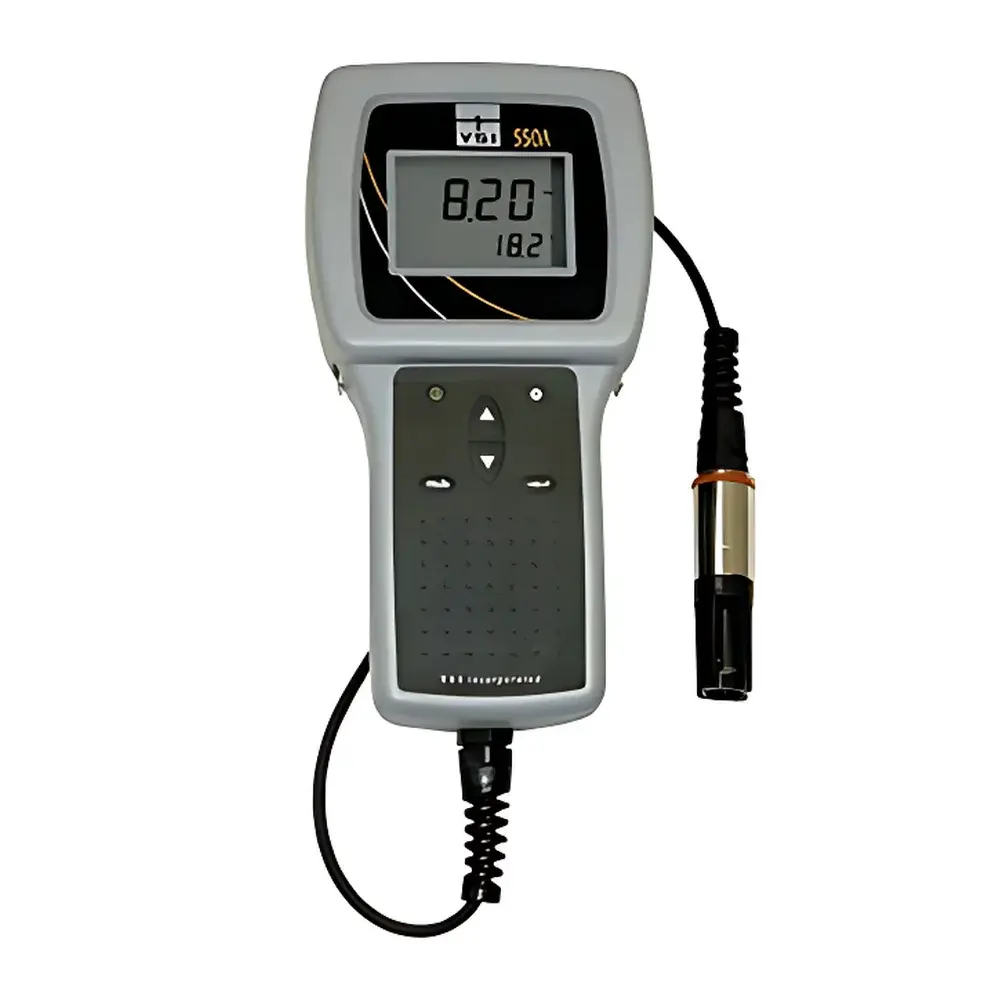
YSI 550A Portable Dissolved Oxygen Meter
| Brand | YSI |
|---|---|
| Origin | USA |
| Model | YSI 550A |
| Instrument Type | Portable |
| IP Rating | IP67 |
| Measurement Principle | Polarographic (Clark-type) Electrode with Thermistor Temperature Compensation |
| DO Range | 0–50 mg/L (0–500% air saturation) |
| Temperature Range | –5 to +45 °C |
| DO Accuracy | ±2% or ±2% air saturation (0–200%), ±6% (200–500%) |
| Temp Accuracy | ±0.3 °C |
| Resolution | 0.01/0.1 mg/L (selectable), 0.1 °C, 0.1/1% air saturation (selectable) |
| Battery Life | Up to 2000 hours |
| Cable Options | 3.7 m, 7.5 m, 15 m, 30 m |
| Calibration | Built-in DO calibration chamber, automatic temperature compensation, manual salinity & altitude compensation |
Overview
The YSI 550A Portable Dissolved Oxygen Meter is a field-deployable, ruggedized instrument engineered for high-reliability dissolved oxygen (DO) and temperature measurements in freshwater, estuarine, marine, wastewater, and aquaculture environments. It employs a polarographic (Clark-type) electrochemical sensor principle—where oxygen diffuses through a selective gas-permeable membrane onto a cathode, generating a current proportional to the partial pressure of dissolved O2. This signal is linearly correlated to concentration (mg/L) and percent air saturation under defined atmospheric and salinity conditions. Temperature is measured concurrently using a high-stability thermistor with proven long-term drift characteristics—YSI’s proprietary thermal reference standard widely adopted in regulatory monitoring programs. The instrument’s IP67-rated housing ensures full submersion resistance up to 1 meter for 30 minutes and protection against dust ingress, making it suitable for harsh outdoor deployments without external enclosures.
Key Features
- Field-replaceable DO sensor module—enabling rapid maintenance without returning the unit to service centers
- Next-generation polyethylene (PE) membrane cap—reducing response time (t90 < 15 s) and minimizing stirring dependence per ASTM D888-22 guidelines
- Stainless-steel probe body with integrated weight—designed for vertical deployment and stable immersion in flowing or turbulent water columns
- Strain-relief fittings at both cable termini—mitigating mechanical fatigue at solder joints and extending cable service life beyond 5 years under routine use
- Integrated calibration and storage chamber—maintains electrode hydration and zero-stability during transport; supports one-point air-saturation or aqueous standard calibration
- Backlit graphical LCD with intuitive single-hand operation—optimized for gloved use and low-light conditions
- Automatic temperature compensation (ATC), user-adjustable salinity (0–70 ppt) and barometric pressure (300–1100 hPa) inputs—ensuring traceable DO corrections per ISO 5814:2012 and APHA Standard Methods 4500-O G
Sample Compatibility & Compliance
The YSI 550A is validated for use across diverse aqueous matrices including raw surface water, treated effluent, groundwater, seawater, and recirculating aquaculture systems. Its polarographic sensor exhibits minimal interference from common ions (e.g., Cl−, NO3−, SO42−) and is unaffected by hydrogen sulfide concentrations below 2 mg/L. The instrument complies with key international standards for field DO measurement: ISO 5814:2012 (Water quality — Determination of dissolved oxygen — Electrochemical probe method), ASTM D888-22 (Standard Test Methods for Dissolved Oxygen in Water), and EPA Method 360.1 (Dissolved Oxygen—Electrochemical Probe). While not inherently 21 CFR Part 11 compliant, audit trails and calibration records may be documented manually per GLP/GMP requirements for environmental laboratories undergoing third-party accreditation (e.g., ISO/IEC 17025).
Software & Data Management
Data logging is performed internally with timestamped DO and temperature values stored in non-volatile memory (up to 2,000 readings). Readings are exportable via RS-232 serial interface to YSI’s legacy ProComm software or generic terminal emulators for CSV conversion. No cloud connectivity or proprietary firmware updates are supported—consistent with the device’s design philosophy of operational simplicity and long-term hardware stability. All calibration events—including date, operator ID (manually entered), ambient pressure, and salinity—are retained alongside measurement records to support chain-of-custody documentation in regulatory reporting.
Applications
- Regulatory compliance monitoring for NPDES and WFD discharge permits
- In situ profiling of hypolimnetic oxygen depletion in stratified lakes and reservoirs
- Wastewater treatment plant process control—especially in activated sludge aeration basins and denitrification zones
- Aquaculture pond health assessment and feed optimization based on diurnal DO cycling
- Ecological field studies requiring spatially distributed, battery-powered DO mapping
- Emergency response assessments following chemical spills or algal bloom events
FAQ
What calibration standards are recommended for the YSI 550A?
Zero-point calibration is performed using sodium sulfite solution (0 mg/L); span calibration uses air-saturated water prepared at known temperature, salinity, and barometric pressure—per ISO 5814 Section 7.2.
Can the YSI 550A measure DO in high-salinity seawater?
Yes—salinity compensation is manually entered (range: 0–70 ppt), enabling accurate mg/L conversion per the Garcia & Gordon (1992) solubility algorithm embedded in the firmware.
Is the sensor membrane replaceable in the field?
Yes—the entire DO module—including membrane, electrolyte, and cathode—is designed as a snap-in cartridge and requires no tools for replacement.
How often should the DO sensor be calibrated?
Calibration frequency follows site-specific QA/QC protocols; EPA recommends daily calibration for compliance-grade data, while research applications may extend to weekly intervals with verification checks.
Does the instrument support GLP-compliant data integrity?
It provides essential metadata (time, temp, salinity, pressure) but lacks electronic signatures or automated audit logs; manual logbooks or LIMS integration are required to meet full GLP traceability requirements.
Related Products







