
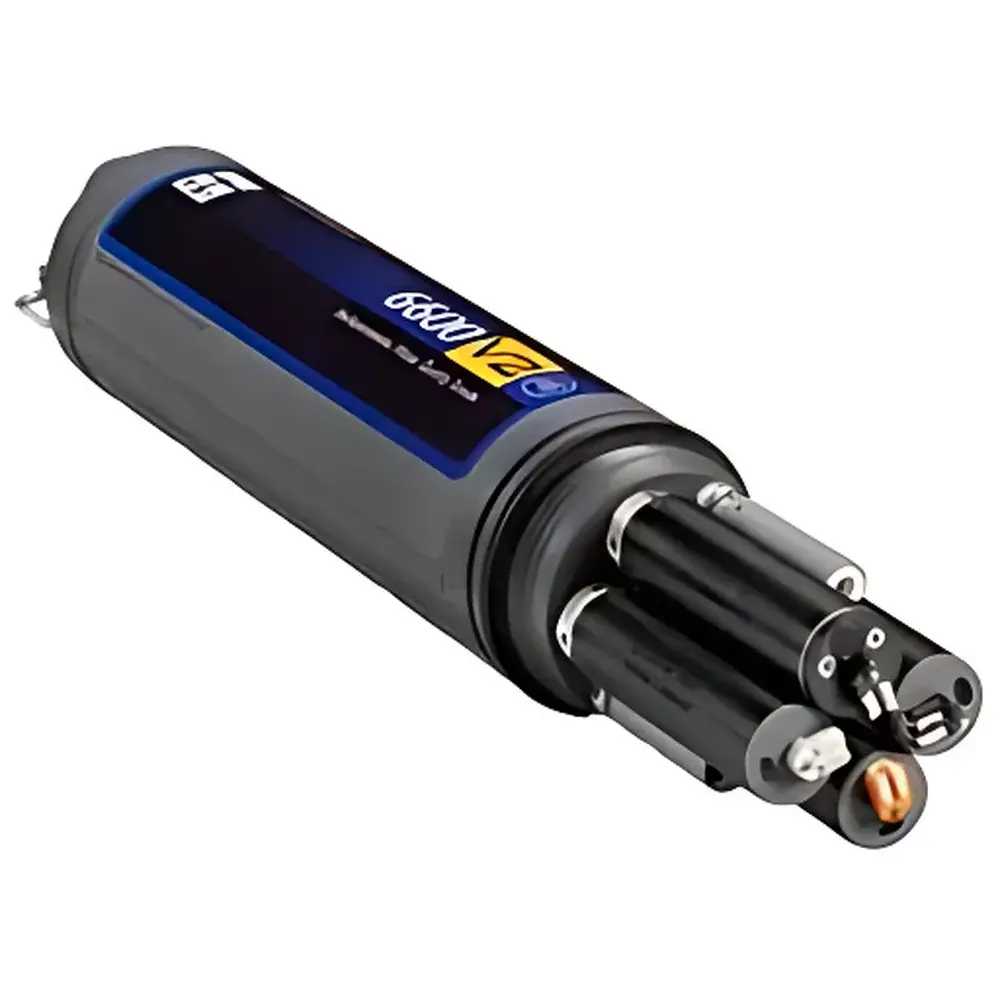
YSI 6600V2 Multi-Parameter Water Quality Sonde
| Origin | USA |
|---|---|
| Manufacturer Type | Authorized Distributor |
| Origin Category | Imported |
| Model | YSI 6600V2 |
| Price | Upon Request |
Overview
The YSI 6600V2 Multi-Parameter Water Quality Sonde is a field-deployable, self-contained environmental monitoring platform engineered for high-fidelity in-situ measurement of physical, chemical, and biological water quality parameters. Built upon YSI’s proven sonde architecture, the 6600V2 integrates up to four optical sensors—ROX optical dissolved oxygen (DO), chlorophyll-a, phycocyanin (for cyanobacteria), and turbidity—alongside electrochemical and physical sensors including pH, ORP, conductivity, temperature, depth, salinity, and rhodamine WT fluorometry. Its measurement principle relies on fluorescence lifetime detection (for DO and pigment sensors), potentiometric response (pH/ORP), inductive or electrode-based conductivity, and pressure transduction (depth). Designed for deployment across freshwater, seawater, and wastewater matrices, the sonde operates reliably from −5 °C to 50 °C and supports long-term unattended operation in both shallow and deep-water environments (up to 200 m depth with optional deep-water pressure sensor). The instrument complies with core methodological frameworks referenced in Standard Methods for the Examination of Water and Wastewater (23rd ed.), enabling traceable data generation suitable for regulatory reporting and scientific research.
Key Features
- Optical ROX dissolved oxygen sensor utilizing fluorescence quenching lifetime technology—immune to flow rate variation, insensitive to H2S interference, and stable under hypoxic conditions.
- User-replaceable modular sensor design (excluding depth sensor), allowing rapid field calibration, maintenance, and configuration changes without factory service.
- Integrated cleaning brush™ mechanism on all optical sensors to mitigate biofouling, bubble adhesion, and particulate deposition—extending calibration intervals and ensuring signal stability over extended deployments.
- Non-volatile internal memory storing up to 150,000 data records; data integrity preserved during power loss or battery replacement.
- Dual power options: eight AA alkaline batteries (typical field life: 54 days at 15-minute sampling interval, 20 °C) or external 12 V DC supply via RS-232/SDI-12 interface.
- Rugged PVC housing rated for continuous submersion; compact form factor (8.9 cm diameter × 54.9 cm length with depth sensor; 3.18 kg with batteries).
Sample Compatibility & Compliance
The YSI 6600V2 is validated for use in diverse aquatic media—including lakes, rivers, estuaries, coastal marine zones, drinking water reservoirs, and wastewater treatment effluents. Sensor outputs conform to widely accepted analytical conventions: conductivity-derived parameters (specific conductance at 25 °C, resistivity, TDS) are calculated per Standard Methods equations; turbidity measurements reference AMCO-AEPA polymer standards; chlorophyll-a and phycocyanin quantifications are calibrated against laboratory-extracted algal standards and culture-based cell counts. While not certified to ISO/IEC 17025 or EPA Method equivalency out-of-box, the sonde supports GLP-aligned data acquisition when paired with audit-trail-capable software and documented calibration procedures. Its measurement uncertainty profiles align with typical field-grade instrumentation expectations for environmental monitoring programs compliant with US EPA National Lakes Assessment protocols and EU WFD monitoring requirements.
Software & Data Management
Data retrieval and configuration are managed via YSI EcoWatch™ software (Windows-compatible), which supports sensor setup, real-time telemetry, post-processing, QA/QC flagging, and export to CSV, Excel, or database formats. EcoWatch enables batch calibration coefficient entry, time-series visualization, and metadata annotation—including site ID, operator, deployment date, and sensor serial numbers. Though EcoWatch itself does not implement FDA 21 CFR Part 11 electronic signature or audit trail features, raw binary data files retain full timestamped sensor readings and diagnostic flags (e.g., sensor saturation, low battery, communication errors), facilitating third-party validation workflows. SDI-12 and RS-232 interfaces allow integration with Campbell Scientific CR-series loggers, OTT Hydromet systems, or custom SCADA architectures for remote telemetry.
Applications
- Drinking water source protection: Early detection of cyanobacterial blooms via phycocyanin and chlorophyll-a co-monitoring, coupled with DO and pH trends indicating metabolic shifts.
- Eutrophication assessment: Long-term tracking of nutrient-driven responses—including turbidity–chlorophyll relationships, DO diel cycles, and conductivity–salinity gradients in estuarine transition zones.
- Harmful algal bloom (HAB) forecasting: Correlation of rhodamine WT tracer dilution with hydrodynamic models; validation of satellite-derived chlorophyll products using in-situ ground truth.
- Wetland biogeochemistry: High-resolution profiling of redox potential (ORP), DO, and pH across sediment–water interfaces to characterize denitrification and methanogenesis zones.
- Regulatory compliance monitoring: Support for Total Maximum Daily Load (TMDL) implementation, NPDES permit verification, and State Revolving Fund (SRF)-supported watershed studies.
FAQ
What is the maximum operational depth for optical sensors?
All optical sensors (ROX DO, chlorophyll-a, phycocyanin, turbidity, rhodamine WT) are rated for continuous operation to 61 m depth.
Can the 6600V2 be upgraded from an older 6600 model?
Yes—YSI offers official upgrade kits including a new probe base, ROX DO sensor module, firmware update, and software revision to achieve full 6600V2 functionality.
Is the instrument compatible with modern operating systems beyond Windows XP?
EcoWatch v5.x is officially supported on Windows 7/10/11 via compatibility mode; raw data files remain fully readable in Python, R, or MATLAB for contemporary analysis pipelines.
How is conductivity used to derive TDS and salinity?
TDS (mg/L) is calculated using the standard conversion factor of 0.64 × conductivity (µS/cm); salinity (ppt) is derived from conductivity and temperature using the PSS-78 equation as implemented in Standard Methods.
Does the sonde support automated QA/QC flagging?
Yes—built-in diagnostics automatically flag anomalies such as sensor saturation, out-of-range temperature, pressure drift, and low battery voltage; these flags are embedded in each data record.
Related Products







