
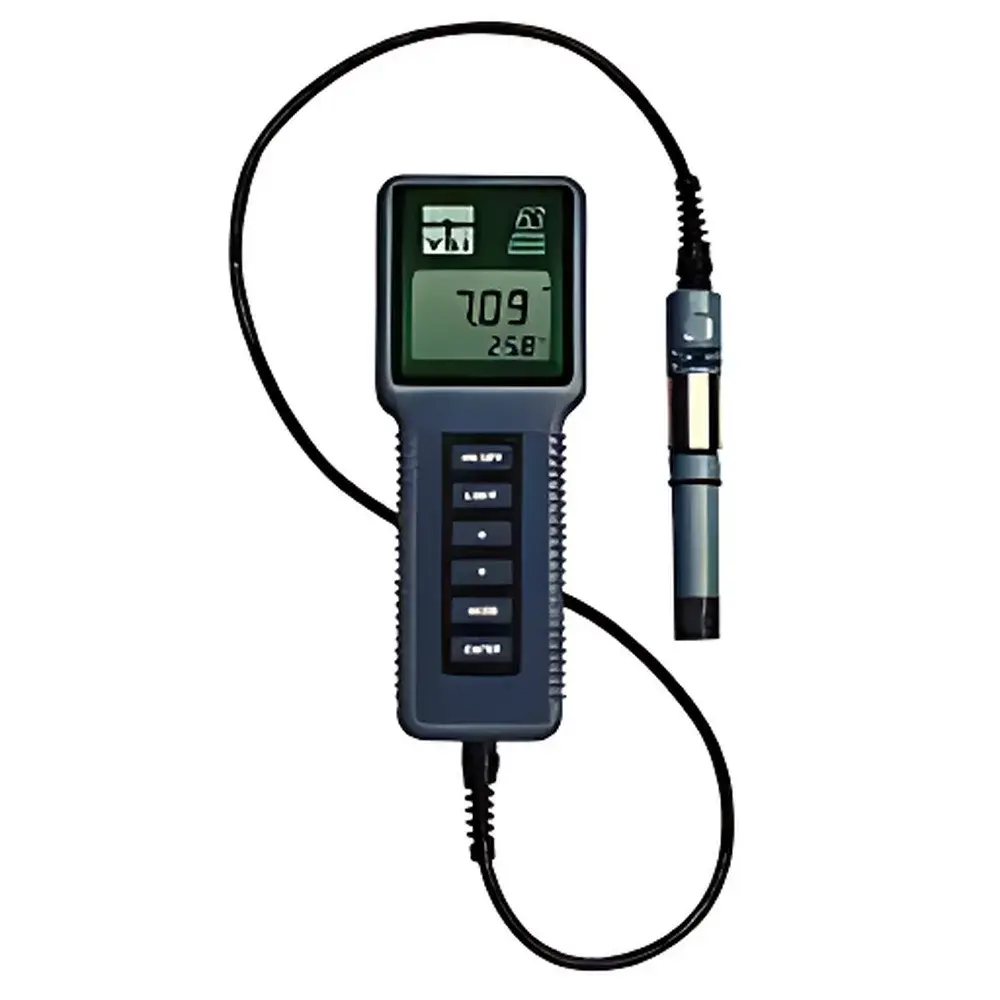
YSI YSI-63 Portable pH/Conductivity/Salinity/Temperature Meter
| Brand | YSI |
|---|---|
| Origin | USA |
| Model | YSI-63 |
| Probe Type | Integrated pH/Conductivity/Temp Sensor |
| Depth Rating | 30 m |
| Display | Backlit LCD |
| Data Storage | 50 non-volatile readings |
| Electrode Interface | Waterproof BNC |
| pH Range | 0–14 pH (with auto temp compensation) |
| Conductivity Range | Auto-ranging, 0–200 mS/cm |
| Salinity | Calculated from conductivity & temperature (PSS-78 standard) |
| Temp Range | −5 to +50 °C |
| Construction | Stainless steel probe body with polymer electrode guard |
| Cable | Shielded, stress-relieved, 30-m field-replaceable cable |
| Power | Standard alkaline batteries (field-swappable) |
| Compliance | IP68 submersible rating |
| Warranty | 1-year probe warranty |
Overview
The YSI YSI-63 Portable pH/Conductivity/Salinity/Temperature Meter is a rugged, field-engineered multiparameter instrument designed for reliable in-situ water quality assessment in demanding environmental monitoring applications. Built upon YSI’s legacy of precision electrochemical sensing, the YSI-63 employs potentiometric glass electrode technology for pH measurement and four-electrode AC conductometry for high-stability conductivity determination. Temperature is measured via integrated platinum resistance (PT1000) sensor, enabling automatic temperature compensation (ATC) across all parameters. Salinity is computed in real time using the Practical Salinity Scale 1978 (PSS-78), derived from conductivity and temperature inputs per international oceanographic standards. Its fully submersible probe—rated IP68 and validated to 30 meters—eliminates the need for sample retrieval, minimizing contamination risk and preserving in-situ chemical equilibria. The system operates without external power sources or laptops, delivering immediate, calibrated field data under variable ambient lighting and physical stress conditions.
Key Features
- Ruggedized stainless-steel probe housing with polymer-shielded glass pH electrode and quad-nickel conductivity cell—engineered for long-term stability in turbid, abrasive, or biofouling-prone waters.
- Field-replaceable, waterproof BNC electrode interface with integrated strain relief—designed to prevent cable fatigue and maintain signal integrity after repeated deployment cycles.
- Backlit, high-contrast LCD display with ergonomic viewing angle—optimized for readability in low-light environments including dawn/dusk surveys and shaded stream banks.
- Onboard microprocessor with self-diagnostic boot sequence—verifies sensor continuity, battery voltage, calibration status, and memory integrity at power-on.
- Non-volatile internal memory storing up to 50 timestamped measurements—including pH, conductivity, salinity, temperature, and date/time—retained without battery power.
- Integrated probe storage compartment—doubles as a dark, temperature-stabilized chamber for DO sensor calibration (when used with compatible YSI DO modules) and protects electrodes during transport.
Sample Compatibility & Compliance
The YSI-63 is validated for use in freshwater, estuarine, and coastal marine matrices—including rivers, lakes, wetlands, groundwater wells, and tidal creeks. Its composite sensor design avoids cross-sensitivity between pH and conductivity measurements, ensuring accuracy across wide ionic strength gradients (0–200 mS/cm). All electrochemical components comply with ASTM D1293 (pH of water), ASTM D5391 (conductivity of pure water), and ISO 7888 (electrical conductivity of natural waters). The instrument meets IP68 ingress protection requirements per IEC 60529 and supports GLP-compliant data collection through manual entry of operator ID and site metadata. While not FDA 21 CFR Part 11–certified (as it lacks electronic signature capability), its audit-ready data log satisfies EPA Region-specific QA/QC protocols for Tier 1 field screening and long-term trend monitoring programs.
Software & Data Management
Data export is performed via manual transcription or optional RS-232 serial interface (using YSI-provided cables and terminal emulation software). No proprietary drivers or cloud synchronization are required—raw values are ASCII-formatted and compatible with common spreadsheet and LIMS platforms. Calibration coefficients (pH slope, offset; conductivity cell constant) are stored in non-volatile memory and persist across battery changes. The unit supports two-point pH calibration (using NIST-traceable buffers) and single-point conductivity verification—both executed entirely in the field without auxiliary hardware. Firmware updates are not user-accessible; device functionality remains stable across operational lifetimes, prioritizing field reliability over feature expansion.
Applications
- Regulatory compliance monitoring under NPDES permits and state water quality standards.
- Baseline characterization and post-remediation verification at brownfield and landfill leachate sites.
- Wetland hydrology studies requiring concurrent pH/conductivity profiling across elevation gradients.
- Marine education and citizen science initiatives where durability, intuitive operation, and battery longevity are critical.
- Emergency response assessments following chemical spills or wastewater overflows—providing immediate triage-level water chemistry data.
- Long-term ecological research involving seasonal tracking of acidification trends in headwater streams.
FAQ
Is the YSI-63 suitable for drinking water analysis?
Yes—the instrument meets ASTM D1293 and EPA Method 150.1 requirements for pH and conductivity testing in potable water systems, provided calibration is performed with certified reference materials before each sampling event.
Can the pH electrode be recalibrated in the field after exposure to high-sediment water?
Yes—its sealed BNC connector allows rapid electrode replacement or recalibration using portable buffer kits; no disassembly of the probe body is required.
Does the YSI-63 support dissolved oxygen measurement?
No—the YSI-63 is a dedicated pH/conductivity/salinity/temperature platform. For DO integration, users must pair it with a separate YSI ProDSS or EXO system, or utilize the probe storage chamber for manual DO sensor calibration.
What maintenance is required between deployments?
Rinse the probe thoroughly with deionized water after each use; store the pH electrode in storage solution (not DI water) and keep the conductivity cell dry. Inspect cable strain reliefs and O-rings semiannually for cracking or compression set.
How does the auto-ranging conductivity function improve measurement accuracy?
By dynamically selecting the optimal excitation frequency and gain setting based on measured conductance, the four-electrode circuit minimizes polarization error and electrode fouling artifacts—particularly critical in low-conductivity freshwater or high-TDS industrial effluents.
Related Products







