
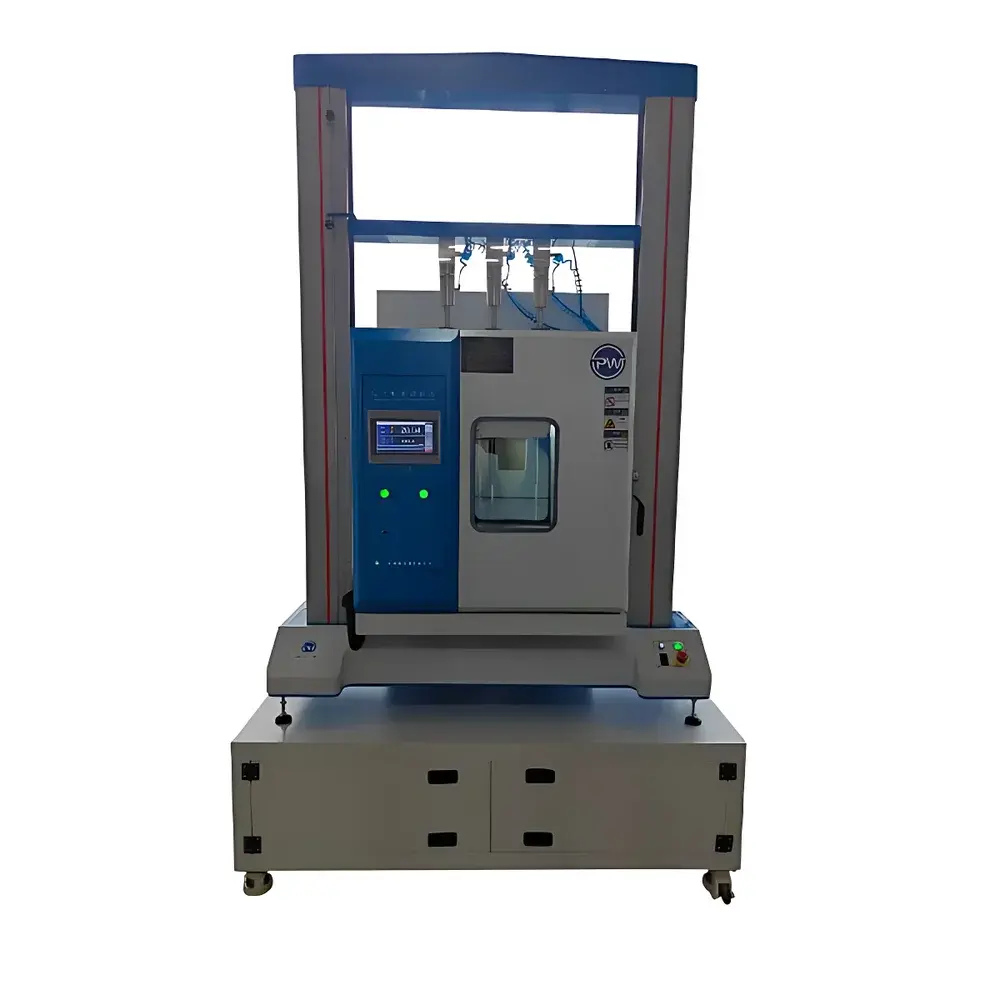
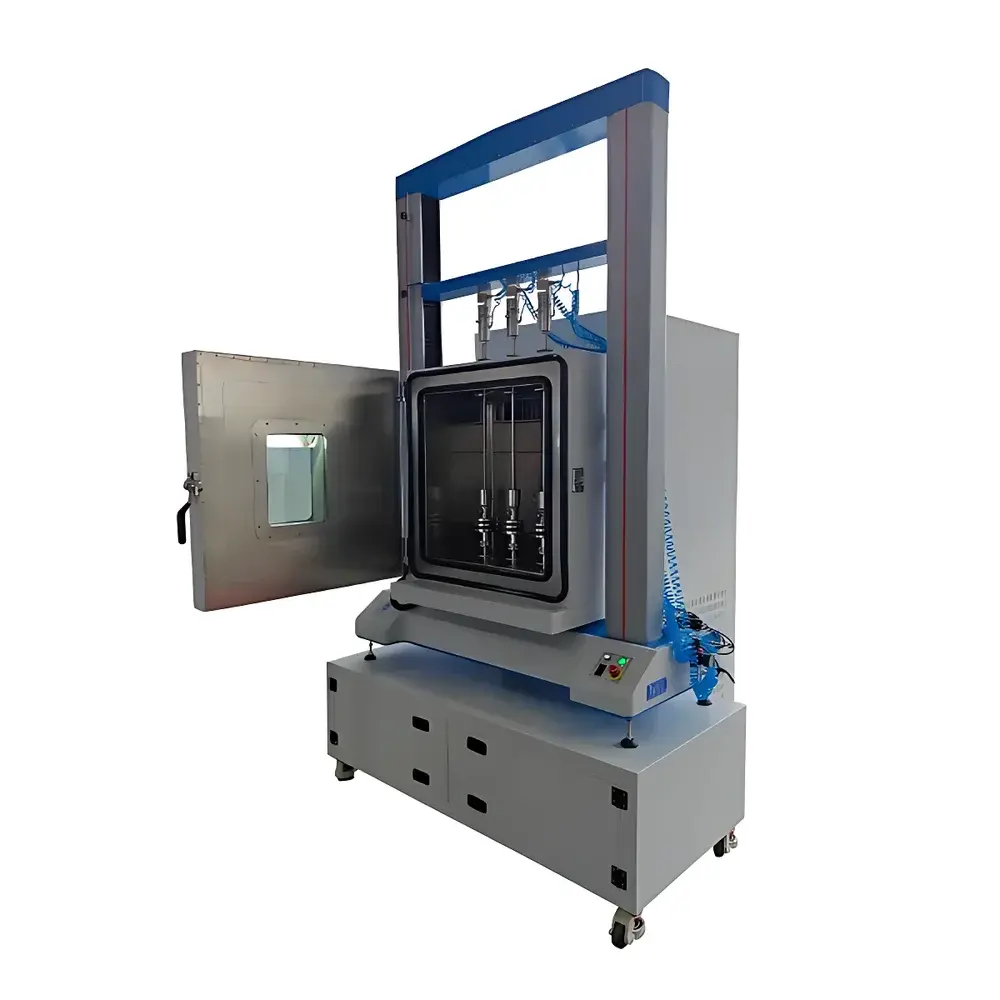
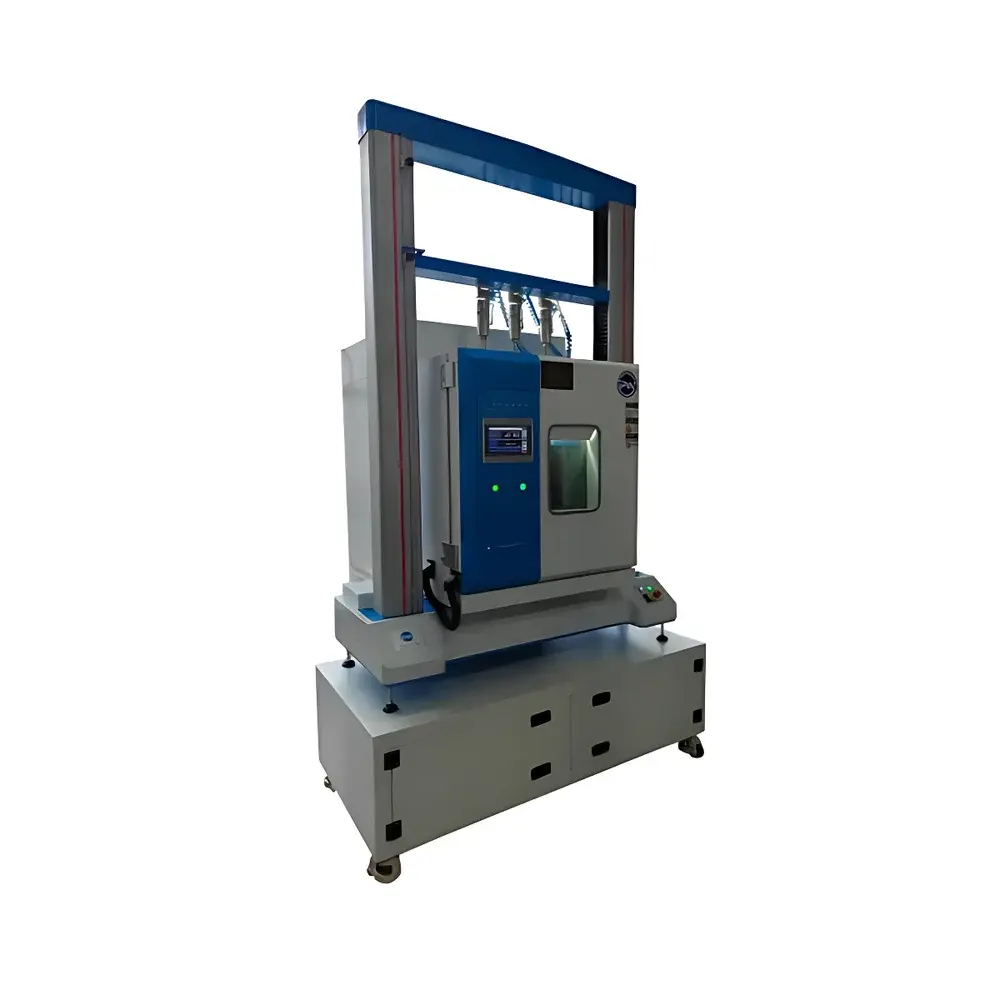
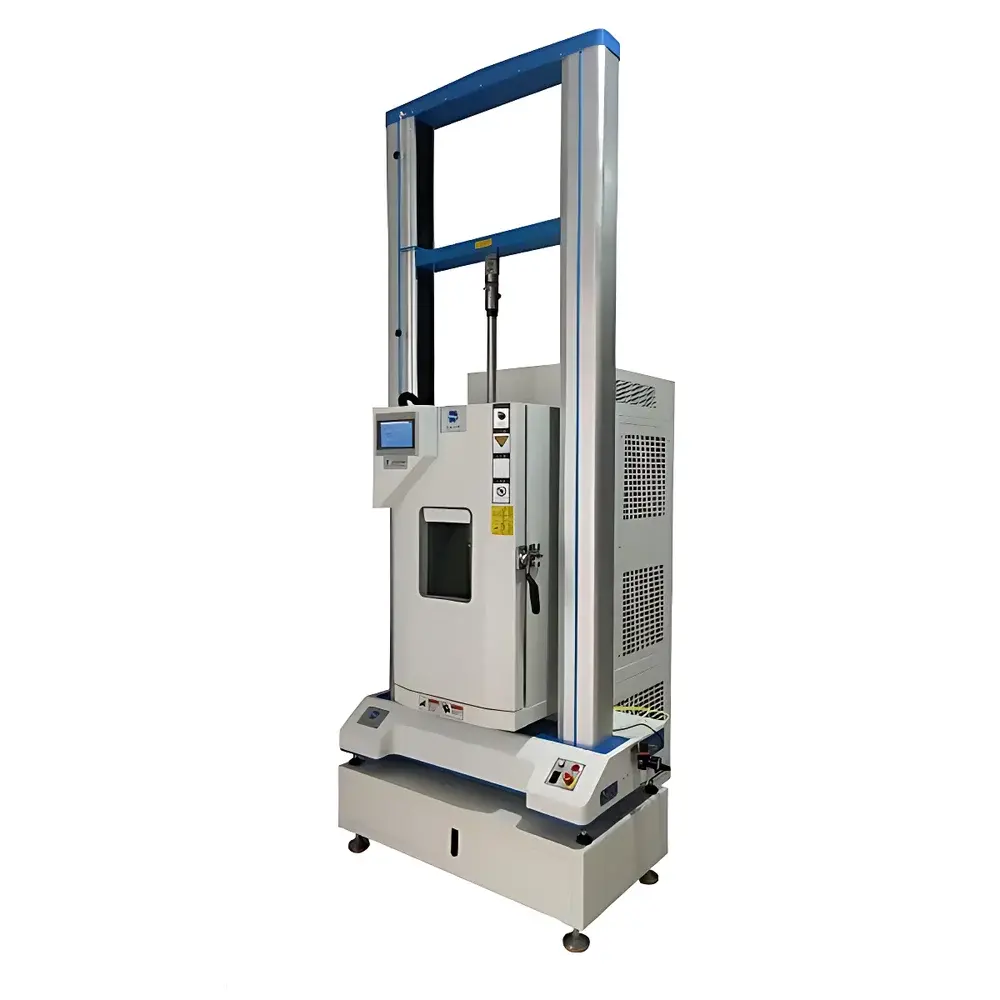
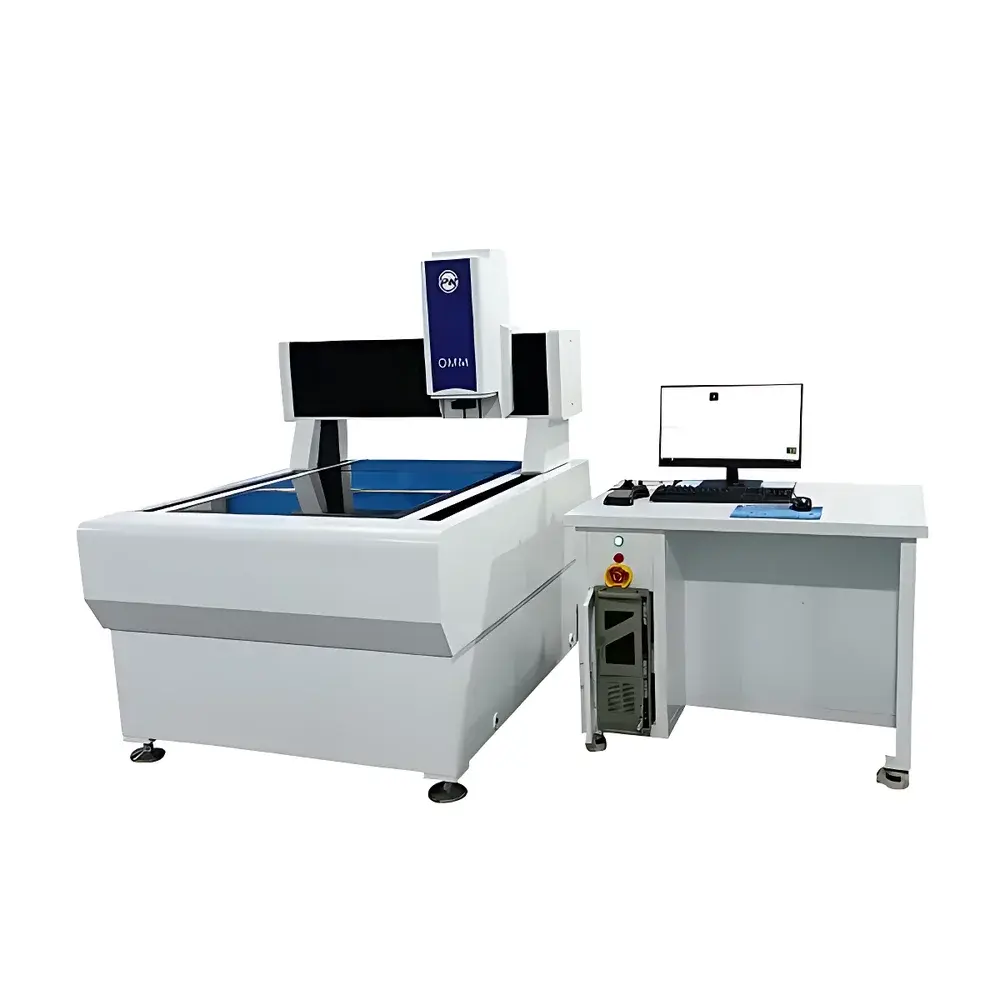
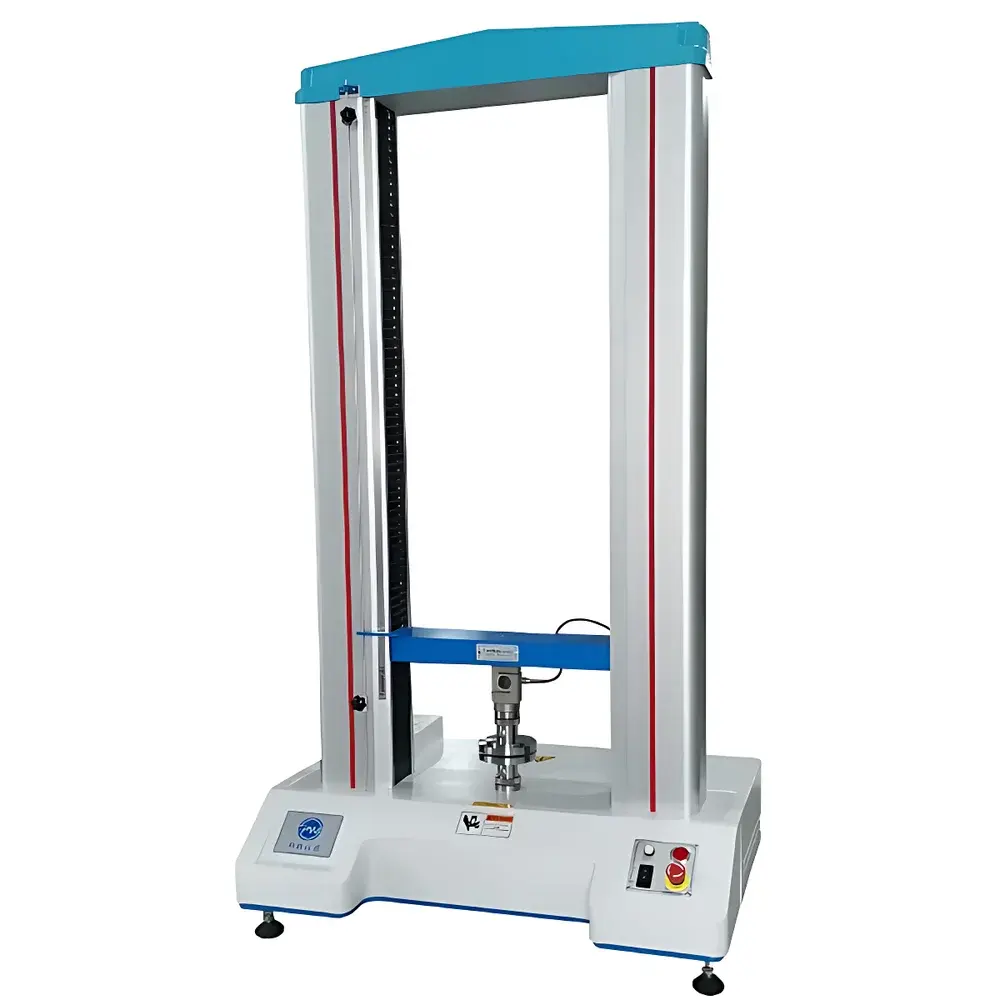
Yuelian PW-UCD80-40 Tri-Station Stress Relaxation Tester
| Brand | Yuelian/PW |
|---|---|
| Origin | Guangdong, China |
| Model | PW-UCD80-40 |
| Load Capacity | 5 kN (triple station) |
| Temperature Range | −40 °C to +150 °C |
| Displacement Resolution | 1/1,000,000 |
| Force Resolution | 1/1,000,000 |
| Force Accuracy | ±0.03% of full scale |
| Displacement Accuracy | ±0.01 mm |
| Temperature Control Accuracy | ±1 °C |
| Temperature Display Resolution | 0.1 °C |
| Test Speed | 0.1–100 mm/min (programmable) |
| Compression Platen Diameter | 100 mm |
| Parallelism Tolerance | ±0.01 mm |
| Chamber Dimensions (W×D×H) | 60×35×62 cm |
| Overall Dimensions (W×D×H) | 110×230×230 cm |
| Weight | ~350 kg |
| Power Supply | 220/380 V, 50/60 Hz, 30 A |
| Total Power Consumption | ~5 kW |
| Refrigeration System | Hitachi compressor with cold-balance control |
| Heating System | SUS304 stainless steel finned heater |
| Circulation | Forced-air fan system |
| Humidity Range | 20–98% RH |
| Compliance | ISO 527, ASTM D638, ASTM D3410, GB/T 1040, GB/T 528, GB/T 7759 |
Overview
The Yuelian PW-UCD80-40 Tri-Station Stress Relaxation Tester is an electromechanical testing system engineered for high-precision, time-dependent mechanical characterization of polymeric and elastomeric materials under controlled thermal environments. It operates on the fundamental principle of stress relaxation—measuring the decay in load required to maintain a constant strain over time—enabling quantification of viscoelastic behavior including creep compliance, relaxation modulus, and structural recovery kinetics. Designed specifically for rubber, plastic, adhesive, and composite material development and quality assurance, the system integrates a triple-station configuration to allow concurrent evaluation of three independent specimens under identical or differentiated thermal-mechanical conditions. Its dual-column frame, servo-motor-driven precision ball-screw actuation, and PID-regulated environmental chamber support standardized testing across a broad temperature range (−40 °C to +150 °C), making it suitable for both ambient and accelerated aging protocols per ISO 7619-1, ASTM D7121, and GB/T 7759-2015.
Key Features
- Tri-station synchronized compression architecture enables parallel testing of three samples—reducing inter-test variability and improving throughput without compromising repeatability.
- High-resolution force transduction (1/1,000,000 FS) and displacement sensing (1/1,000,000 stroke) ensure traceable measurement integrity aligned with ISO 7500-1 Class 0.5 calibration requirements.
- Integrated environmental chamber with Hitachi rotary compressor and SUS304 heating elements delivers stable thermal control (±1 °C accuracy) and uniform airflow via forced convection—validated per IEC 60068-3-5 for thermal homogeneity.
- 7-inch programmable touchscreen HMI supports multi-step temperature ramping, dwell scheduling, and real-time data overlay; compatible with user-defined test sequences per ASTM E1823 definitions of “relaxation hold” and “step-strain” protocols.
- Full PC-based control interface offers configurable stop conditions—including overload cutoff, specimen failure detection, upper/lower limit enforcement, and automatic return-to-start—ensuring operational safety and GLP-compliant test continuity.
- Modular fixture design accommodates standard compression platens (Ø100 mm), thickness compensation accessories, and optional custom tooling for ASTM D395 Type A/B geometry or ISO 37 dumbbell configurations.
Sample Compatibility & Compliance
The PW-UCD80-40 supports solid, cured, or vulcanized specimens in sheet, disk, or molded forms—commonly used in automotive sealing compounds, medical-grade silicones, pressure-sensitive adhesives (PSAs), thermoplastic elastomers (TPEs), and crosslinked EPDM formulations. Its mechanical and thermal specifications meet the dimensional and performance criteria outlined in ISO 527 (tensile properties), ASTM D638 (plastics tensile testing), ASTM D3410 (compressive properties of polymer matrix composites), and GB/T 1040 (Chinese national standard for tensile testing of plastics). Environmental control capabilities align with ASTM D3763 (low-temperature impact) and ISO 62 (moisture conditioning), while software audit trails and electronic signature support facilitate alignment with FDA 21 CFR Part 11 and EU Annex 11 requirements for regulated laboratories.
Software & Data Management
Bundled proprietary software provides ISO/IEC 17025-compliant data acquisition, visualization, and reporting workflows. Users can define relaxation tests using time-based or strain-triggered endpoints, apply exponential or logarithmic curve fitting (e.g., Prony series decomposition), and export raw datasets in CSV or XML formats for third-party analysis (MATLAB, Origin, JMP). The system logs timestamped metadata—including temperature setpoint deviation, force drift rate, and actuator position error—for full traceability. Optional upgrade paths include networked deployment, LIMS integration via OPC UA, and automated report generation compliant with GLP/GMP documentation standards.
Applications
- Quantifying long-term compressive stress decay in O-rings and gasket materials under sustained deformation at elevated service temperatures.
- Evaluating shelf-life stability of PSA tapes through accelerated relaxation profiling at 40 °C/75% RH per PSTC-107.
- Characterizing crosslink density evolution in silicone elastomers during post-cure aging cycles.
- Validating finite element model inputs by extracting time-temperature superposition (TTS) master curves from multi-temperature relaxation datasets.
- Supporting ISO 10993 biocompatibility assessments via mechanical stability testing of implant-grade polymers under physiological thermal conditions.
FAQ
What standards does the PW-UCD80-40 comply with for stress relaxation testing?
It supports method execution per ASTM D7121 (Standard Test Method for Stress Relaxation of Elastomers), ISO 7759 (Rubber—Determination of Stress Relaxation), and GB/T 7759 (Determination of Stress Relaxation of Vulcanized Rubber).
Can the system perform both compression and tensile relaxation tests?
The base configuration is optimized for compression-mode relaxation using parallel platens. Tensile relaxation requires optional extensometer integration and modified grips—available as a factory-configured upgrade path.
Is remote monitoring and data export supported?
Yes—the system includes Ethernet connectivity, real-time web-based dashboard access, and batch export functionality for raw force/time/temperature arrays in industry-standard formats.
How is thermal uniformity validated inside the chamber?
Chamber mapping is performed per IEC 60068-3-5 using nine calibrated PT100 sensors; results are documented in the installation qualification (IQ) report provided with each unit.
Does the software support 21 CFR Part 11 compliance out of the box?
Electronic signatures, audit trail logging, and role-based access control are enabled by default; full validation documentation (URS, FAT/SAT, IQ/OQ/PQ templates) is available upon request for regulated environments.





