
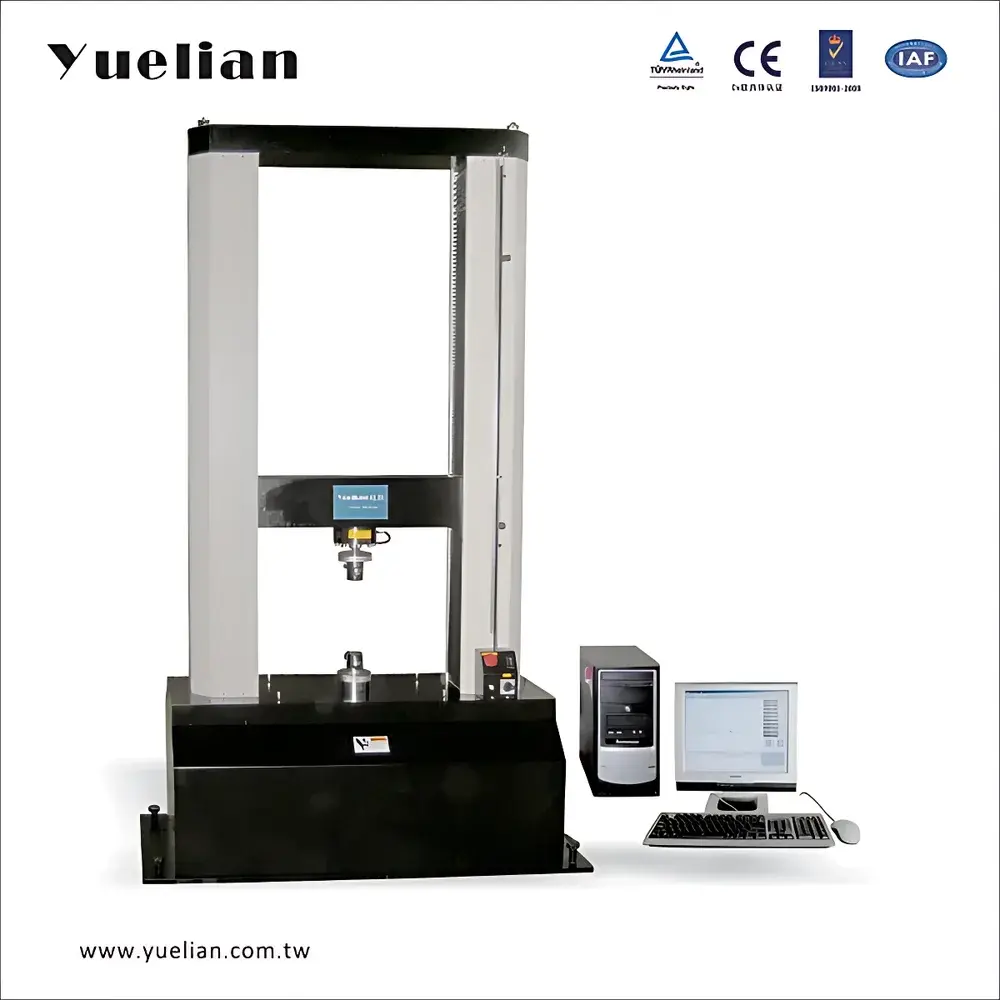
Yuelian YL-1151 Universal Testing Machine
| Brand | Yuelian |
|---|---|
| Origin | Guangdong, China |
| Manufacturer Type | Authorized Distributor |
| Country of Origin | China |
| Model | YL-1151 |
| Instrument Type | Electromechanical Universal Testing Machine |
| Load Capacity Options | 1 kN, 2 kN, 5 kN, 10 kN, 20 kN, 50 kN, 100 kN (dual-range configuration available) |
| Display Interface | PC-based control and visualization |
| Force Resolution | 1/250,000 full scale |
| Force Accuracy | ≤ ±0.5% of reading |
| Crosshead Travel Resolution | 0.005 mm |
| Maximum Travel | 1000 mm |
| Test Width | 550 mm |
| Speed Range | 0.5–500 mm/min (software-programmable) |
| Force Unit Conversion | kgf, N, lbf, g, ton, MPa |
| Safety & Control Modes | Overload shutdown, emergency stop, automatic rupture stop, upper/lower limit stop, auto-return function |
| Dimensions (W×D×H) | 92 × 75 × 199 cm |
| Drive System | Servo motor with timing belt and precision ball screw transmission |
| Power Consumption | 1800 W |
| Weight | ~800 kg |
| Electrical Supply | 220 V, 50/60 Hz, 10 A |
| Standard Accessories | One set of universal grips, proprietary test software, USB interface cable |
| Optional | Customer-supplied desktop PC |
| Compliance Standards | ISO 7500-1, JJG 475-88, ASTM E4, DIN 51221, JIS B7721 / B7733, EN 10002-1 / EN 10002-2, BS 1610, GB/T 228 |
Overview
The Yuelian YL-1151 Universal Testing Machine is an electromechanical static testing system engineered for high-reproducibility mechanical characterization of engineering materials across research laboratories, quality assurance departments, and industrial R&D facilities. Based on the principle of controlled uniaxial force application via servo-driven crosshead displacement, the system measures fundamental mechanical responses—including tensile strength, compressive yield, flexural modulus, peel adhesion, shear resistance, and tear propagation—under standardized loading conditions. Its modular architecture supports both single- and dual-capacity load cell configurations, enabling seamless transition between low-force polymer testing and high-load metallic structural evaluation without hardware reconfiguration.
Key Features
- Precision electromechanical actuation using a high-torque servo motor coupled to a preloaded ball screw and timing belt transmission—ensuring minimal backlash, thermal drift, and positional hysteresis.
- Force measurement accuracy certified to ≤ ±0.5% of reading per ISO 7500-1 Class 1, supported by 250,000-count analog-to-digital resolution for robust signal fidelity across dynamic and quasi-static regimes.
- Programmable crosshead speed range from 0.5 to 500 mm/min, with real-time velocity feedback and closed-loop position control ensuring compliance with ASTM E4 and GB/T 228 strain-rate requirements.
- Integrated safety architecture featuring six independent stop mechanisms: overload cutoff, hardware emergency stop, specimen rupture detection, user-defined travel limits, software-initiated halt, and automatic return-to-start post-test.
- Modular grip interface compatible with wedge-action, pneumatic, hydraulic, and custom-fabricated fixtures—facilitating rapid adaptation to ASTM D638, ISO 527, ISO 179, EN 1311-1, and other material-specific test protocols.
Sample Compatibility & Compliance
The YL-1151 accommodates specimens ranging from thin polymer films (≥0.05 mm thickness) to structural steel coupons (up to 50 mm width × 25 mm thickness), with standard test width of 550 mm and vertical clearance of 1000 mm. It meets metrological traceability requirements under national verification regulation JJG 475-88 and international calibration standards ISO 7500-1. Mechanical test procedures align with ASTM E4 (load verification), ASTM D882 (thin plastics), ASTM D638 (tensile plastics), ISO 6892-1 (metallic tensile), EN 10002-1 (metallic materials), and GB/T 228.1–2021 (Chinese metallic tensile standard). The system is suitable for GLP-compliant environments when paired with audit-trail-enabled software configuration.
Software & Data Management
The embedded Windows-based control suite provides ISO/IEC 17025-aligned data acquisition, processing, and reporting. Core capabilities include real-time force–displacement curve overlay, multi-curve comparative analysis, automatic parameter extraction (e.g., ultimate tensile strength, offset yield stress, Young’s modulus, elongation at break, peel average force), and customizable report generation in PDF or Excel formats. Data persistence is ensured via native MS Access database integration with timestamped metadata, operator ID logging, and version-controlled test method templates. The software supports 21 CFR Part 11–compliant electronic signatures when deployed with validated authentication modules and system audit trails.
Applications
- Quality control of incoming raw materials (e.g., elastomer batches, aluminum extrusions, composite laminates).
- Mechanical validation of packaging substrates (peel strength of laminated films, seal integrity of thermoformed trays).
- Structural performance assessment of automotive components (seatbelt webbing tensile, gasket compression set, battery housing impact resistance).
- R&D of biomedical polymers (suture tensile fatigue, hydrogel compression modulus, biodegradable scaffold degradation profiling).
- Regulatory submission support for FDA 510(k), CE marking, and IEC 60601-1 mechanical safety documentation.
FAQ
What load capacities are supported, and can dual-range operation be configured?
The YL-1151 offers seven standard load cell options (1 kN to 100 kN); dual-range configurations allow automatic sensor switching within a single test sequence to maintain optimal resolution across low- and high-force domains.
Is the system compatible with third-party test fixtures or extensometers?
Yes—the machine features ISO 26203-compliant mounting interfaces and analog/digital I/O ports supporting industry-standard clip-on and non-contact extensometers, as well as custom-engineered grips.
Does the software support automated pass/fail decision logic based on specification limits?
Yes—tolerance bands can be defined per parameter; results are color-coded and flagged in reports when out-of-specification thresholds are exceeded.
What documentation is provided for regulatory audits?
Factory calibration certificates, ISO 7500-1 verification reports, software validation summary (IQ/OQ), and electrical safety certification (GB 4793.1) are supplied standard with each unit.
Can test methods be exported/imported between instruments?
Test method files (.ytm format) are fully portable across YL-1151 units and support version-controlled library management via network-shared directories.



