
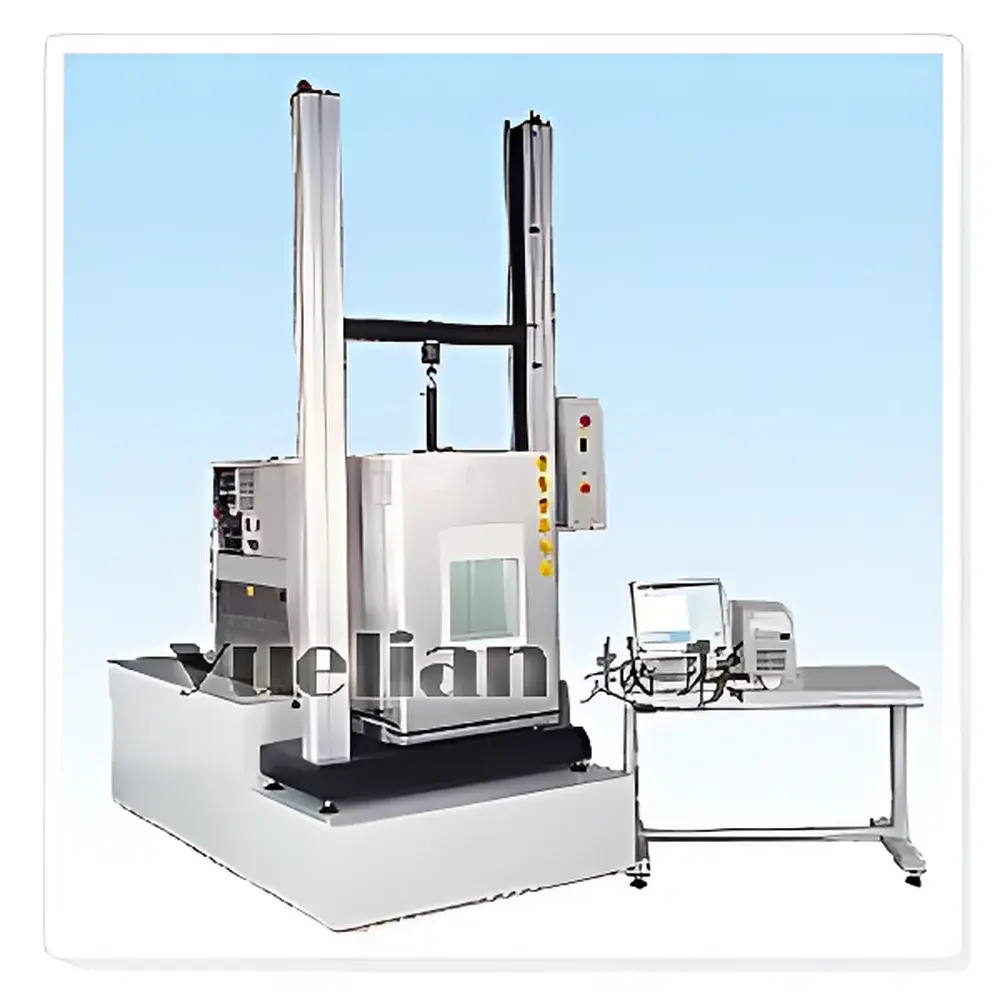
Yuelian YL-1162 High-Low Temperature Tensile Testing Machine
| Brand | Yuelian |
|---|---|
| Origin | Guangdong, China |
| Model | YL-1162 |
| Load Capacity Options | 20 / 50 / 100 / 200 / 500 / 1000 / 2000 kg |
| Temperature Control Range | 50–200 °C |
| Temperature Accuracy | ±1 °C (±1% at 100 °C) |
| Temperature Control Method | PID Auto-Tuning |
| Resolution | 100,000 counts (e.g., 0.005 kg for 500 kg load cell) |
| Force Accuracy | < ±0.5 % FS |
| Test Speed Range | 1–1000 mm/min (keyboard-adjustable) |
| Effective Test Space | 28 × 28 × 60 cm (W×D×H) |
| Machine Dimensions | 120 × 60 × 150 cm (W×D×H) |
| Weight | 230 kg |
| Power Supply | AC 220 V, 50–60 Hz, 4 A |
| Drive System | Dual Ball-Screw Actuation |
| Safety Protection | Upper/Lower Mechanical Limits + Emergency Stop Button |
| Data Storage | Up to 50 test results onboard |
| Output Interface | Standard RS-232 for printer or PC connection (optional software available) |
Overview
The Yuelian YL-1162 High-Low Temperature Tensile Testing Machine is a precision-engineered electromechanical testing system designed for static mechanical property evaluation of materials under controlled thermal conditions. It operates on the principle of uniaxial force application—applying calibrated tensile, compressive, peel, or tear loads to specimens while maintaining a stable, programmable temperature environment between 50 °C and 200 °C. Unlike ambient-only testers, the YL-1162 integrates a thermally insulated test chamber with PID-driven heating control, enabling reproducible evaluation of temperature-dependent mechanical behavior—including modulus softening, yield point shifts, elongation-at-break variations, and creep resistance. Its dual ball-screw actuation system ensures high positional fidelity and minimal axial runout, critical for ASTM D638, ISO 527, and GB/T 1040-compliant testing protocols. The machine meets fundamental structural requirements for GLP-aligned laboratories and supports traceable calibration per ISO/IEC 17025 guidelines when used with certified load cells and displacement transducers.
Key Features
- Integrated high-temperature chamber with PID auto-tuning control and ±1 °C thermal stability at 100 °C (±1% full-scale deviation)
- Seven selectable load capacities (20–2000 kg), each configured with factory-calibrated load cells offering < ±0.5 % full-scale accuracy
- High-resolution data acquisition: 100,000-count A/D conversion enabling sub-gram resolution (e.g., 0.005 kg at 500 kg range)
- Wide-speed servo-driven actuation (1–1000 mm/min), adjustable via front-panel keypad without external controllers
- LCD display with backlight supports simultaneous real-time readouts of load (N/kg/lbf) and displacement (mm/in), with user-selectable metric/imperial units
- Quick-release modular fixture interface compatible with standard wedge, pneumatic, and environmental grips
- Onboard memory stores up to 50 complete test records, including peak load, break elongation, modulus, and stress–strain curve metadata
- Dual ball-screw transmission with protective dust shields to minimize wear, preserve long-term positioning repeatability, and reduce maintenance intervals
- Hardware-level safety architecture: independent upper/lower mechanical limit switches plus emergency stop circuit compliant with IEC 60204-1
- RS-232 serial port for direct thermal printer output or optional PC-based control and advanced data analysis (software sold separately)
Sample Compatibility & Compliance
The YL-1162 accommodates a broad range of specimen geometries within its 28 × 28 × 60 cm internal test volume, supporting ASTM-standard dumbbell, dog-bone, strip, and film specimens up to 60 cm in gauge length. It is routinely deployed for polymer films, elastomers, composites, adhesives, textiles, and metal foils requiring elevated-temperature mechanical validation. While not certified to UL or CE as a standalone unit (as supplied by a domestic distributor), its mechanical design conforms to core structural provisions of ISO 7500-1 (static calibration of force-proving instruments) and ISO 5893 (tensile/compression testing machines). When paired with NIST-traceable calibration artifacts and operated under documented SOPs, the system satisfies audit requirements for ISO 9001, IATF 16949, and basic GMP environments where material release testing is performed.
Software & Data Management
The YL-1162 operates autonomously via its embedded microcontroller and LCD interface; however, optional Windows-compatible software enables extended functionality including multi-curve overlay, statistical reporting (mean, SD, CV%), automatic pass/fail flagging against user-defined limits, and export to CSV, Excel, or PDF formats. The software supports 21 CFR Part 11-ready configurations—including electronic signatures, audit trails, and role-based access control—when installed on validated laboratory PCs. All raw data files retain timestamped metadata (test ID, operator, date/time, temperature setpoint, speed, load range), ensuring full traceability for internal QA reviews or regulatory submissions.
Applications
- Evaluation of thermoplastic melt strength degradation above glass transition temperature (Tg)
- Creep compliance testing of silicone elastomers at 150 °C for automotive sealing applications
- Peel adhesion performance of pressure-sensitive tapes under accelerated thermal aging
- Tensile modulus shift in carbon-fiber-reinforced PEEK during post-molding heat treatment
- Brittle-to-ductile transition analysis of engineering thermoplastics across 50–200 °C
- Quality control of medical-grade PVC tubing after sterilization-cycle simulation
FAQ
Does the YL-1162 support sub-zero temperature testing?
No. The standard configuration provides heating only, with a minimum operational temperature of 50 °C. Cryogenic capability requires custom chamber modification and is not offered by the manufacturer.
Can test parameters be saved and recalled for routine QC checks?
Yes. Up to 50 test configurations—including speed, target load, hold time, and temperature setpoint—can be stored in non-volatile memory and loaded with one keypress.
Is third-party calibration certification included with purchase?
Calibration certificates are not bundled but can be requested at additional cost. Certified load cells and thermal probes must be calibrated annually per ISO/IEC 17025-accredited providers to maintain measurement integrity.
What is the maximum specimen thickness accommodated by the standard grips?
Standard wedge grips accept specimens up to 15 mm thick. Thicker or irregular cross-sections require custom jaw inserts, available upon request.
How is thermal uniformity verified inside the test chamber?
Uniformity is characterized during factory acceptance testing using three-point thermocouple mapping (top/mid/bottom). Users should perform periodic verification using calibrated handheld probes at defined locations per internal SOP.



